
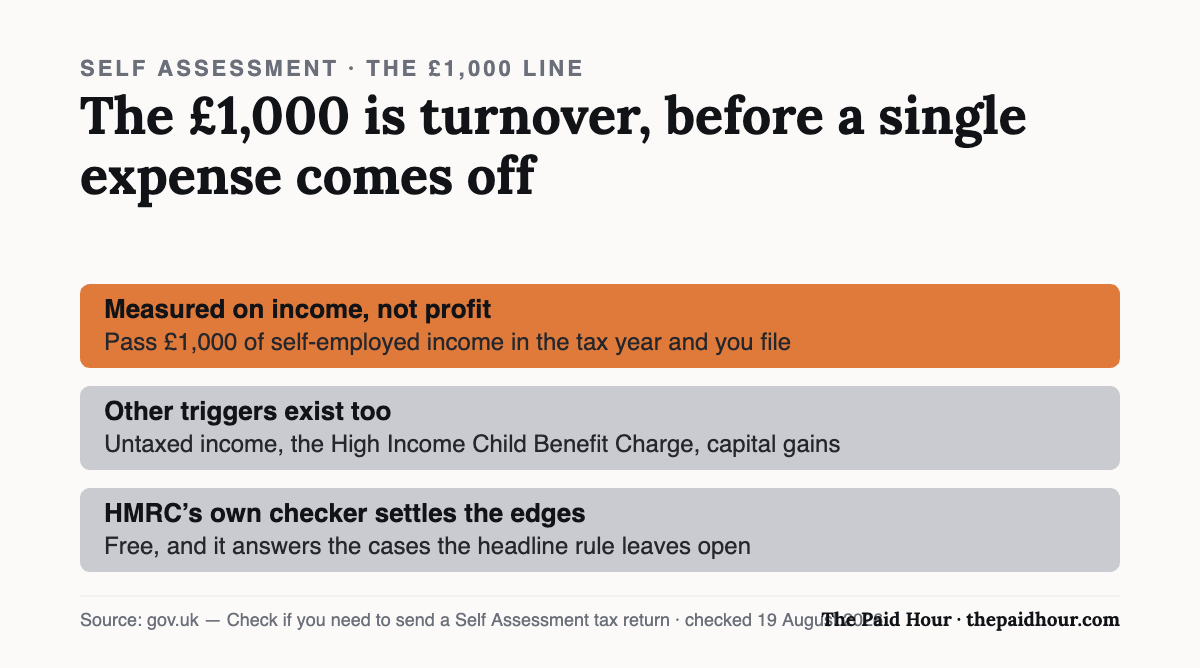
The one-paragraph answer: You must file a tax return if self-employed income passed £1,000 in the tax year, and that means turnover, before expenses come off. Other triggers exist (untaxed income, the Child Benefit charge, capital gains), and HMRC’s own checker settles edge cases. The £1,000 line is the one people misread.
In short. You have to send a Self Assessment return if you were self-employed and earned more than £1,000 in the tax year, and HMRC means turnover here, before taking off anything you can claim tax relief on. Partners in a partnership, anyone who owed Capital Gains Tax or the High Income Child Benefit Charge outside PAYE, and off-payroll workers repaying a student loan have to file too. Untaxed income, rent, tips, savings interest, dividends, foreign income, can trigger it as well. Never filed before? Tell HMRC by 5 October.
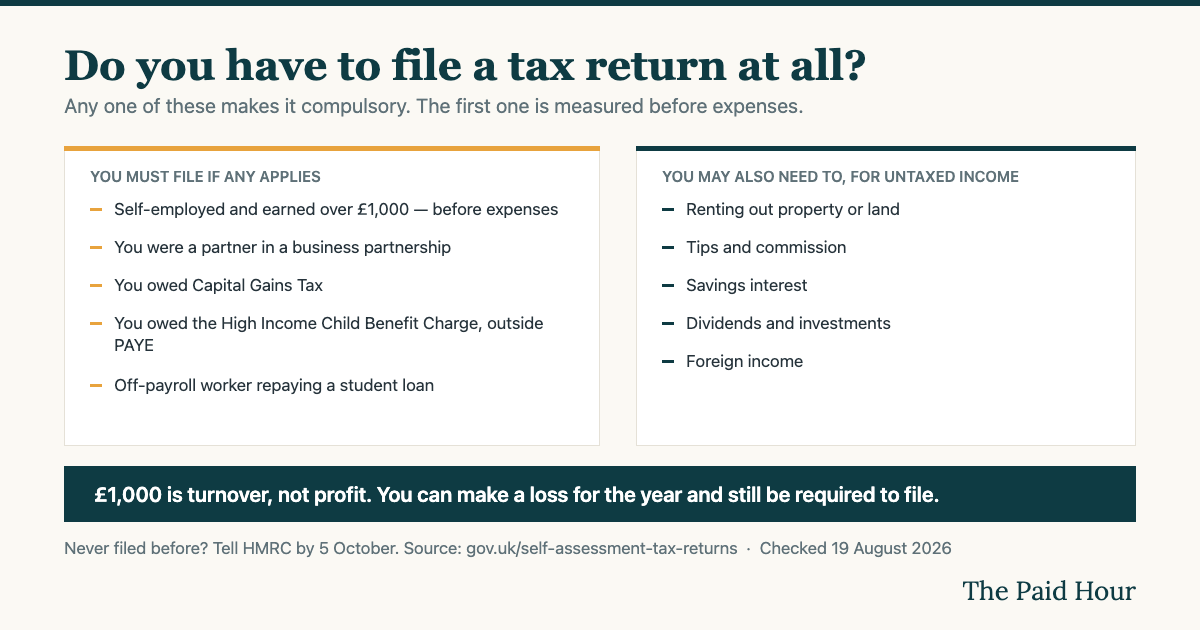
Table of Contents
The £1,000 that decides your tax return: turnover rather than profit
HMRC’s wording here is specific and worth quoting exactly: you must file if you were self-employed as a sole trader and earned more than £1,000 “before taking off anything you can claim tax relief on.”
That’s the money that came in. Not what was left after you paid for materials, software, travel or insurance.
Which produces a result that feels wrong the first time you run into it: you can lose money over the year and still be legally required to file a return. A photographer who invoiced £4,000 and spent £5,200 on a new camera body has made a £1,200 loss, and is squarely inside Self Assessment anyway.
Filing in that situation isn’t just an obligation, either. It’s usually to your advantage, a recorded loss can be set against tax, which is one of the reasons people register voluntarily in the first place.
The five things that make a tax return compulsory
Any one of these applying in the last tax year (6 April to 5 April) means you must file:
- Self-employed with more than £1,000 of gross income
- A partner in a business partnership: regardless of the amount involved
- You owed Capital Gains Tax on something you sold or disposed of that had gone up in value
- You owed the High Income Child Benefit Charge and don’t pay it through PAYE
- You’re an off-payroll worker repaying a student or postgraduate loan
That last one is narrow and easy to miss. Work through an off-payroll arrangement and have a student loan, and the return is compulsory even where nothing else on this list applies to you. The student loan guide covers how the repayment gets calculated.
Untaxed income is the tax return category people forget
You may also need to file if you’ve got income nobody’s already deducted tax from:
- money from renting out property or land
- tips and commission
- savings interest
- dividends, including from investments
- foreign income
- any taxable UK income if you’re non-UK resident
Tips and commission catch a lot of people most often, because they feel like part of a wage rather than separate income in their own right. Savings interest has become more relevant as rates have risen. And dividends matter a lot to anyone who took the limited company route, the dividend allowance is only £500.
Note the different wording. The first list says “you must.” This one says “you may,” because it depends on the amounts involved and what’s already been taxed. HMRC has a checker for exactly this, and it’s worth two minutes of your time if you’re unsure either way.
Reasons to file a tax return when you don’t have to
Filing voluntarily is a real option, and there are three good reasons to do it:
- To prove you’re self-employed, needed for Tax-Free Childcare and Maternity Allowance claims.
- To pay voluntary Class 2 National Insurance, which protects your State Pension record in a year where profits were under £7,105.
- To claim Income Tax relief on maintenance payments.
The first two are the ones that matter most to freelancers, and both are worth more than the hour the return itself takes.
The 5 October rule for a first tax return
Need to complete a return for the previous tax year? You have to tell HMRC by 5 October when either:
- you’ve never sent a tax return before, or
- you registered before but didn’t need to send a return for the most recent year
That second case is the one that surprises returning freelancers most. Having been in Self Assessment years ago doesn’t mean you’re still in it now. Dropped out and coming back? The 5 October deadline applies to you all over again.
You tell HMRC by registering for Self Assessment. Miss it, and a failure-to-notify penalty becomes possible on top of everything else, see what late filing costs.
If you no longer need to file a tax return
Stopping isn’t automatic either, unfortunately. Wound the business down, or gone back to employment? Tell HMRC and ask them to stop sending returns. Until you do, the obligation carries on, and so do the penalties for not meeting it.
People are still being penalised for returns relating to businesses they closed years ago, purely because nobody ever told HMRC it had ended.
So what should you do about your tax return?
- Add up your gross self-employed income for the tax year. Before expenses. Over £1,000? You’re filing.
- Run down the compulsory list: partnership, Capital Gains, Child Benefit charge, off-payroll with a student loan.
- Check your untaxed income against the second list, and use HMRC’s checker if it’s close.
- New or returning to Self Assessment? Register by 5 October.
- Stopped trading? Tell HMRC so the returns actually stop coming.
- The Freelancer Tax Checklist: every step, dated
Still working through whether you need to file after checking the lists above? The honest answer for most straightforward sole traders comes down to that £1,000 figure. Under £1,000 and none of the above apply? The trading allowance explains what you still need to do, which is keep records, even though you file nothing.
Once you know you do need to file, the next question is which registration route applies: sole trader, SA1 or partnership.
Crossed £1,000 in 2025/26 and never told HMRC? The registration deadline for that year is 5 October 2026: how to register as a sole trader with HMRC.
Sources
- GOV.UK, Who must send a tax return
- GOV.UK: Check if you need to send a Self Assessment tax return
- GOV.UK — If you no longer need to send a tax return
- GOV.UK, High Income Child Benefit Charge
Rules checked 19 August 2026. This is general information, not financial or tax advice.
A job plus a side income: where does it land?
Side Hustle Tax Starter 2026/27. A six-module starter course and six working templates that tell you, in an evening, whether you owe anything at all, and set up the twenty-minute monthly routine that keeps it that way.
- The nine badges of trade as questions you can answer about your own income
- What the platforms send HMRC, the small-seller exemption, and three reply letters for when a letter arrives
- A sales log with a running £1,000 alert, an allowance-versus-expenses sheet, and a tax set-aside calculator at 2026/27 rates
Selling platforms now hand your sales data to HMRC once a year. Selling your own old possessions is never taxable. Buying to resell, making things, or freelancing is. Knowing which side you are on is the whole question.
Buying more than one? All ten 2026/27 courses for £107, against £328 at full price.
Need this ready-made? → Self Assessment Prep Checklist Pack: every deadline, record and allowance in 9 pages (£7.99, instant download)