
Checked 29 October 2026 against HMRC’s Budget 2026 documents. From October 2027, online marketplaces will collect VAT on sales by UK VAT-registered businesses, and by other UK businesses selling £90,000 or more a year on one platform. Personal sales, second-hand goods and business-to-business sales are left out. HMRC will set the final threshold and start date in secondary legislation in 2027.
Online marketplace VAT is changing for UK sellers. Since 2021, platforms like Amazon and eBay have collected VAT on sales by overseas sellers. The Budget on 28 October 2026 extends that duty to UK businesses. So from October 2027, the marketplace, not you, will collect and pay the VAT on many of your sales.
If you sell on Amazon, eBay, Etsy, OnBuy or a similar site, this guide explains who is in scope, who is not, what it means for your prices and cash flow, and what to do now.
Table of Contents
Online marketplace VAT 2027: what changes
| Today | From October 2027 | |
|---|---|---|
| Overseas sellers | Marketplace collects VAT | Marketplace collects VAT |
| UK VAT-registered sellers | You charge and pay the VAT | Marketplace collects VAT |
| Other UK businesses selling £90,000+ a year on one platform | You must register for VAT and pay it | Marketplace collects VAT |
| Personal sales, second-hand goods, B2B sales | Normal rules | Not covered by the new rules |
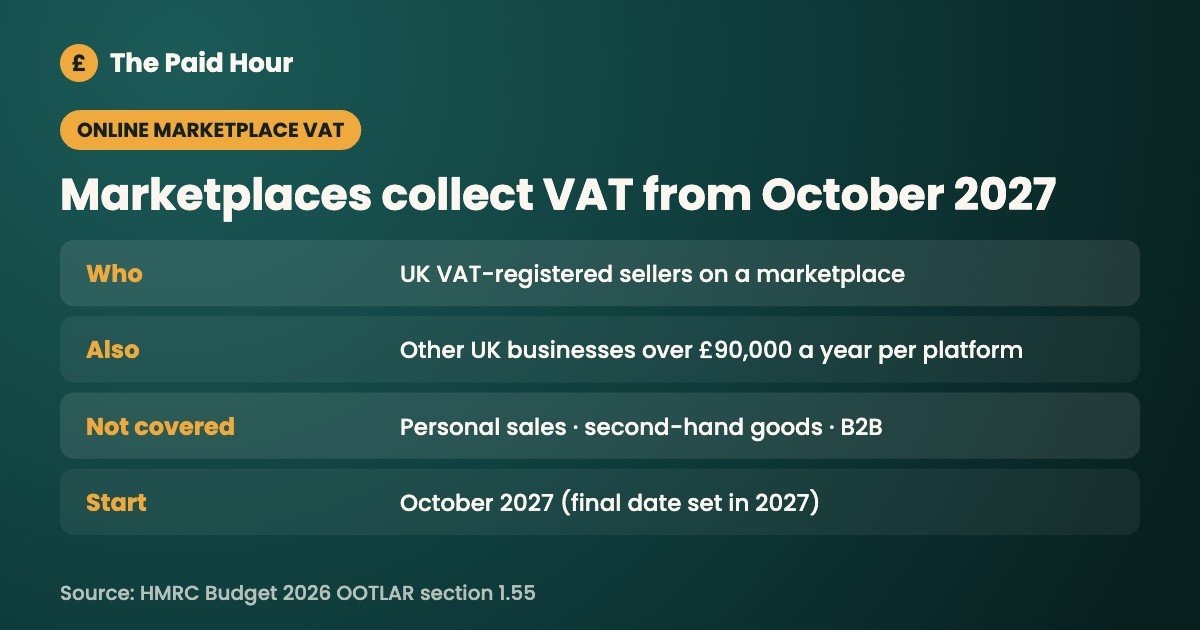
It is one of the less noticed items in the Budget 2026 winners and losers list. The government says it wants to tackle UK sellers on online marketplaces who do not pay the VAT they owe, and to protect high street businesses that do. Putting the duty on the platform is the simplest way to close that gap.
Who the online marketplace VAT rules cover
UK VAT-registered sellers
If you are registered for VAT and sell on a marketplace, the marketplace will collect VAT on those sales, whatever your turnover on that platform.
UK businesses selling £90,000 or more on one platform
The rules also cover any other UK business with annual sales of £90,000 or more on a single platform. £90,000 is also the VAT registration threshold, so a business at that level should already be registered. This part of the rule is aimed at sellers who are not. HMRC will confirm the exact per-platform threshold in 2027.

Who is not affected
- Personal sales. Clearing out your wardrobe on Vinted or selling your old phone on eBay is not covered.
- Second-hand goods. Many resellers of used items use the second-hand margin scheme, and the new rules exclude second-hand goods.
- Business-to-business sales. If you sell to other VAT-registered businesses, the normal rules continue.
- Small sellers who are not VAT-registered and sell under £90,000 on each platform.
Being outside these VAT rules does not mean HMRC cannot see your sales. Platforms already report seller income to HMRC under the digital platform reporting rules that started in January 2024. Our guide to HMRC platform reporting for Vinted, eBay and Etsy explains when that applies.
How online marketplace VAT collection will work
Under the existing rules for overseas sellers, the marketplace is treated as the seller for VAT. It charges VAT to the customer, pays it to HMRC and sends you the sale price after VAT. The new rules extend that model to UK sellers. HMRC has not yet published the detail, so some questions remain open:
- How VAT-registered sellers will reclaim VAT on their own costs, such as stock bought in the UK.
- How the Flat Rate Scheme will work for sellers whose sales go through a marketplace.
- How marketplaces will report the VAT they collected on your behalf, for your own records.
- Exactly when in October 2027 the rules start.
We will update this guide as soon as HMRC publishes the draft regulations.
What it means for your prices and cash flow
For a VAT-registered seller, the main change is admin. The VAT still gets paid, just by the platform. Your net income per sale should be similar, but your VAT return will look different and your payouts will arrive with VAT already taken off.
For a seller above the threshold who has not been charging VAT, the change is bigger. If you keep the same price, the marketplace takes a sixth of every standard-rated sale as VAT. A £60 item would leave you £50 before fees. Your options are to raise prices, cut costs or accept a lower margin.
Online marketplace VAT calculator
Based on the Budget 2026 announcement. HMRC will confirm the threshold and start date in 2027. Standard rate VAT 20% assumed. Not personal tax advice.
5 steps to get ready for online marketplace VAT

- Check your VAT position. Add up your taxable turnover across all channels for the last 12 months. If it is over £90,000, you should already be registered. See the £90,000 VAT threshold explained.
- Split your sales by platform. The new threshold is per platform, so know your Amazon, eBay and Etsy figures separately.
- Review your prices and margins. Model what happens if VAT comes off the top of every sale.
- Ask about the Flat Rate Scheme. If you use it, talk to your accountant before 2027, because the interaction is not yet clear.
- Use software that reconciles payouts. Marketplace payouts will look different. Accounting software that imports platform data saves hours.
If you need software that can pull in marketplace payouts and bank feeds, Xero and QuickBooks both connect to common selling platforms through apps. Affiliate link: we may earn a commission at no cost to you.
Online marketplace VAT does not change your income tax
This is a VAT change only. You still pay income tax on your profit through Self Assessment, or through Making Tax Digital if your qualifying income is over the threshold. From 6 April 2027 that threshold is £30,000. Small sellers also gain from the trading allowance rising to £3,000 from April 2027. See the trading allowance explained and side hustle tax in the UK.
Online marketplace VAT by type of seller
| Seller | What changes in October 2027 |
|---|---|
| Hobby seller clearing out the loft | Nothing. Personal sales are excluded. |
| Vintage reseller using the margin scheme | Likely nothing. Second-hand goods are excluded. |
| Crafter on Etsy, not VAT-registered, £20,000 a year | Nothing on VAT. Keep an eye on the £90,000 VAT threshold across all channels. |
| Amazon seller, VAT-registered | The marketplace collects VAT on your sales. Your VAT return and payouts change. |
| eBay seller, £120,000 a year, not registered | In scope. You should already be VAT-registered. Get advice now. |
| Wholesaler selling to trade buyers | Nothing. B2B sales are excluded. |
Does online marketplace VAT 2027 apply to TikTok Shop sellers?
The government paper does not name any platform. It only says “online marketplaces”. TikTok Shop is a marketplace where UK customers buy goods from sellers, so it is sensible to expect the same rules as Amazon, eBay and Etsy. HMRC has not published a list of platforms yet.
If TikTok Shop is covered, the same two groups of UK sellers are affected:
- sellers who are already VAT-registered
- businesses that sell £90,000 or more a year on that one platform
For those sellers, TikTok Shop would collect the VAT on each sale and pay it to HMRC from October 2027. You would no longer hold that VAT yourself until your VAT return.
Example (made-up figures). Ms B sells £20,000 a year on TikTok Shop and is not VAT-registered. Under this plan nothing changes for her on VAT. But the normal £90,000 VAT registration threshold still adds all her sales together: TikTok Shop, Etsy and her own website.
This is still a plan, not law. The government says it intends to start in October 2027, and later rules will set how the £90,000 platform test works. TikTok already reports seller income to HMRC, which is a separate rule. See does TikTok Shop report sellers to HMRC.
Source: GOV.UK, Extending VAT online marketplace liability, published 28 October 2026. Checked 17 November 2026.
Online marketplace VAT timeline
| Date | What happens |
|---|---|
| 2021 | Marketplaces start collecting VAT for overseas sellers |
| January 2024 | Platforms start reporting seller income to HMRC |
| 28 October 2026 | Budget announces the extension to UK sellers |
| 2027 | Secondary legislation sets the threshold and start date |
| October 2027 | Marketplaces collect VAT on in-scope UK sales |
Online marketplace VAT and selling on your own website
The new duty applies to sales through online marketplaces. Sales through your own Shopify or WooCommerce shop are not marketplace sales, so you keep charging and paying VAT yourself as now. Many sellers use both. If that is you, your VAT records will soon have two streams: marketplace sales where the platform handled the VAT, and direct sales where you did.
Keep the two apart in your books from the start. It makes your VAT return easier and it stops you paying VAT twice on the same sale by mistake.
Common online marketplace VAT mistakes to avoid
- Treating the £90,000 per platform as your VAT threshold. The VAT registration threshold still counts all your taxable sales across every channel.
- Assuming Vinted-style used sales are always exempt. Buying stock to resell is trading, even if the goods are used. Check how the second-hand rules apply to you.
- Waiting for October 2027 to check prices. If VAT will come off every sale, you need to plan price changes and stock buying early.
- Ignoring platform reports. HMRC already receives seller data from platforms. Make sure your tax return matches what the platform reports.
What HMRC still has to confirm
Budget 2026 set the direction, but several details will come in secondary legislation during 2027: the exact per-platform threshold, the start date in October 2027, and how the rules work with the Flat Rate Scheme and VAT reclaims. Online marketplaces will also need time to change their systems, so expect platform emails explaining the change well before it starts. We will add each confirmed detail here as soon as HMRC publishes it.
Frequently asked questions
What is the online marketplace VAT change in 2027?
From October 2027, online marketplaces will collect VAT on sales by UK VAT-registered businesses and by other UK businesses selling £90,000 or more a year on one platform.
Does online marketplace VAT affect Vinted sellers?
Not for personal sales. Selling your own used items is excluded, and second-hand goods are excluded from the new rules.
Is the £90,000 threshold per platform?
Yes. Budget 2026 described a minimum annual sales threshold per platform of £90,000. HMRC will confirm it in secondary legislation in 2027.
Will Etsy and eBay charge VAT on my sales?
If you are VAT-registered, or sell £90,000 or more a year on that platform, the marketplace will collect VAT on in-scope sales from October 2027.
Do I still need to register for VAT?
The VAT registration threshold is still £90,000 of taxable turnover across your business. The new rules change who collects VAT on marketplace sales, not when you must register.
How we checked this online marketplace VAT guide
The rules on this page come from section 1.55 of HMRC’s overview of tax legislation and rates, published with the Budget on 28 October 2026, and from the Budget report. Where HMRC has not yet set a detail, such as the exact start date, we say so. We will update the guide when the draft regulations appear in 2027. This is general information, not personal tax advice.
Sources
- HMRC, Budget 2026 overview of tax legislation and rates (section 1.55)
- HM Treasury, Budget 2026
- ChannelX, Big tax changes for self-employed marketplace sellers
- GOV.UK, VAT registration threshold
Filing it yourself this year?
HMRC Tax & Expense Mastery 2026/27. Nine modules and eleven working templates that take a UK freelancer from “do I even need to register” to a correct return, with MTD quarters built in.
- Fifteen expense categories, with the trap inside each one (training, clothing, meals, the seven-year pre-trading rule)
- Home and vehicle: flat rate against actual cost, with the £312 break-even worked out and the mileage lock-in rule
- The year-one payments-on-account cash shock, and the routine that stops it landing twice
HMRC does not send a list of what you forgot to claim. Most freelancers leave several hundred pounds of legitimate expenses on the table every single year, and the return still gets filed.
Buying more than one? The Complete Freelancer System, all five for £87, against £193 bought separately.