
Table of Contents
Crypto mining tax UK rules catch most hobbyist miners off guard because HMRC taxes the reward twice, once as income, then again when it’s sold.
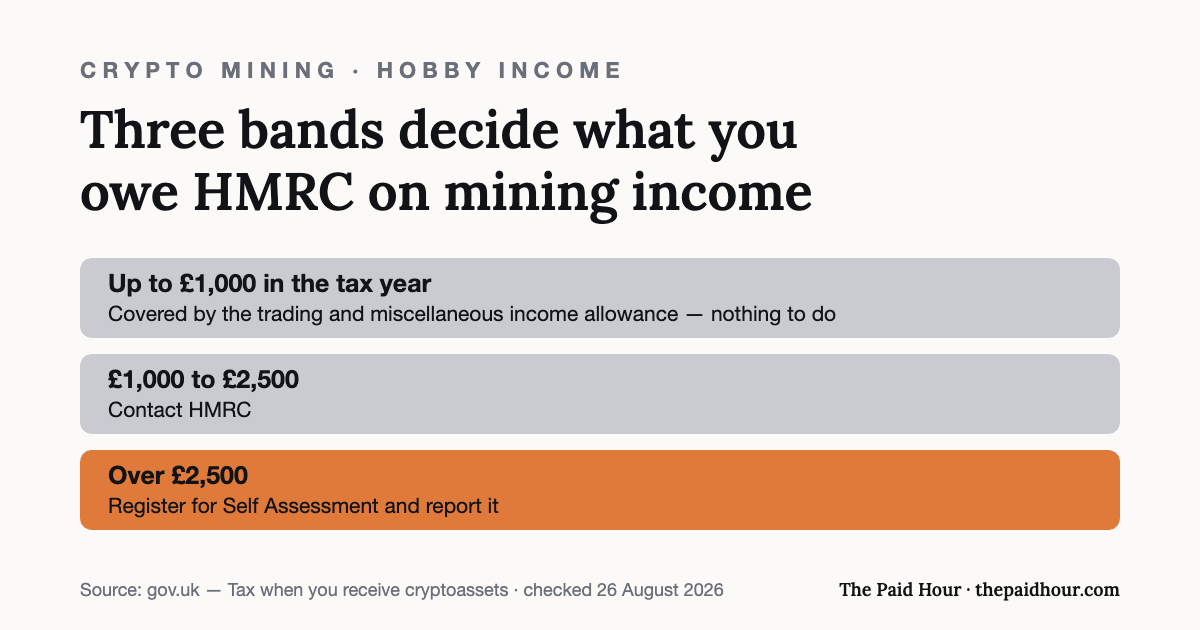
Quick answer: Mined crypto is taxed twice. Once on its sterling value the moment the reward lands, and again on any rise in value between then and the day you sell. If the mining is not a trade, HMRC treats the reward as other taxable income, and you get “up to £1,000 allowance each tax year for trading and miscellaneous income”. Above £1,000 you have to tell HMRC; above £2,500 you have to register for Self Assessment.
The instinct is that every coin landing in a wallet is instantly taxable. It is not, not automatically, and not always at the point people assume. How crypto mining is taxed in the UK turns on one question HMRC takes seriously, and on a second tax event most miners forget entirely.
Getting crypto mining tax UK treatment right starts here. Get the first wrong and you either pay tax you never owed or, more likely, under-report income you assumed was too small to matter.
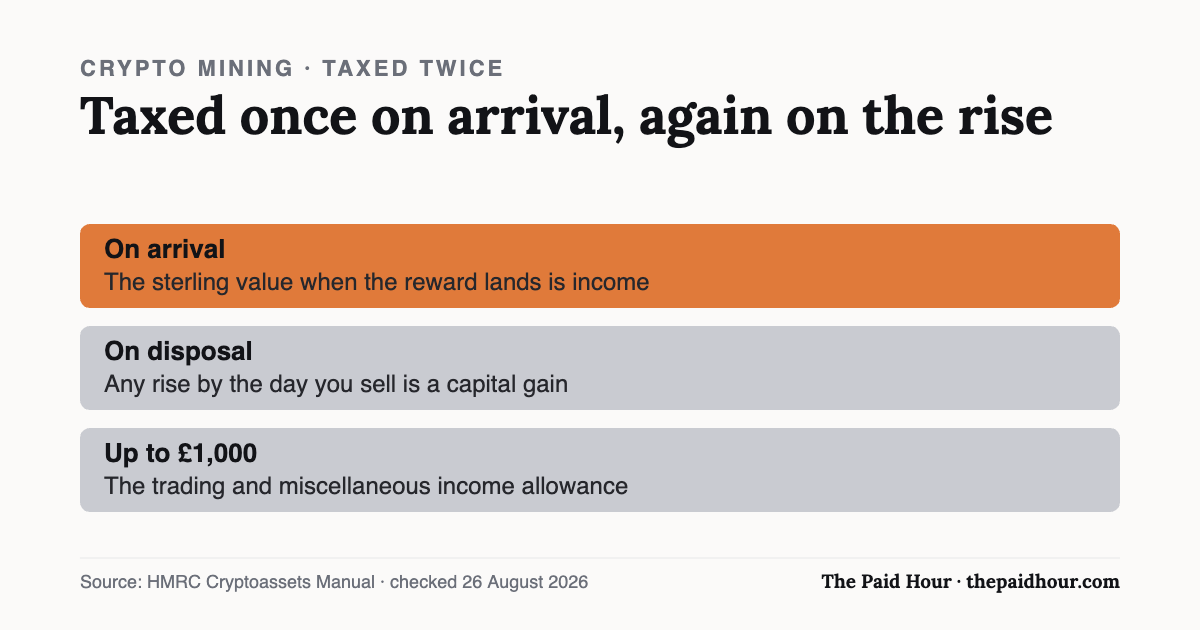
Crypto mining: two taxable events rather than one
The first happens on receipt. HMRC’s Cryptoassets Manual puts the taxable amount as “the pound sterling value (at the time of receipt) of any tokens awarded”, the market value the second the coin arrives instead of the price on the day you eventually cash out.
The second happens when you dispose of it. HMRC’s guidance is direct about this: if you sell a cryptoasset you have already paid Income Tax on, you “calculate Capital Gains Tax as normal on any increase in the value of the tokens since you received them”.
Plenty of miners pay tax once, on receipt, and never think about it again, until they sell something that has tripled since it landed. Which units count as sold, and at what cost, follows the pooling rules.
Crypto mining as trade or hobby: the question everything hangs on
HMRC does not leave this to instinct. Whether mining amounts to a taxable trade “depends on a range of factors such as: degree of activity, organisation, risk, commerciality”. That is the badges-of-trade framework, the same one applied to car boot sales and dropshipping, pointed at GPU rigs. There is a fuller walkthrough in the guide to how HMRC decides you are trading.
Note what is not on that list: how much you earned. A rig that made £300 last year can still be a trade, and a wallet that received £4,000 of casual rewards can still be miscellaneous income. It is the shape of the activity that decides, not the size of the number. That is the core of crypto mining tax UK confusion: size of the payout tells you nothing about which regime applies.
In practice, dedicated hardware bought to turn a profit, real time invested, and anything run like an operation all push toward trade. Spare capacity on a machine you own anyway, running in the background, generally does not.
If crypto mining is not a trade: other taxable income and the £1, 000 allowance
This is where most people asking the question sit. HMRC’s guidance: if you receive tokens from mining, staking or lending and are not carrying on a trade, “HMRC will treat the tokens as other taxable income”. The sterling value at receipt is still taxable, with appropriate expenses reducing what is chargeable.
Then the allowance. In HMRC’s own words, “you can get up to £1,000 allowance each tax year for trading and miscellaneous income”. Take the allowance instead of your actual costs, not as well, it is one or the other. For a small miner whose electricity bill is nowhere near £1,000, the allowance is the better deal, and it is a flat deduction with no receipts to keep.
What matters more is what the £1,000 does to your reporting duty:
| Other taxable income for the year | What you have to do |
|---|---|
| £1,000 or less | Nothing. No return needed for it. |
| Between £1,000 and £2,500 | Contact HMRC. |
| Over £2,500 | Register for Self Assessment and report it. |
One ceiling rather than one per activity. If mining sits alongside other casual income, they share the same £1,000, the wider rules are in the guide to when side hustle income has to be declared.
If crypto mining is a trade: Self Assessment, National Insurance and MTD
Clear the trade bar and mining profits are self-employment income, taxed through Self Assessment at your normal Income Tax rate: 20% within the basic rate band up to £50,270, 40% above it, with the rates and thresholds on gov.uk.
National Insurance follows, and it is worth being precise here because the point is widely misreported. For 2026/27 the Class 2 rate is £3.65 a week and the Small Profits Threshold is £7,105, but above that threshold Class 2 contributions are treated as having been paid. Your record is protected and you hand over nothing. What you pay is Class 4: 6% on profits between £12,570 and £50,270, then 2% above £50,270.
Making Tax Digital is the other one people get backwards. The test is qualifying income, which HMRC defines as your total income from self-employment and property “before expenses (also known as turnover), based on the tax return you submitted in the previous tax year”. Turnover rather than profit. Mining that clears £50,000 of gross rewards but nets £8,000 after electricity is still inside MTD.
The thresholds: over £50,000 from 6 April 2026, over £30,000 from April 2027, over £20,000 from April 2028. Miscellaneous income does not count toward qualifying income at all, which is a real advantage of staying on the hobby side of the line. The dates are in the guide to MTD quarterly deadlines.
The second bill: Capital Gains Tax when you sell
Whichever side of the trade line you are on, a second event waits. The value HMRC taxed at receipt becomes your cost basis, the price you “paid”, even though nothing left your bank account. Any rise between receipt and disposal is a gain, and selling is not the only disposal: swapping one token for another and spending it both count.
For 2026/27 the annual exempt amount is £3,000. Above that, gains are taxed at 18% within your basic rate band and 24% above it, or at 24% throughout if you are already a higher or additional rate taxpayer. The allowance sat above £12,000 a few years ago, so gains that used to disappear under it now routinely do not.
If the price fell instead, that is a capital loss. Worth recording even in a year you cannot use it, because losses carry forward.
Crypto mining as hobby and trade, side by side
| Not a trade | A trade | |
|---|---|---|
| Tax on receipt | Income Tax, as other taxable income | Income Tax, as self-employment profit |
| Deduction | £1,000 allowance or actual expenses | Actual business expenses |
| National Insurance | None | Class 4 at 6% and 2%; Class 2 treated as paid above £7,105 |
| Counts toward MTD qualifying income | No | Yes, on turnover |
| Where it goes on the return | Other UK income | Self-employment pages |
| CGT on later disposal | Yes, on the gain since receipt | Yes, on the gain since receipt |
Crypto mining dates, and the one that comes first
Registration happens before you know what you owe. If you need to declare mining income for the first time, tell HMRC by 5 October following the end of the tax year it relates to. Then file and pay by 31 January. Both figures may need to appear on the same return: the income at receipt, and any gain on disposal, so this is rarely the single-number job people expect. The full year is mapped out in the 2026/27 tax year calendar.
The crypto mining records that make this survivable
For every reward, keep the date and time it arrived, its sterling value at that exact moment, and which wallet or pool it came through. That valuation does double duty — taxable income now, cost basis later, which is why reconstructing it eighteen months on from exchange history and a hazy memory of what the market was doing never quite works.
A spreadsheet is fine. Where HMRC enquiries into mining go, they tend to go straight at whether the receipt-date value can be evidenced instead of asserted.
The two mistakes that show up every year
The first is timing. People value what they mined at today’s price when they sit down to file, rather than the price on the day it landed. In a volatile year that gap is enormous, and it is wrong in both directions.
The second is self-flattery in reverse. People who have clearly built something, four rigs, a dedicated room, a spreadsheet tracking profitability per coin, file as a hobby because it feels smaller. HMRC does not assess on how it feels. Degree of activity, organisation, risk, commerciality: a rack of ASICs bought to turn a profit reads as exactly what it is.
VAT is a separate question and not a settled one for mining rewards. If you are VAT registered, take advice on it rather than assuming either way. The wider picture (staking, DeFi, being paid in crypto for freelance work), is in the guide to crypto tax for UK sole traders.
If the price fell instead of rising, that capital loss has its own deadline: four years from the end of the tax year of the disposal.
Been paid in crypto, or sold some this year?
UK Crypto Tax for the Self-Employed 2026/27. Seven modules and a four-sheet toolkit that computes a Section 104 pool properly and separates what is capital gains from what is income.
- A pool calculator that carries the running average cost and computes the gain on every disposal, same-day and 30-day rules applied first
- The disposals people miss: crypto-to-crypto, spending it, gifting it
- Losses, negligible value claims for dead tokens, and the record pack HMRC expects you to hold for five years and ten months
Under the Cryptoasset Reporting Framework, exchanges have been collecting and reporting UK users’ data since 1 January 2026. The rules did not change. HMRC just stopped having to guess.
Buying more than one? All ten 2026/27 courses for £107, against £328 at full price.
Sources
- gov.uk. Check if you need to pay tax when you receive cryptoassets
- HMRC Cryptoassets Manual CRYPTO21150: mining
- gov.uk, Tax-free allowances on property and trading income
- gov.uk: Self-employed National Insurance rates
- gov.uk, Income Tax rates and Personal Allowances
- gov.uk. Work out your qualifying income for Making Tax Digital for Income Tax
- gov.uk, Capital Gains Tax allowances
- gov.uk: Capital Gains Tax rates
- gov.uk — Register for Self Assessment
The £1,000 allowance and the reporting bands were re-checked against gov.uk on 26 August 2026.
Every figure and quotation above was checked against gov.uk on 25 August 2026. This is general information about how HMRC taxes mined cryptoassets, not tax advice, and nothing here is investment advice or a recommendation to buy, sell or hold any cryptoasset. For your own circumstances, speak to an accountant or contact HMRC directly.
Whether HMRC treats your setup as a hobby or a trade changes how crypto mining tax UK rules apply to you, get that classification right before you file, not after.