
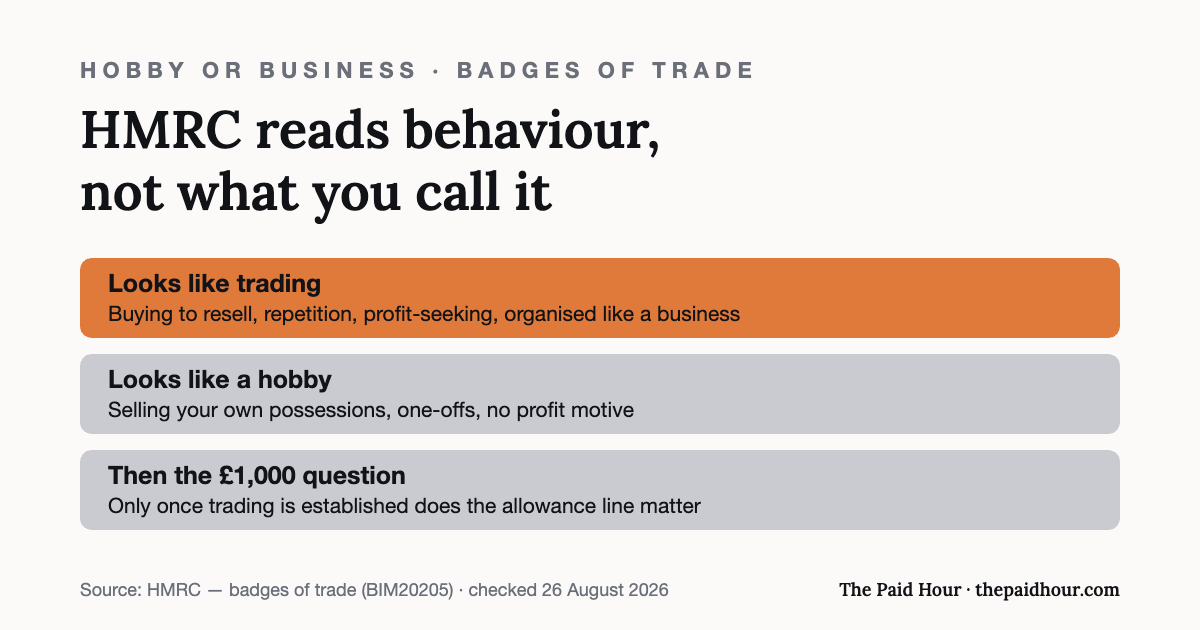
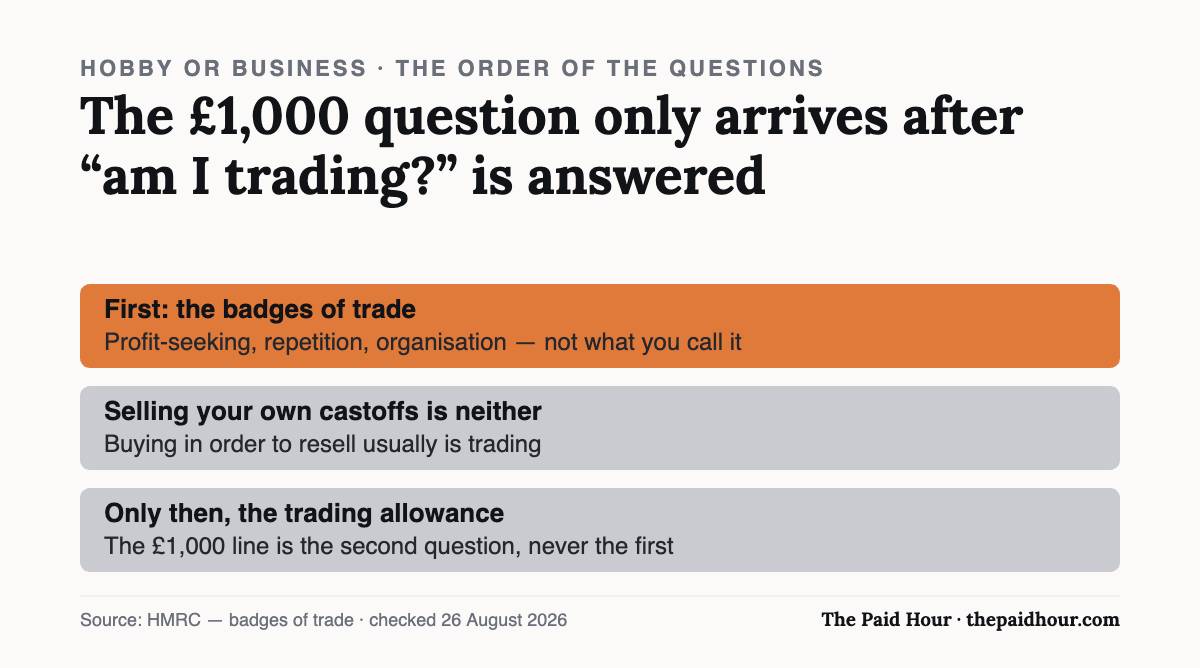
What matters here: Whether HMRC sees hobby or business is decided by the badges of trade, profit-seeking, repetition, organisation, not by what you call it. The £1,000 trading allowance question only arrives after the hobby or business one, after “am I trading?” is answered. Selling your own castoffs is neither; buying to resell usually is.
Hobby or business. Before you can ask “how much of this is tax-free,” you have to answer that question first: is this even trading? Those are two separate tests, and mixing them up is where a lot of confusion starts.
The £1,000 trading allowance question is about how much of your trading income is tax-free once something already counts as trading (gov.uk), covered in full in the £1,000 trading allowance explained. This post is about the question that comes before that: does HMRC even consider what you’re doing to be trading, or is it a hobby, a one-off sale, or the disposal of personal possessions? That’s decided using a different framework: the “badges of trade.”
What are the “badges of trade” that decide hobby or business?
The badges of trade are a set of indicators HMRC and the courts use to work out whether an activity amounts to trading for tax purposes. The concept comes from the 1955 Royal Commission on the Taxation of Profits and Income, which reviewed decades of UK case law and identified a set of recurring “badges,” or characteristics, that tend to mark out a trade.
That original list has since been refined through further case law and is now set out in HMRC’s internal guidance, the Business Income Manual, at BIM20205 (gov.uk) and the origin note at BIM20201 (gov.uk).
No single badge is decisive on its own. HMRC’s guidance is explicit that these factors are weighed together to form an “overall impression”: courts look at the whole picture rather than a tick-box checklist (gov.uk).
The badges HMRC lists, and what they say about hobby or business
Per HMRC’s Business Income Manual, here are the actual badges of trade used to draw the hobby or business line:
- Profit-seeking motive: intending to make a profit supports trading, but intention alone isn’t conclusive (gov.uk).
- The number of transactions: systematic, repeated transactions point toward trading rather than a one-off event (gov.uk).
- The nature of the asset: whether the asset only really benefits its owner through resale, versus something that provides income or personal enjoyment while you hold it (gov.uk).
- Existence of similar trading transactions or interests, if the activity resembles an existing trade you (or a connected business) already run, that supports trading (gov.uk).
- Changes made to the asset: modifying or improving something specifically to make it easier to sell, or more profitable, supports trading (gov.uk).
- The way the sale was carried out: a sale conducted in a typically “trade” manner (marketing, organised selling) supports trading more than an emergency or forced one-off sale (gov.uk).
- The source of finance, if you borrowed money to acquire the asset and could only realistically repay that loan by reselling it, that supports trading (gov.uk).
- Interval of time between purchase and sale: a quick turnaround supports trading; holding something indefinitely points away from it (gov.uk).
- Method of acquisition: something you inherited or were given as a gift is less likely to be treated as part of a trade than something you deliberately bought to resell (gov.uk).
These nine are the current, expanded form of the six badges the 1955 Royal Commission originally identified (gov.uk).
Why hobby or business matters separately from the £1,000 allowance
Because the two questions get answered in the wrong order all the time, and it changes what you need to do.
- Badges of trade answers: is this activity a trade at all? Selling a few unwanted items on Vinted, or occasionally gifting away something you no longer want, generally isn’t trading — no profit-seeking motive, no repeated pattern, and the goods weren’t acquired or altered for resale. HMRC has separate guidance for people earning through online marketplaces to help draw this line (gov.uk).
- The £1,000 trading allowance answers: given that this IS trading income, how much of it is tax-free, and do I need to register? That figure only comes into play once you’ve established you’re trading, gov.uk’s registration guidance frames the £1,000 test around income earned as a self-employed sole trader instead of around whether the activity qualifies as self-employment at all (gov.uk).
Put another way: if the badges say “no, this isn’t a trade,” the £1,000 allowance is irrelevant. Hobby proceeds and personal sales generally aren’t taxable regardless of amount. If the badges say “yes,” only then does the £1,000 figure become the next question.
What to do if you are not sure which you are
Look at your own activity against the badges above as a whole, not any single one in isolation. A repeated pattern of buying stock specifically to resell for profit, run in an organised way and financed with the expectation of repayment through sales, leans strongly toward “trading” even at small scale. A single sale of something you owned personally, inherited, or made occasionally as a hobby, with no real profit-seeking pattern, leans the other way.
If your situation sits close to the line, HMRC’s own guidance is the right place to check specifics rather than guessing, and an accountant can weigh the badges against your facts. Once you’ve concluded an activity is trading, the next step is usually working out whether you need to register, our guide to registering as a sole trader with HMRC walks through that.
Where this leaves you
“Badges of trade” and the “£1,000 trading allowance” are not the same test. Badges of trade decide whether an activity is trading at all, using nine indicators from HMRC’s Business Income Manual, weighed together rather than individually. The £1,000 allowance only becomes relevant once that first question is already answered “yes”: it’s about how much of already-established trading income is tax-free instead of about whether you’re trading in the first place.
Concluded you are trading? The next question is whether you need to file a return for it.
A job plus a side income: where does it land?
Side Hustle Tax Starter 2026/27. A six-module starter course and six working templates that tell you, in an evening, whether you owe anything at all, and set up the twenty-minute monthly routine that keeps it that way.
- The nine badges of trade as questions you can answer about your own income
- What the platforms send HMRC, the small-seller exemption, and three reply letters for when a letter arrives
- A sales log with a running £1,000 alert, an allowance-versus-expenses sheet, and a tax set-aside calculator at 2026/27 rates
Selling platforms now hand your sales data to HMRC once a year. Selling your own old possessions is never taxable. Buying to resell, making things, or freelancing is. Knowing which side you are on is the whole question.
Buying more than one? All ten 2026/27 courses for £107, against £328 at full price.
Need this ready-made? → Self Assessment Prep Checklist Pack, every deadline, record and allowance in 9 pages (£7.99, instant download)
Sources
- BIM20205 (Meaning of trade: badges of trade: summary), gov.uk
- BIM20201 (Meaning of trade: badges of trade: the origin of the concept), gov.uk
- BIM20235 (Meaning of trade: badges of trade: repeated operations), gov.uk
- BIM20245 (Meaning of trade: badges of trade: nature of the asset), gov.uk
- BIM20250 (Meaning of trade: badges of trade: income-producing assets), gov.uk
- BIM20295 (Meaning of trade: badges of trade: reasons for sale), gov.uk
- Tax-free allowances on property and trading income. Gov.uk
- Set up as a sole trader, gov.uk
- Check if you need to tell HMRC about your income from online platforms: gov.uk
The £1,000 trading allowance figure was re-checked against gov.uk on 26 August 2026. This is general information about how the rules work, not tax advice. The links above go to the primary sources; for your own circumstances, speak to an accountant or contact HMRC directly.