
Before you read on: Self Assessment late filing penalties add up fast. Miss the 31 January Self Assessment deadline and you get £100 immediately. Three months late adds £10 a day up to £900. Six months adds 5% of the tax due or £300, whichever is greater, and twelve months adds the same again. Because those last two have a £300 floor rather than being purely percentage-based, someone who owes no tax at all can still end up £1,600 down. Late payment penalties are separate from the late filing penalties, and come on top of them.
Table of Contents
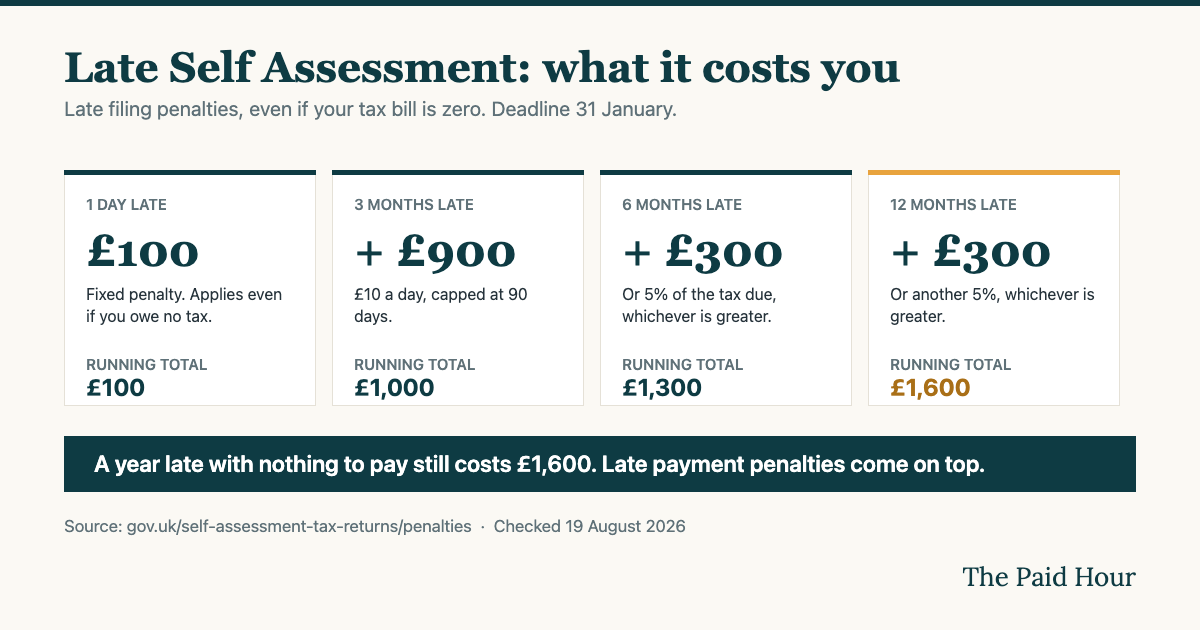
How a late return escalates. The running total assumes no tax is due.
Late filing penalties: why a zero tax bill still costs £1, 600
This is the part almost nobody expects, so it’s worth being precise about the wording. HMRC’s six-month penalty is “5% of the tax due or £300, whichever is greater”. The twelve-month penalty uses the same formula.
If your tax due is nil, 5% of nil is nil, but £300 is greater than nil. So you pay £300. Twice.
- Initial penalty: £100
- Daily penalties from 3 months, £10 a day for up to 90 days: £900
- At 6 months: £300
- At 12 months: £300
Total: £1,600, on a tax bill of nothing. The penalties are for not filing, not for not paying. If HMRC has asked you for a return, they want the return, whether or not there’s any money at the end of it.
Which is why the single most useful piece of advice about Self Assessment is unglamorous: if you can’t pay, still file. Filing on time and paying late is a much cheaper mistake than doing it the other way round.
Late payment penalties are a separate ladder
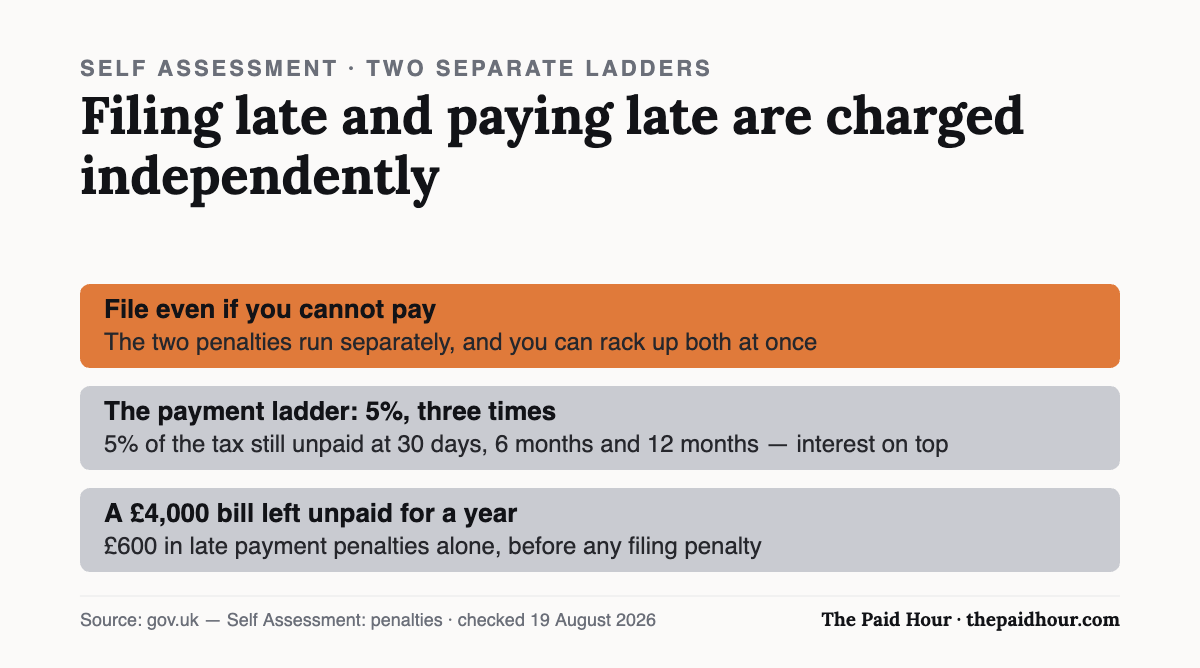
Filing late and paying late are charged independently, and you can rack up both. On the payment side you’re charged 5% of the tax still unpaid at three points: 30 days, 6 months and 12 months. Interest runs on the amount owed on top of that.
Worked through on a £4,000 bill left entirely unpaid for a year, the penalties alone come to £600. Three separate 5% charges of £200, before any interest. Pair that with a return filed twelve months late and the same person’s looking at £1,600 in filing penalties plus £600 in payment penalties plus interest, on a £4,000 liability.
Watch the timing that is easy to miss: the first late-payment penalty lands at 30 days rather than three months, roughly 2 March. There’s no comparable grace period to the one people assume exists.
If you’re in Making Tax Digital, late filing penalties change
Everything above is the Self Assessment penalty regime, and it’s still what applies to most filers right now. But if your qualifying income was over £50,000 in 2024–25, you were moved into Making Tax Digital for Income Tax from 6 April 2026, and from your 2026–27 tax year onward (the return due 31 January 2028), these penalties stop applying to you entirely.
HMRC replaces both the late filing and late payment penalties above with a points-based system for MTD users: you get a penalty point for each missed quarterly update or return deadline, and hitting 4 points triggers a flat £200 penalty, with another £200 for each further miss. Late payment moves to a tiered system too, no penalty in the first 15 days, roughly 3% (or nothing, in year one) between 16 and 30 days, then progressive percentages plus interest after that. Full detail on HMRC’s MTD penalties guidance.
Registering late: a separate penalty from late filing penalties
There’s a third penalty most first-timers have never heard of. If you register for Self Assessment after 5 October and haven’t paid your whole bill by 31 January, you may get a failure to notify penalty.
Two things make this one awkward. It’s calculated on the tax still outstanding, so it scales with how much you owe. And it can arrive up to twelve months after HMRC receives your return, long after you thought the matter was closed.
The escape is straightforward: register by 5 October following the end of the tax year you started in, and this penalty can’t apply to you. Started trading in the 2026/27 tax year? That date is 5 October 2027.
Late filing penalties: the dates, in order
| Date | What happens |
|---|---|
| 5 October | Deadline to register for Self Assessment for the tax year that ended the previous 5 April |
| 31 October | Deadline for a paper return |
| 30 December | Deadline to file online if you want tax under £3,000 collected through your PAYE code |
| 31 January | Online filing deadline, balancing payment, and first payment on account |
| ~2 March | First 5% late payment penalty, at 30 days |
| 31 July | Second payment on account |
If the July and January payments are a surprise to you, read how payments on account work: they’re the reason a first January bill is often half as large again as people budgeted for.
If you’ve already missed it: cutting the late filing penalties
- File now, today, even if it’s incomplete and even if you can’t pay. Daily penalties stop accruing from the date you file. Every day you delay past the three-month point is another £10.
- Then deal with the payment separately. HMRC has a Time to Pay arrangement for people who can’t pay in one go. Arranging it is far better than staying silent.
- Check whether you’ve got a reasonable excuse. You can appeal a penalty. HMRC publishes what it accepts — serious illness, a bereavement, service failures at HMRC’s end. Being busy or having lost your paperwork isn’t on the list.
- Pay any penalty within 30 days of the date on the notice.
- If you no longer need to file at all, tell HMRC and ask them to stop issuing returns. People keep receiving, and keep being penalised for, returns for businesses they closed years ago.
HMRC also publishes a penalty estimator, which is worth running if you want the actual figure instead of a worst case.
Avoiding Self Assessment late filing penalties next year
Self Assessment late filing penalties almost always trace back to the same root cause: the pattern behind almost every late return is the same: the records weren’t kept during the year, so filing meant reconstructing twelve months of transactions in January, so it got postponed. The deadline isn’t really the problem; the bookkeeping is.
Two things that fix it, in order of how much they help:
- Keep records as you go, however you do it. A spreadsheet updated monthly beats software you never open. Knowing what you can claim is what makes it worth the effort.
- File in April or May, not January. Filing early doesn’t mean paying early, the payment’s still due 31 January. You just find out what you owe nine months before you have to hand it over, which is the most useful thing you can do for your own cash flow.
First year doing this? Start here. Working out whether you need to file at all? The National Insurance thresholds are a useful cross-check on your profit figure.
Two neighbours of this problem: registering late carries its own, separate penalty, and if you are racing a deadline with a simple return, return-only software such as GoSimpleTax exists for exactly that.
Filing it yourself this year?
HMRC Tax & Expense Mastery 2026/27. Nine modules and eleven working templates that take a UK freelancer from “do I even need to register” to a correct return, with MTD quarters built in.
- Fifteen expense categories, with the trap inside each one (training, clothing, meals, the seven-year pre-trading rule)
- Home and vehicle: flat rate against actual cost, with the £312 break-even worked out and the mileage lock-in rule
- The year-one payments-on-account cash shock, and the routine that stops it landing twice
HMRC does not send a list of what you forgot to claim. Most freelancers leave several hundred pounds of legitimate expenses on the table every single year, and the return still gets filed.
Buying more than one? The Complete Freelancer System, all five for £87, against £215 at full price.
Need this ready-made? → Self Assessment Prep Checklist Pack, every deadline, record and allowance in 9 pages (£7.99, instant download)
Sources
- GOV.UK. Self Assessment penalties
- GOV.UK, Estimate your penalty for late returns and payments
- GOV.UK: Self Assessment deadlines
- GOV.UK, Appeal against a penalty
- GOV.UK. If you cannot pay your tax bill on time
Penalty amounts checked 19 August 2026. This is general information, not financial or tax advice. If you’ve received a penalty notice and think it’s wrong, HMRC’s appeal process is the route, and a tax adviser is worth the fee where the sums are large.