
The one-paragraph answer: The question is not how far you travelled. It is whether your places of work are predictable. A bricklayer moving to a new site every three weeks could claim journeys of up to 55 miles. A milkman driving to the same depot every morning could not claim a journey of two. If your trade is itinerant, your home can be the base of operations and the travel is business travel. If there is a pattern, the journey to it is a commute, and a commute is never deductible.
Table of Contents
Self-employed travel expenses are one of the few areas where the rule you were told is almost right and still leads you into the wrong answer. Everyone knows you cannot claim commuting. Very few people can say what makes a journey a commute.
GOV.UK gives one line, that you cannot claim travel between home and work, and leaves the hard part alone. The hard part is that when you work for yourself, nobody has told you where work is.
What business travel can a self-employed person claim?
Fares, fuel, parking, vehicle running costs, hotel rooms and meals on overnight business trips are all on HMRC’s list. Non-business driving, fines and travel between home and work are not.
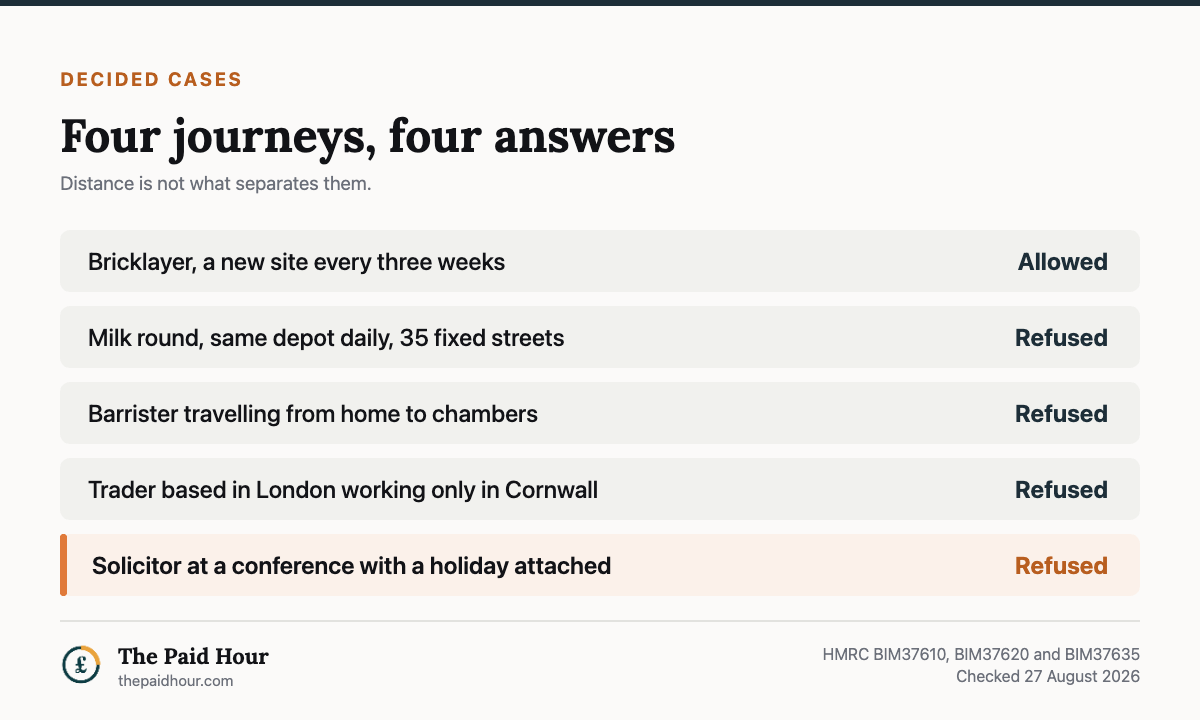
Four decided cases do more to explain the boundary than the list does.
The bricklayer whose home was the base
Horton v Young is the case every itinerant trade rests on. Mr Horton laid bricks under subcontracts at building sites within about 55 miles of home, roughly three weeks a site. He had no office anywhere. His tools, his contracts and his records lived at his house.
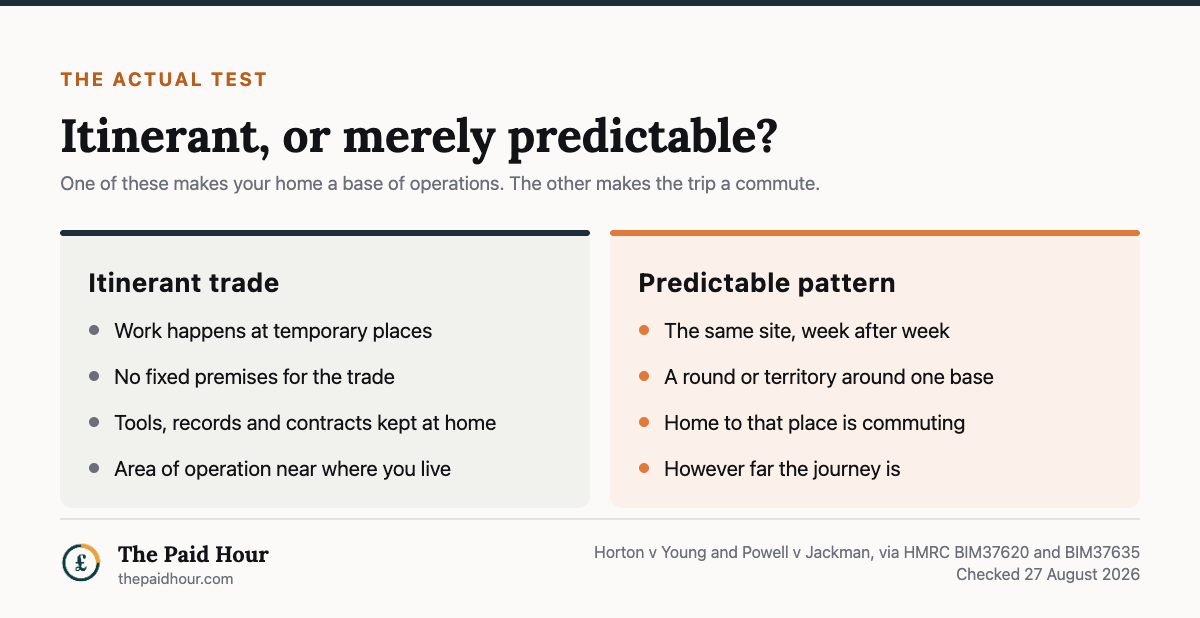
The Commissioners refused his travel. Brightman J allowed it, and drew the distinction the whole area now turns on: there is a fundamental difference between someone who travels from home to a shop, and someone who travels from home to a number of different locations for a purely temporary purpose.
Home was not incidentally where he kept things. It was the only fixed point the business had. That made it the base of operations, and everything outward from a base of operations is business travel.
Brightman J turns up again a decade later in the House of Lords, refusing a barrister the cost of her court clothes. He was consistent: an expense with two purposes running through it does not get split.
The milkman who lost on predictability
Powell v Jackman, from 2004, is the case that stops people over-reading Horton. Mr Powell ran a milk franchise. Every morning he drove from home to the depot, collected the float and the goods, and delivered to a round of about 35 streets. All of the paperwork: records, computer, filing, was done at home.
On the Horton reasoning he should have won. He did not. Lewison J held the travel was not allowable, and the reason was predictability: there was no predictability about where Mr Horton would be working, whereas Mr Powell had a round arranged around one depot in one town.
Doing your admin at home does not create a base of operations. A pattern beats a home office every time.
Distance is not the business travel test, in either direction
Fifty-five miles was fine for the bricklayer. Two miles was not fine for the milkman. So a long journey does not earn a deduction and a short one does not lose it.
Distance does bite at the far end, though. Brightman J gave his own limit: a commercial traveller who lives in London while working entirely in Cornwall cannot claim the London-to-Cornwall leg, because at that point living where you live is a personal choice the trade is paying for. The base has to be near the work for the base argument to hold.
Why a home office does not settle business travel
The oldest case here is Newsom v Robertson, a barrister who worked at home in the evenings and vacations and claimed the journeys between home and chambers. Refused. He had two places of work and travelling between the private one and the professional one was, in substance, getting to work.
This is the one that catches freelancers with a client they attend every Tuesday. The use of home claim is a separate relief with its own rules, and having one does not convert the Tuesday journey into business travel.
Business travel between jobs in the same day
Journeys made in the course of the trade (site to site, client to client, workshop to supplier) are business travel and are not affected by any of the above. The commuting rule bites on the leg between home and a place of work, not on the ones in the middle of the day.
Which means the driver whose morning leg is disallowed may still have most of the day’s mileage allowable. Log it that way and the record answers the question by itself.
Business travel with a holiday on the end
This one costs people real money. In Bowden v Russell & Russell a solicitor flew to America and Canada for professional conferences and also intended to take a holiday. He argued the trip maintained his standing and would bring in clients. All of it was refused.
Not apportioned. Refused. The court fastened on his own admission that the visit had two purposes, and two purposes is fatal.
The practical lesson is about intention at the moment you book. A trip that was for the conference does not stop being that because you had a nice dinner. A trip you planned as a conference-and-a-week-away was never wholly and exclusively anything. If you want the weekend, pay for the weekend separately and be able to show it.
What you can claim on business travel that qualifies
Either actual running costs or the flat-rate mileage allowance, one or the other for a given vehicle, not both. Fares, parking and tolls. Hotel and reasonable meals where the trip keeps you away overnight, and reasonable food and drink where the journey falls outside your normal pattern. The simplified expenses flat rates cover the vehicle side if you would rather not track running costs.
What to keep
A mileage log with the date, the route and the reason. It sounds like bureaucracy until an inspector asks why a Tuesday journey repeats forty times in a year, and the reason column is the only thing standing between you and a pattern.
Keep it for at least five years after the filing deadline. Travel is one of the biggest lines in most sole-trader accounts, which is why it features in what triggers a tax return enquiry. The full picture sits in allowable expenses for UK freelancers and the exclusions in disallowable expenses.
Filing it yourself this year?
HMRC Tax & Expense Mastery 2026/27. Nine modules and eleven working templates that take a UK freelancer from “do I even need to register” to a correct return, with MTD quarters built in.
- Fifteen expense categories, with the trap inside each one (training, clothing, meals, the seven-year pre-trading rule)
- Home and vehicle: flat rate against actual cost, with the £312 break-even worked out and the mileage lock-in rule
- The year-one payments-on-account cash shock, and the routine that stops it landing twice
HMRC does not send a list of what you forgot to claim. Most freelancers leave several hundred pounds of legitimate expenses on the table every single year, and the return still gets filed.
Buying more than one? The Complete Freelancer System, all five for £87, against £215 at full price.
Sources
- BIM37620: travel costs, base of trade operations, HMRC Business Income Manual
- BIM37635: predictability of places of work, HMRC Business Income Manual
- BIM37610: overseas conference plus holiday, HMRC Business Income Manual
- BIM47705: travel and subsistence, general, HMRC Business Income Manual
- Expenses if you are self-employed: travel, GOV.UK
Horton v Young is reported at [1971] 47 TC 60, Powell v Jackman at [2004] 76 TC 87, Newsom v Robertson at [1952] 33 TC 452 and Bowden v Russell & Russell at [1965] 42 TC 301. The facts and the judges’ reasoning are taken here from HMRC’s Business Income Manual rather than from the law reports. The allowable and disallowable travel lists are GOV.UK’s wording. All pages read on 27 August 2026. This is general information about how the rules work, not tax advice. Check your own position with HMRC or an accountant before you file.