

Business insurance premiums for cover the business needs come off your profits. HMRC names indemnity insurance premiums in box 28 and property insurance in box 21. Cover on your own life or health is personal and does not. The part almost nobody mentions is the other direction: a business insurance payout that compensates you for lost profit, or for a cost you had already deducted, is trading income. And HMRC states plainly that whether you got relief on the premium does not decide how the payout is taxed.
Table of Contents
Is business insurance tax deductible? For business cover, yes, and it is one of the safer lines on a return. The interesting question is the one that arrives the year you actually claim.
This page is about the tax treatment rather than what to buy. If you are still deciding on cover, start with self-employed business insurance.
Business insurance premiums, and the two boxes they hide in
HMRC splits insurance across two boxes on the self-employment pages, which is a small thing that causes a surprising amount of double-counting and omission.
Box 21 (rent, rates, power and insurance) includes property insurance. Box 28 (accountancy, legal and other professional fees) includes indemnity insurance premiums.
So your professional indemnity sits in a box named after your accountant, and your contents cover sits in a box named after rent. Neither is where most people would look first.
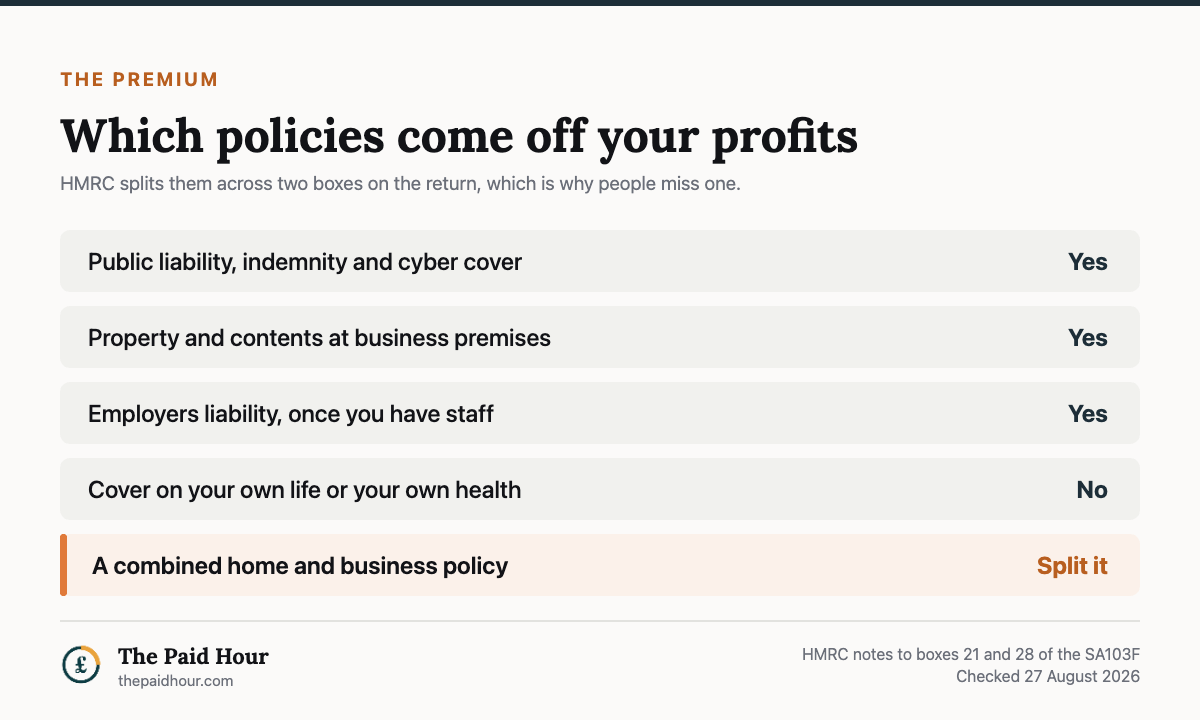
Public liability, professional indemnity and cyber cover are all bought because the trade creates the risk, so they pass the wholly and exclusively test without difficulty. Employers’ liability is not optional once you have staff, which settles the question before it is asked.
Cover on you is not business insurance
Life cover, private medical, critical illness, income protection. These are bought to protect a person, and the person is not the trade. The same reasoning that stops you deducting a coat or a lunch.
That does not make them a bad idea. A sole trader with no statutory sick pay behind them has a real gap to fill. It just means the premium comes out of taxed income, like your mortgage.
A policy that covers both: home-and-business contents on one certificate, say, is apportioned. Take the business share, keep the calculation, and use the same one next year.
The business insurance payout that catches people
You have a fire, or a client claims against you, or a laptop is stolen. The insurer pays. Is that money taxable?
The instinct is no. Insurance restores you to where you were; nothing has been earned; and in the case of personal cover you never even got relief on the premium, so surely the state has no claim on the proceeds.
HMRC addresses that reflex head on. Its manual states that the deductibility of insurance premiums for tax purposes will not determine whether a recovery forms part of trading income.
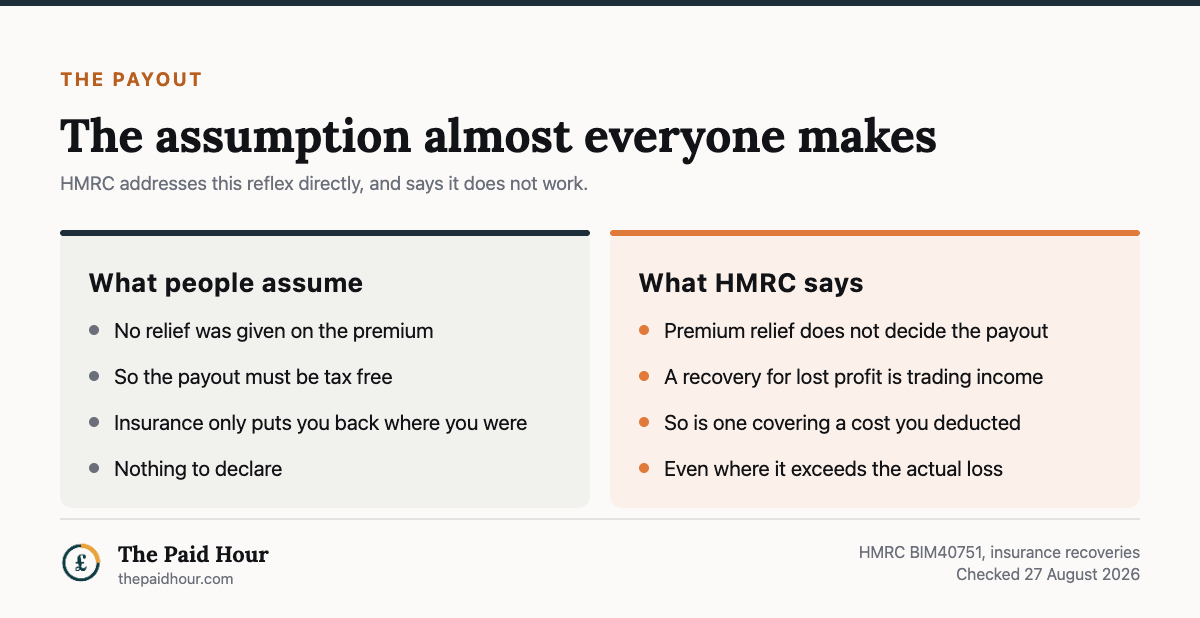
The two are simply different questions. The premium is tested against whether it was spent for the trade. The payout is tested against what it is replacing.
What the business insurance payout is replacing
HMRC’s framing is a hole in the commercial profits. If the money is filling one, it is trading income.
Business interruption cover replacing three months of income you would have invoiced: trading income, because the income it replaces would have been. A payout covering the cost of hiring replacement equipment, where you also deducted that cost: trading income, or you would be relieved twice for the same event.
Stock destroyed and paid for by the insurer: trading income, including where the payment exceeds what the stock cost you. That last part surprises people, and it follows from the same logic. The stock would have been sold at more than cost too.
The place it changes is where a payout relates to a capital asset rather than to profits. That is a different set of rules and a different calculation, and it is worth getting advice on rather than guessing, because the answer depends on what happens to the asset next.
Why business insurance matters more than it sounds
A claim year is already a bad year. The thing you insured against happened, you have spent time on the claim, and cash is tight.
A payout that lands in that year without being recognised as income produces a return that understates profit, and an understated return is the kind of error that carries a penalty on top of the tax when it surfaces. Nothing about it is deliberate. It is simply that insurance money does not feel like turnover.
The practical fix is to treat any settlement letter as a document with two purposes: closing the claim, and telling your bookkeeping what the money is for. A payout described line by line is far easier to allocate than a single figure.
Policy records to keep for your insurance claim
The schedule showing what each policy covers, so the split between box 21 and box 28 is not guesswork. For a combined policy, the apportionment and how you reached it.
And for any claim: the settlement breakdown alongside the costs it relates to. If a payout covered a cost you also deducted, those two documents belong in the same folder. It is the pairing that shows you handled it correctly rather than twice. The full picture is in allowable expenses for UK freelancers, and what stays out in disallowable expenses.
Want the whole tax system, not one rule?
HMRC Tax & Expense Mastery 2026/27. Nine modules and eleven working templates that take a UK freelancer from “do I even need to register” to a correct return, with MTD quarters built in.
- Fifteen expense categories, with the trap inside each one (training, clothing, meals, the seven-year pre-trading rule)
- Home and vehicle: flat rate against actual cost, with the £312 break-even worked out and the mileage lock-in rule
- The year-one payments-on-account cash shock, and the routine that stops it landing twice
HMRC does not send a list of what you forgot to claim. Most freelancers leave several hundred pounds of legitimate expenses on the table every single year, and the return still gets filed.
Buying more than one? The Complete Freelancer System, all five for £87, against £193 bought separately.
Sources
- BIM40751: receipts, insurance recoveries, HMRC Business Income Manual
- Self-employment (full) SA103F and notes, GOV.UK
- BIM37007: wholly and exclusively, overview, HMRC Business Income Manual
- Expenses if you are self-employed, GOV.UK
The box 21 and box 28 wording, including property insurance and indemnity insurance premiums, is quoted from HMRC’s notes to the SA103F self-employment pages, reference 12/25. The statement that the deductibility of premiums does not determine whether a recovery forms part of trading income, and the treatment of recoveries for lost profit, deducted costs and stock, are from HMRC’s Business Income Manual at BIM40751, last updated 4 August 2026.
Payouts relating to capital assets are outside the scope of this page and are deliberately not covered here. All pages read on 27 August 2026. This is general information about how the rules work, not tax advice. Check your own position with HMRC or an accountant before you file.