
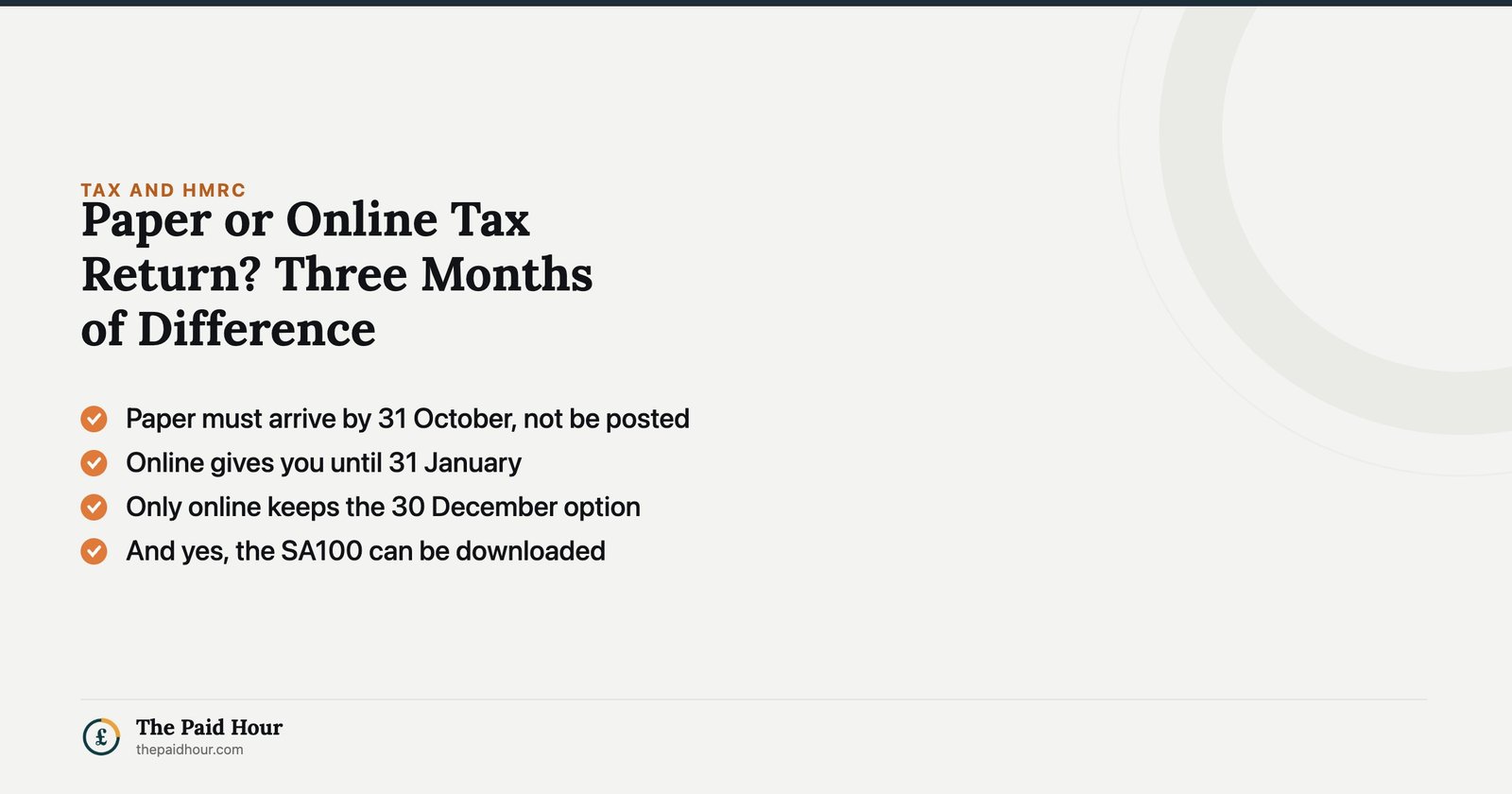
What matters here: Paper and online are the same tax return with two different deadlines three months apart, for 2025/26, 31 October 2026 on paper and 31 January 2027 online. The paper deadline is the date HMRC must have received it, not the date you posted it. Filing online also keeps open the option of having a bill under £3,000 collected through your PAYE code, which needs the return in by 30 December. And one correction: the SA100 can be downloaded. It is the SA200 short return you cannot get unless HMRC sends it.
Almost nobody chooses paper on purpose any more. The people who end up filing on paper are usually there because something blocked the online route. An account they could not get into, a page the software would not handle, a first year where the UTR arrived too late.
Which is worth knowing in advance, because the paper deadline has already gone by the time most people start thinking about tax.
Received, not posted: the paper tax return deadline
GOV.UK phrases the paper deadline as HMRC must receive your paper tax return by 11.59pm on 31 October. Not sent by. Not postmarked.
That is a meaningfully different deadline from the online one, which you can hit at 11.58pm from your sofa. A paper return posted on 30 October is late, and a £100 penalty follows whether or not the tax was paid on time.
If you are filing on paper, send it recorded and send it early. The date HMRC opened the envelope is the only date that matters, and you cannot prove it.
Yes, you can download the SA100
A surprising amount of published advice says you have to ring HMRC and ask for a paper return. GOV.UK gives two options: download the SA100, or call and ask for it. Downloading is one of them.
What you cannot get is the SA200 short tax return, HMRC’s own instruction is to fill it in only if HMRC sends it to you, and you cannot download it. Two different forms, and the rule about one has been attached to the other for years.
You will also need the right supplementary pages, which on paper is your job rather than the system’s.
What the three months between tax return deadlines buy
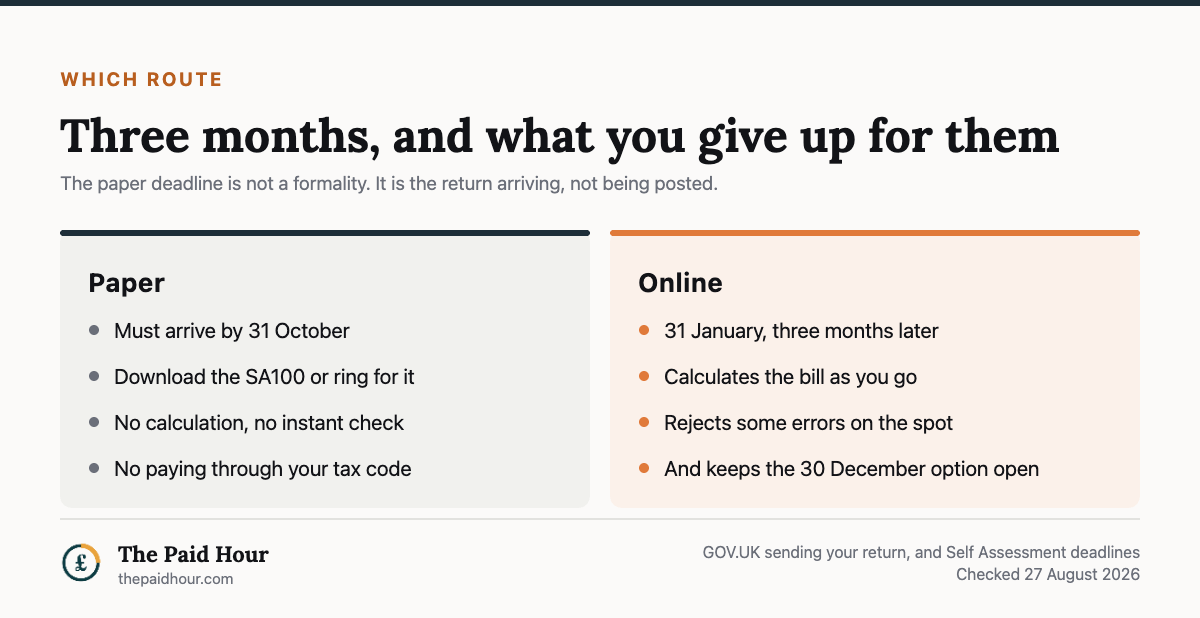
More than time. Filing online does three things paper does not.
It calculates. You see the bill as you go, rather than posting the figures and waiting to be told. For anyone whose income moved during the year, that is the difference between planning for January and being surprised by it.
It catches some mistakes. Not all of them. The system will happily accept a wrong number in the right box. But it stops the structural errors, the ones where a page is missing or a figure cannot be what you typed.
It keeps the 30 December door open. Which brings us to the deadline nobody can explain.
The 30 December date
It sits in every list of Self Assessment deadlines and almost nothing says what it is for.
If you owe less than £3,000 and you already pay tax through PAYE, HMRC can collect the Self Assessment balance through your tax code over the following twelve months instead of demanding it in one payment on 31 January. To be considered, the return has to be in by 11.59pm on 30 December.
That is a useful cash-flow option for anyone employed and self-employed at the same time, and it is closed off entirely by filing on paper, or by filing online on 2 January like everybody else.
When a paper tax return is the right answer
It has not disappeared, and there are situations where it is the sensible route.
Some entries HMRC’s own online service does not support, in which case the choice is paper or commercial software. Some people cannot verify their identity to the standard the online service requires. And some simply do not want to, which is allowed.
If any of those is you, the important thing is the calendar. Work backwards from 31 October, not from 31 January, and register by 5 October if this is your first year, because a UTR that arrives in November has already cost you the paper option.
Missing the paper tax return deadline is not fatal
Worth saying, because people assume it is.
If 31 October has gone and you have not filed on paper, you have not missed the deadline. You have lost the paper option. File online by 31 January and you are on time, with no penalty.
If you registered for Self Assessment after 5 October 2026, your filing date may not be 31 January at all. HMRC sends a letter or email with its own deadline for the return, three months from the date on it. The tax is still due by 31 January 2027 either way, so the letter is not a reason to put the bill off.
What you cannot do is post a paper return in December and treat it as within the online deadline. The deadline follows the method, and a late paper return is late even though an online one filed the same day would not be.
What to keep
On paper: a photocopy of everything you sent and the proof of posting. That pair is the only evidence you will have if HMRC says nothing arrived, and it costs a few pounds at the counter.
Online: the submission receipt and reference. Both routes need the underlying records kept for at least five years after the filing deadline, and if this is your first year the ground rules are in your first Self Assessment.
Filing it yourself this year?
HMRC Tax & Expense Mastery 2026/27. Nine modules and eleven working templates that take a UK freelancer from “do I even need to register” to a correct return, with MTD quarters built in.
- Fifteen expense categories, with the trap inside each one (training, clothing, meals, the seven-year pre-trading rule)
- Home and vehicle: flat rate against actual cost, with the £312 break-even worked out and the mileage lock-in rule
- The year-one payments-on-account cash shock, and the routine that stops it landing twice
HMRC does not send a list of what you forgot to claim. Most freelancers leave several hundred pounds of legitimate expenses on the table every single year, and the return still gets filed.
Buying more than one? The Complete Freelancer System, all five for £87, against £215 at full price.
Sources
- Self Assessment tax returns: deadlines, GOV.UK
- Self Assessment tax returns: sending your return, GOV.UK
- Self Assessment forms and helpsheets, GOV.UK
- Pay your Self Assessment tax bill through your tax code, GOV.UK
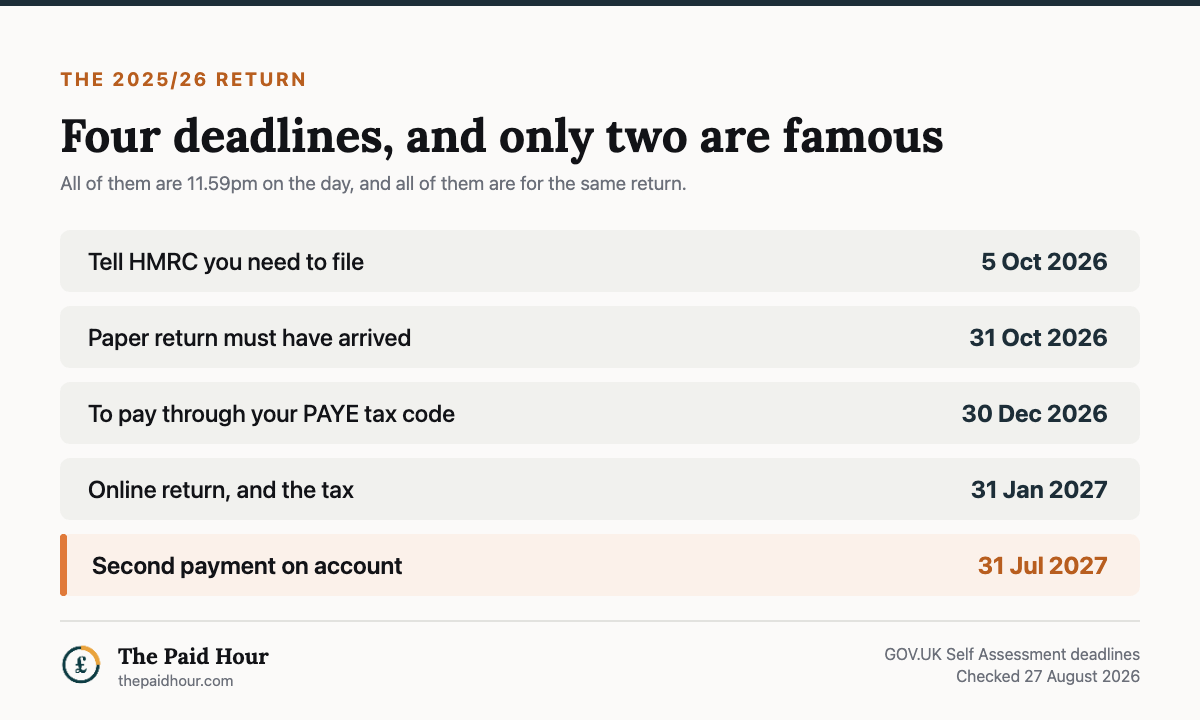
The deadlines quoted are GOV.UK’s for the 2025/26 tax year: 5 October 2026 to tell HMRC, 31 October 2026 for a paper return to be received, 30 December 2026 to be considered for collection through a tax code, and 31 January 2027 for an online return and the tax. Dates move with the tax year, check the ones for the year you are filing.
The wording that you can download the SA100 or call and ask for it is from GOV.UK’s sending your return page; the instruction that the SA200 cannot be downloaded is from the forms and helpsheets page. The under-£3,000 and PAYE conditions are from GOV.UK’s guidance on paying through your tax code. All pages read on 27 August 2026. This is general information about how the rules work, not tax advice.
Dates on this page rechecked against GOV.UK on 14 October 2026.