
Quick answer: A UK sole trader can trade under almost any name, “Jane Smith, trading as Bright Sparks Electrics”, and there is no register to put it on. Gov.uk bars three things: company-style endings like Ltd or plc, offensive names, and names too close to an existing trade mark. The Companies Act adds a fourth: nothing implying a government connection. And once you use a trading name, your real name and a UK address must still appear on invoices, letters and orders.
A trading name is how most sole traders end up with a business name: you stay Jane Smith to HMRC, and Bright Sparks Electrics to customers. The setup is deliberately light. No registration, no fee, no approval, which is exactly why the rules that do exist are easy to miss. There are four things a sole trader business name can’t be, and one paperwork duty that starts the moment you use one.
Trading as: can a sole trader use any business name they like?
Nearly. Gov.uk puts it plainly: “You can trade under your own name, or you can choose another name for your business.” No permission, no cost, no form. The formal shape is “Jane Smith, trading as Bright Sparks Electrics”, your legal identity stays your own name, and the trading name is a label on top of it rather than a separate legal thing.
There’s no business name register, and no protection either
You won’t find anywhere to register it: not Companies House, not HMRC. Gov.uk’s set-up-as-a-sole-trader steps contain no naming step at all, you pick the name and start using it. (A limited company is the opposite case: its name is registered at Companies House, and once registered no other company can take the identical name.)
The flip side of no register: nobody owns a trading name. Another sole trader can put the same words above a different shop, and the name itself gives you nothing to stop them with. It cuts the other way too: gov.uk’s own warning is that a name too close to someone’s registered trade mark can be forced to change “if someone makes a complaint”, and by then the signage is paid for.
Nothing stops one sole trader using two trading names for two lines of work, either; each one just drags the same disclosure duty along with it. If the brand matters, the tool is a registered trade mark — from £205, usually three to four months to grant if nobody objects. That’s a separate exercise with its own traps, and worth doing properly before the name is painted on a van.
The four things your business name can’t be
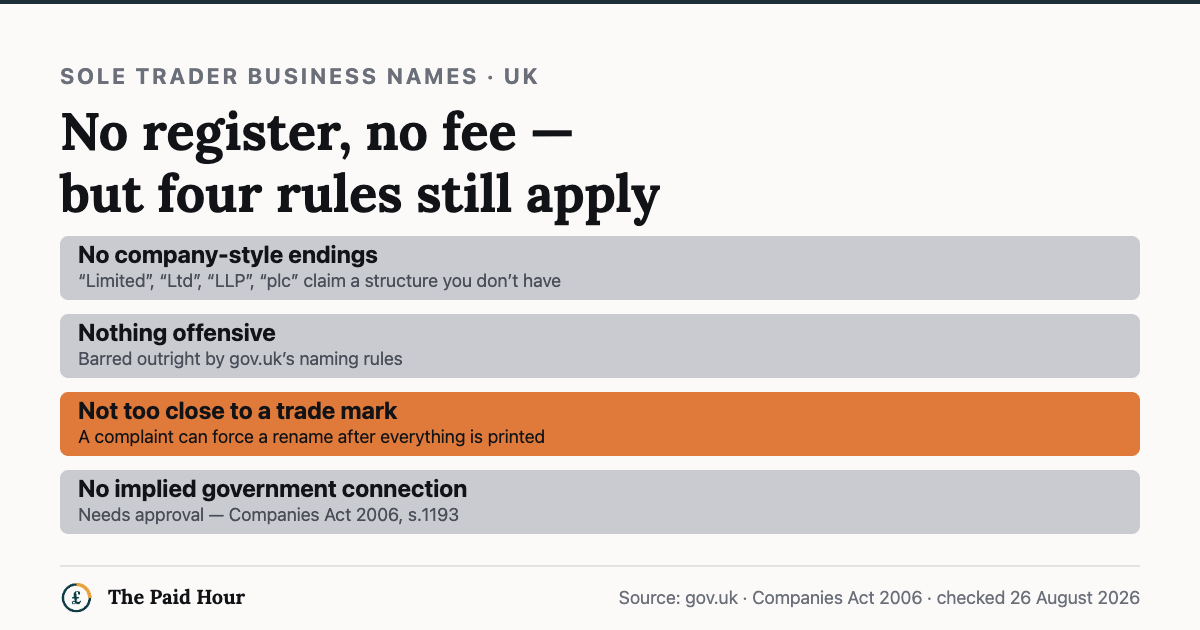
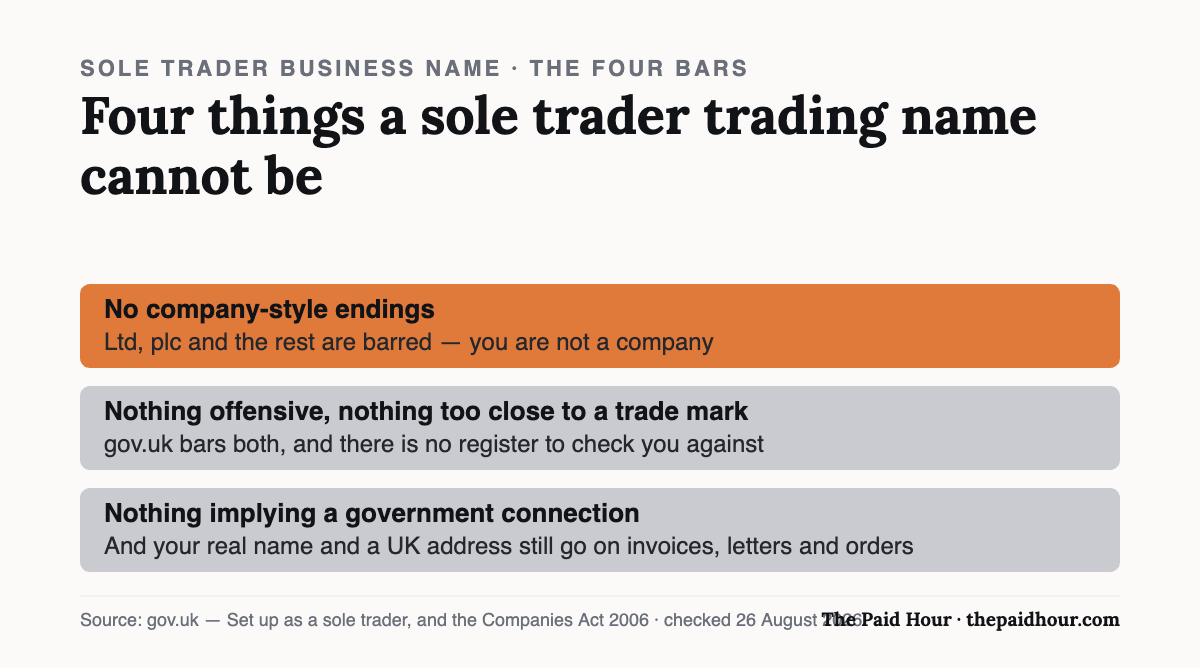
Gov.uk’s list for sole traders is short. No company-style endings, “limited”, “Ltd”, “limited liability partnership”, “LLP”, “public limited company” or “plc”, because they claim a legal structure you don’t have. Nothing offensive. And nothing too similar to an existing trade mark, because a complaint from the mark’s owner can force a rename after you’ve printed everything.
The Companies Act adds the fourth: without approval, you can’t carry on business under a name likely to give the impression you’re connected with government, a local authority or a public authority (section 1193). “District Council Repairs” isn’t a clever name, it’s an approval you never applied for.
Check the trade mark register before you print anything
Not a legal requirement, just far cheaper than a rebrand. The IPO’s search for a trade mark tool is free. Run it before the domain, the signage and the first box of business cards, and search the obvious variants while you’re there. If your name sits close to a registered mark in your own line of work, pick again now, while changing costs nothing.
Changing a business name later
As informal as choosing one. There’s nothing to update at Companies House or HMRC, because nothing was registered, the work is in your own paperwork: invoice templates, contracts, the premises notice, the website footer. Documents you’ve already issued stay as they were; the disclosure duty attaches to what you send out while using a name rather than retroactively. The expensive part of a name change is never the admin. It’s the reprinting, which is the argument for the trade mark search above happening first.
The paperwork rule: your real name still shows up
The moment you trade under a name, disclosure law follows it. Gov.uk’s invoicing guidance requires “your name and any business name being used” on invoices, plus “an address where any legal documents can be delivered to you if you are using a business name”. The rest of what belongs on the document is in what a UK invoice must include.
The legal spine is Part 41 of the Companies Act 2006. Trading under a business name, you must state your own name and a UK service address, in legible characters, on business letters, written orders for goods or services, invoices and receipts, and written demands for payment (section 1202).
The same information goes on a prominent notice at any premises your customers or suppliers can access (section 1204), and must be handed over in writing to anyone you deal with who asks for it. Failing without reasonable excuse is an offence carrying a fine at level 3 on the standard scale, with a daily default fine while it continues (section 1205). Not a risk worth running to keep a letterhead tidy.
One boundary worth knowing: that list names paper things, letters, orders, invoices, receipts, demands. Part 41’s website-disclosure rules are written for companies, not sole traders, so putting your name and contact address on your site is what a serious business does instead of a strict legal duty. Do it anyway.
And if the business itself isn’t registered yet, that’s the actual first job, registering as a sole trader with HMRC walks through it, trading name and all.
Correction, 26 August 2026: the chart listed three naming restrictions. The rule on names suggesting a connection to government or a local authority, from section 1193 of the Companies Act 2006, was missing. The chart was redrawn with four. See the corrections log.
Is your name, your work and your downside actually covered?
Protect the Business: Legal, IP & Insurance 2026/27. Eight modules and five working sheets built around a complete annotated freelance contract, with a negotiation note under every clause.
- Registering a trade mark yourself: searching, classes, fees and the opposition period
- UK GDPR without a consultant: the ICO fee tiers, a privacy notice, and the 72-hour breach plan
- An insurance sizing calculator by work type, and the client clauses never to sign as they stand, with the redline for each
You own the copyright in what you make until you assign it in writing. Most clients assume the opposite, and most freelance contracts are silent on it.
Buying more than one? All ten 2026/27 courses for £107, against £328 at full price.
Sources
- Become a sole trader: choose your business name: GOV.UK
- Set up as a sole trader: step by step, GOV.UK
- Set up a private limited company: choose a company name. GOV.UK
- How to register a trade mark, GOV.UK
- Search for a trade mark: GOV.UK
- Invoicing and taking payment from customers: what invoices must include — GOV.UK
- Companies Act 2006, Part 41 (Business Names), legislation.gov.uk
The naming rules, the trade mark fee and timescale, the invoice requirements and the Companies Act disclosure duties were re-checked against gov.uk and legislation.gov.uk on 26 August 2026. General information, not legal advice. For a name you’re about to build a brand on, a proper trade mark search or legal opinion is worth the money.