
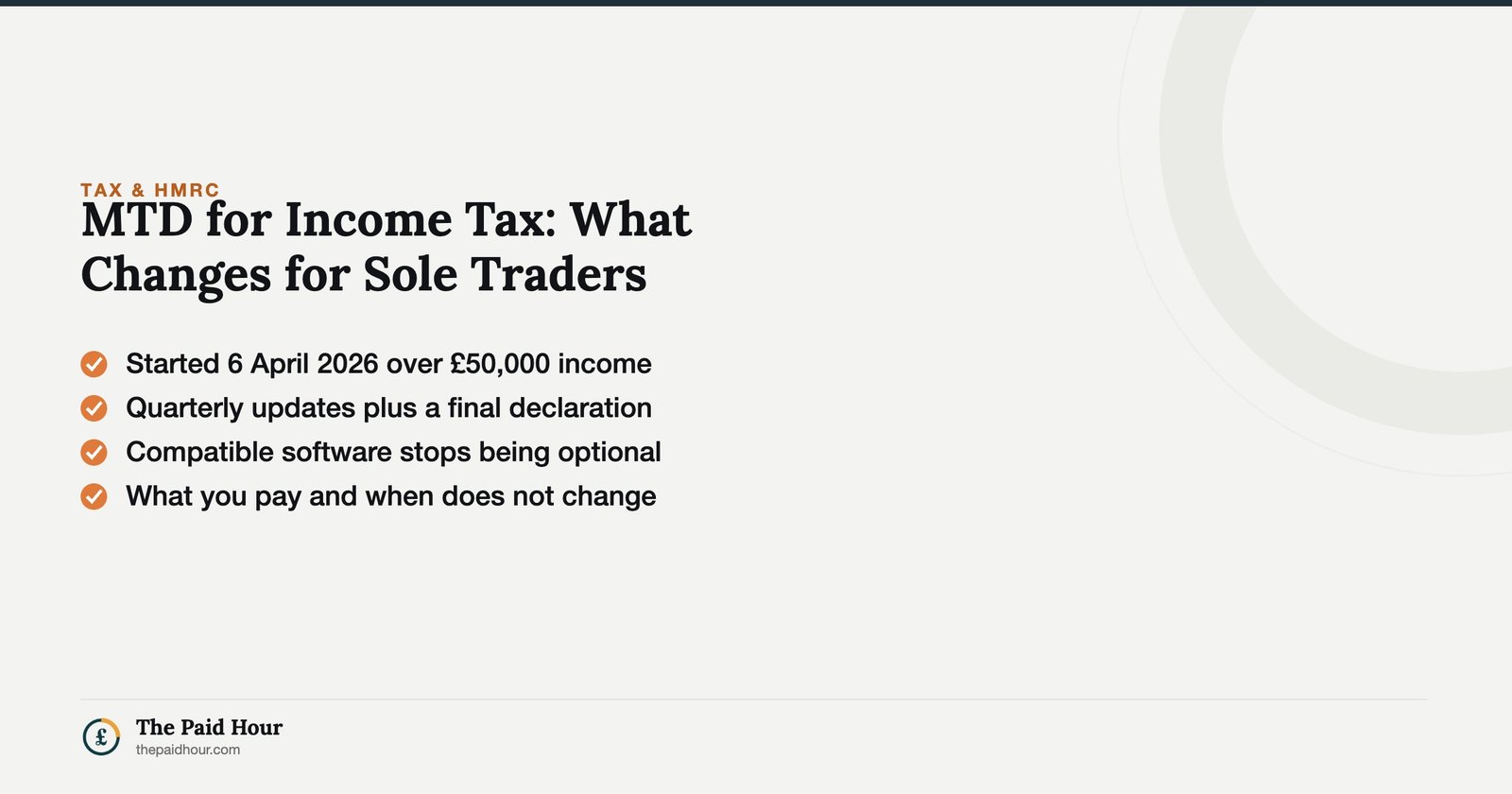
The short version: If your qualifying income as a sole trader was over £50,000 in 2024–25, Making Tax Digital for Income Tax already applies to you, it started on 6 April 2026 and means digital records plus four quarterly updates a year. Over £30,000 joins in April 2027, over £20,000 in April 2028. Your Self Assessment final declaration isn’t going anywhere.
Making Tax Digital for Income Tax is arguably the biggest shake-up to how self-employed people report to HMRC in a generation, and most of what’s been written about it swings between panicky and vague. Here’s what it is, who it catches, and what changes for you day to day.
What Making Tax Digital for Income Tax means
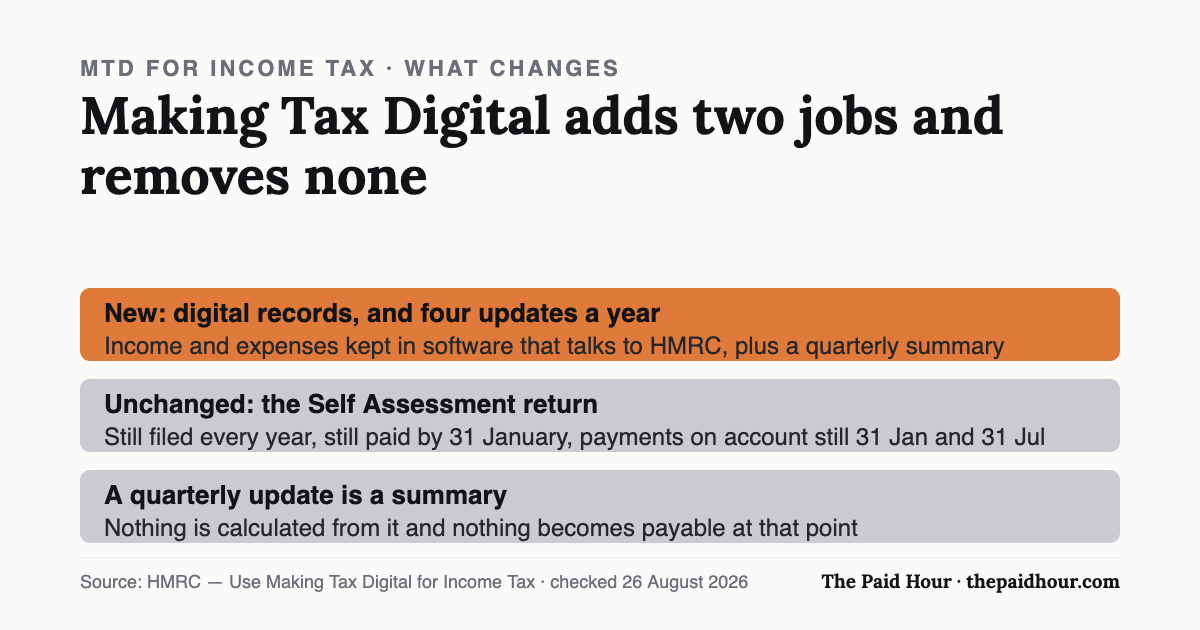
Up to now, a sole trader really only had one job: file a Self Assessment return by 31 January. Making Tax Digital for Income Tax bolts two extra requirements onto that.
- Digital records. Your income and expenses need to be recorded digitally, in software that talks to HMRC. A shoebox of receipts and a spreadsheet you bash out in January doesn’t cut it anymore.
- Quarterly updates. Four times a year, you send HMRC a summary of that quarter’s income and expenses, straight from the software.
Worth stressing: those quarterly updates are summaries rather than bills. Nothing gets calculated and nothing’s due at that point. HMRC is essentially asking you to show your working as you go, instead of dumping it all in one go every January.
Your MTD ITSA start date is set by an earlier tax year’s qualifying income. Source: HMRC, checked 19 August 2026.
Who Making Tax Digital applies to, and when
You need to use Making Tax Digital for Income Tax if all three of these apply: you’re a sole trader or landlord registered for Self Assessment, you’ve got income from self-employment or property, and your qualifying income sits above that year’s threshold (HMRC guidance).
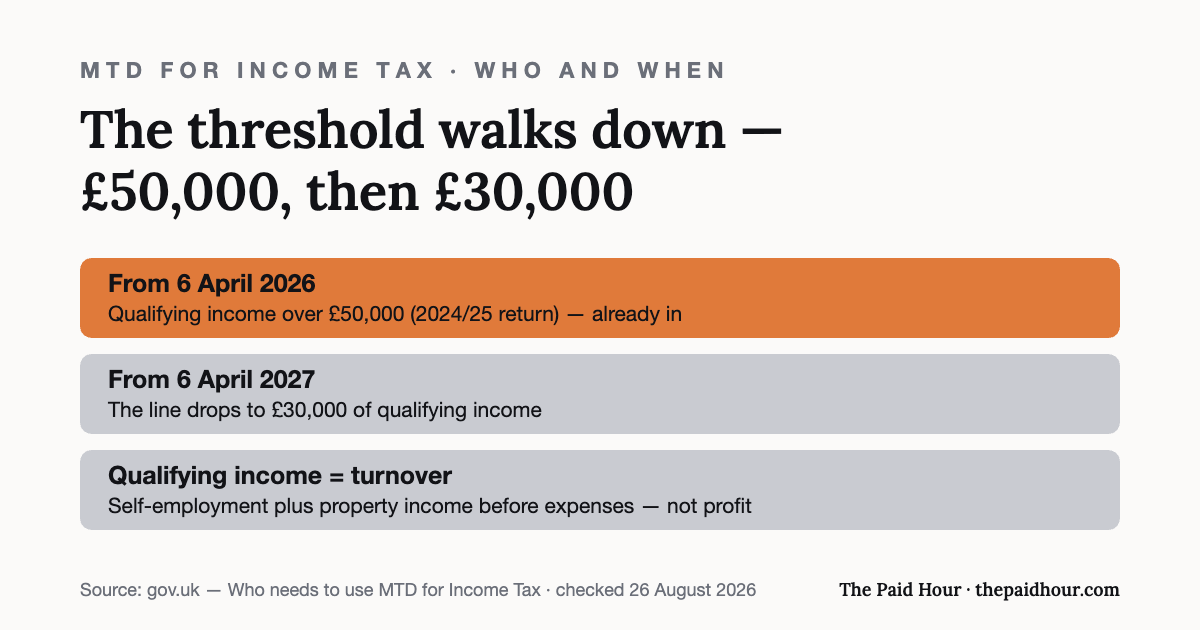
The threshold drops every year. Source: HMRC.
The dates are staggered, and (this is the bit that causes the most mistakes), the year HMRC actually looks at isn’t the year you start:
- Qualifying income over £50,000 in 2024–25, you should already have started, from 6 April 2026.
- Over £30,000 in 2025–26, you start 6 April 2027.
- Over £20,000 in 2026–27, you start 6 April 2028.
Partnerships will be brought into this eventually, but HMRC hasn’t published a date yet.
What counts as “qualifying income”
This is where people trip up, because it isn’t your profit. Qualifying income is worked out from figures on your tax return, and HMRC has a separate page explaining how to calculate it. If you’re anywhere near a threshold, use HMRC’s own checker tool rather than guessing, it’ll tell you whether you’re caught, and from when.
HMRC should have written to you, but don’t count on it
HMRC reviews your Self Assessment return every year and writes to anyone whose qualifying income clears the threshold. That letter’s a courtesy though, not the actual trigger. HMRC is explicit that if nothing arrives, it’s still on you to check whether you need to sign up and to be ready when you do.
So if you comfortably cleared £50,000 in 2024–25 and heard nothing, that’s not a reprieve. Go run the checker.
What doesn’t change
This is the bit that gets lost in the noise. Making Tax Digital doesn’t replace Self Assessment.
- You still file a Self Assessment return every year.
- You still pay what you owe by 31 January.
- Payments on account, if you make them, still fall on 31 January and 31 July.
- You still file a normal Self Assessment return for the tax year before you start using MTD.
Making Tax Digital changes the rhythm of admin through the year rather than the deadline for the money.
What you need to do
- Check whether you’re in, and from when. Use HMRC’s checker, don’t just assume.
- Get compatible software. If you have been putting off the question of whether you need accounting software at all, this is where it gets answered for you. Your current spreadsheet almost certainly won’t do the job. HMRC keeps an approved-software list, and we’ve compared the realistic options for sole traders in our accounting software guide.
- Sign up. You’ll need to already be registered for Self Assessment and to have filed a return in the last two years.
- Authorise the software to talk to HMRC, and double-check your accounting period is set correctly before you file anything.
- Start recording as you go. This is the real behaviour change. Quarterly reporting is easy if the records already exist, miserable if you’re reconstructing three months of receipts the night before.
Can you get out of it?
There are exemptions, being digitally excluded is the main one. Some kick in automatically, some you have to apply for; HMRC lays them out on its exemptions page. Being exempt doesn’t get you out of Self Assessment, though: you still report your income and gains through the usual return.
The honest summary
For most people asking about Making Tax Digital, here’s the honest read: if you’re a sole trader who already uses accounting software and reconciles your bank feed monthly, this is a small change, four button-presses a year. If you do your books in a frantic weekend every January, it’s a genuine change of habit, and that’s the real cost here instead of the software licence.
The threshold drops to £30,000 in 2027 and £20,000 in 2028. If you’re under it right now, you’re not exempt, you’re just next.
Related: what Xero does and whether you need it.
Related: MTD bridging software — the spreadsheet route, and the digital-link rule that decides whether it is compliant.
Running both regimes in your head? MTD for Income Tax vs MTD for VAT sets them side by side.
Common questions about Making Tax Digital
Does Making Tax Digital replace Self Assessment?
No. You still file a Self Assessment return every year, still pay by 31 January, and payments on account still fall on 31 January and 31 July. What changes is the year in between: digital records, and four quarterly updates on top of the return. Making Tax Digital changes the rhythm of the admin, not the deadline for the money.
What is a quarterly update, exactly?
A summary of that quarter’s income and expenses, sent to HMRC straight from the software. Nothing is calculated from it and nothing becomes payable. It is closer to showing your working as you go than to filing four miniature tax returns, which is why the software matters more than the deadline does.
HMRC never wrote to me. Am I out of it?
No. HMRC reviews Self Assessment returns each year and writes to anyone whose qualifying income clears the threshold, but that letter is a courtesy rather than the trigger. If nothing arrived and you comfortably cleared £50,000 in 2024–25, run HMRC’s own checker rather than reading the silence as a reprieve.
I am under the threshold. Does Making Tax Digital still matter?
It matters sooner than it looks. The line drops to £30,000 of qualifying income in 2027 and £20,000 in 2028, and the year HMRC measures sits two years before the year you start. Being under it today means you are next, not that you are exempt.
What happens if I miss a quarterly update?
Nothing, for now. There are no penalties for a missed quarterly update in 2026/27, the points system starts in 2027/28, and the four-point threshold and the charges that follow are set out in what happens if you miss an MTD deadline. The habit still matters more than the penalty: quarterly reporting is painless when the records already exist.
Can I keep using a spreadsheet?
Not on its own. Records have to be kept digitally in software that talks to HMRC, so a spreadsheet you type up in January will not satisfy the rules. The spreadsheet route survives only through bridging software, and that carries its own digital-link condition.
MTD quarters coming and the books are a shoebox?
Digital Bookkeeping System (MTD-ready) 2026/27. Seven modules and a seven-sheet toolkit, built around a category-to-tax-box mapping table that makes your quarterly updates fill themselves.
- A software decision sheet costed over three years, split by turnover, VAT status and phone-or-desktop
- The chart of categories mapped to the Self Assessment and MTD boxes, and the three categories never to auto-categorise
- Weekly and month-end cards, an MTD quarter-close checklist, and an export-and-archive index so their cloud is never your only copy
- Free download: MTD Readiness Checker
Software is priced monthly, excluding VAT, and you will hold the subscription for years. Pick on the wrong number and the difference over three years is more than every course on this site combined.
Buying more than one? All ten 2026/27 courses for £107, against £328 at full price.
Sources
- HMRC. Find out if and when you need to use Making Tax Digital for Income Tax (updated 26 March 2026)
- HMRC, Use Making Tax Digital for Income Tax (updated 16 July 2026)
- HMRC: Self Assessment deadlines
The thresholds and the qualifying-income definition were re-checked against gov.uk on 26 August 2026.
Checked 18 August 2026. This is general information about how the rules work, not tax advice. For your own situation, speak to a qualified accountant.