
Table of Contents
Most business banking comparisons assume you are paid entirely in pounds by UK clients. Wise builds its whole pitch around freelancers who are not. This review checks whether the fee structure and the real exchange rate beat a standard UK business account when a meaningful share of your income arrives in dollars or euros, and covers the thing that rarely leads a Wise review, which is what protects your balance if Wise itself fails.
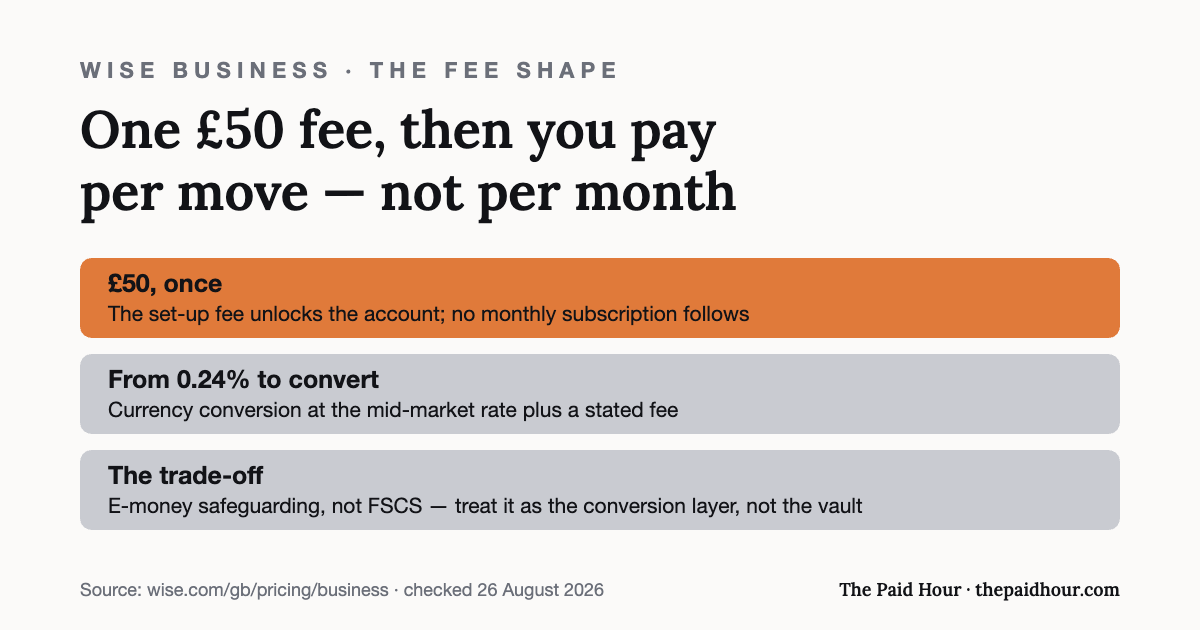
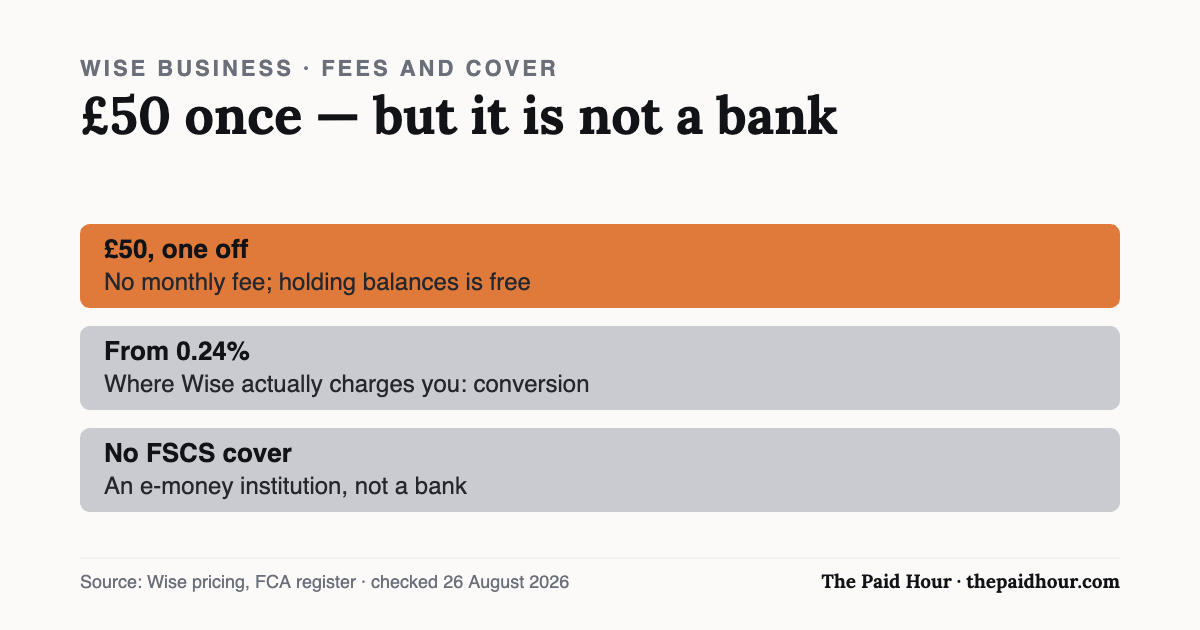
The short version: Wise Business costs £50 once and nothing per month. Holding balances is free, receiving domestic payments in nine currencies is free, and conversion starts at 0.24%. But it is not a bank, Wise Payments Limited is an authorised e-money institution, and your balance is not covered by the FSCS. For international income it is hard to beat on price; as your only account, it leaves you without deposit protection.
What Wise Business costs
Wise Business has an unusually flat fee structure for a UK business account. There is no monthly subscription, and almost everything you pay is tied to a transaction you chose to make.
| What | Wise Business, UK |
|---|---|
| Registering a Wise account | Free |
| One-off Wise Business setup, including local account details | £50 |
| Monthly or annual fee | None |
| Holding a balance in any currency | Free |
| Receiving domestic payments in GBP, EUR, USD and six other currencies | Free |
| Receiving by SWIFT | £2.16, or €2.39 / $6.11 per payment |
| Converting currency | From 0.24%, varies by pair |
| Spending on the Wise card | Free |
| ATM withdrawals | First £250 a month free, then 2.69% on the amount above |
| Topping up an e-wallet | 2% |
Because nothing recurs, the account costs you nothing in a quiet month. That suits irregular or seasonal international income far better than a flat subscription, and it is the single strongest argument for keeping Wise open as a second account even if it is not your main one. Wise also applies a volume discount once you are sending more than £20,000 or the equivalent in a month.
The exchange rate difference that actually matters
Wise’s core claim is that it converts at the mid-market rate and charges the fee separately, rather than burying a markup in the rate itself. That distinction is worth understanding instead of taking on faith, because it is where most of the money moves.
A transfer showing a visible 0.24% fee is not the same product as a transfer advertised as free that carries a two or three per cent spread inside the exchange rate. On £3,000 of monthly invoicing in dollars, the difference between 0.3% and 2.5% is roughly £66 a month. About £790 a year, on income you have already earned. Whether Wise wins for you is arithmetic rather than loyalty: take your last foreign payment, find the rate your current provider gave you, and compare it against the mid-market rate on the same day.
Wise Business is safeguarded, not FSCS protected
This is the part worth reading twice, because it is the real trade-off and it rarely leads a review. Wise is not a bank. Wise Payments Limited is an authorised Electronic Money Institution under the Electronic Money Regulations 2011, and Wise states plainly in its own help centre that its e-money and payment services “are not subject to the Financial Services Compensation Scheme (FSCS)”.
What you get instead is safeguarding. Your money is kept apart from Wise’s own funds and held as a mix of cash at banks, secure liquid assets, mainly government bonds, and a comparable guarantee, spread across institutions including Barclays, Citibank, JPMorgan Chase and Deutsche Bank. Wise does not lend your balance out.
Safeguarding is a genuine protection and it is what the rules require of an e-money firm. What it is not is a statutory compensation scheme. If a bank fails, the FSCS pays eligible depositors up to its limit, usually within days. If an e-money institution fails, your money should be sitting in the safeguarded pool, but getting it back means waiting on an administrator rather than on a compensation scheme. That is the trade, and it is why a lot of freelancers run Wise alongside a bank account instead of instead of one. There is more on the distinction in our guides to e-money accounts versus bank accounts and FSCS protection on business accounts.
Who Wise Business suits
If every client you invoice is in the UK and pays in pounds, Wise Business is solving a problem you do not have. A standard account from our best business bank accounts guide will serve you better, because Wise is not built around everyday UK banking: cash and cheque handling and some Direct Debit arrangements are where it thins out.
If a meaningful share of your invoicing goes out in a currency other than sterling (writers, developers, consultants and designers with international clients are the obvious cases), Wise is worth comparing directly against whatever your current account charges to receive and convert. It is also worth checking against Countingup, which charges a flat 3% on foreign transactions: at any real volume of international income, a fee starting at 0.24% will usually come out considerably cheaper.
What Wise Business isn’t
Wise Business is a payments and holding account, not bookkeeping software. It will not estimate your tax, file anything with HMRC, or keep the digital records that Making Tax Digital for Income Tax requires. If you want those, you are pairing Wise with separate software rather than replacing it — the options are covered in our accounting software comparison.
The honest Wise Business verdict
Wise Business earns its place for one specific reason: transparent exchange rates and low percentage fees on international payments, with no monthly cost sitting underneath. For a freelancer regularly paid in dollars or euros, it is difficult to beat on the numbers.
It is not trying to be your everyday UK business account, and the missing FSCS cover is a real reason not to make it the only place your money sits. Used as the account that receives and converts foreign income, with a bank account behind it for the balance you are not about to spend, it is close to the cheapest sensible setup available. For freelancers with entirely domestic clients, it is not the right first choice at all.
The distinction is worth being precise about: FSCS protection covers deposits held at an authorised bank, up to the published limit. Safeguarded e-money is a different arrangement, the money is held apart from the firm’s own funds, which is not the same promise, and it is worth understanding before a balance sits there for months.
Feast one month, famine the next?
Freelancer Money System 2026/27. Seven modules and five working sheets that pay you a predictable monthly amount out of unpredictable income: the account structure, the percentages, and where every pot should sit.
- A salary set from your trailing twelve-month low, not the average, with the calculator that finds it
- The day-it-lands allocation split, so tax and costs are moved before you can spend them
- The written drought plan for a bad quarter, the FSCS licence checker, and the surplus waterfall for a good year
Normal budgeting assumes a payday. Freelance income does not have one. The fix is not discipline, it is structure, and structure is a one-afternoon job.
Buying more than one? All ten 2026/27 courses for £107, against £328 at full price.
Sources
- Wise. UK Business pricing, fees and limits
- Wise Help Centre, how Wise Payments Ltd safeguards customer funds
- Wise: is Wise a bank, and how it differs from a UK bank
- Countingup, pricing, including the 3% foreign transaction fee
Pricing re-checked against wise.com on 26 August 2026.
Fees and limits checked 24 August 2026 on the providers’ own pages. The FSCS and safeguarding statements are quoted from Wise’s own help centre. Providers change pricing and terms without notice, confirm on Wise’s site before you open an account. This is general information, not financial advice.