
Starling gives sole traders something almost nobody else does: a proper UK bank account, with a banking licence and FSCS protection behind it, for nothing a month. Not an e-money wrapper with a bank’s name on the marketing. An actual bank.
That is the headline, and for most one-person businesses it is also the verdict. But there are two limits worth knowing before you move your money, and one of them will rule Starling out entirely if you take cash.
Disclosure: the link to Starling below is a commercial one and we may earn a commission if you open an account through it. It costs you nothing extra, and it has not shaped the verdict — the cash-deposit limits below are the reason a lot of readers should not open this account, and they are stated as plainly as the good bits. See our affiliate disclosure.
What the Starling business account costs
Nothing. No monthly fee, on both the sole trader account and the limited company account. Starling’s own description is “the fully licensed UK bank account with no monthly fees and 24/7 support.”
Free business banking is not rare any more. Free business banking from a bank holding a full UK licence, rather than an e-money institution, still is, and the difference matters more than the marketing suggests. Our explainer on e-money accounts versus bank accounts covers why.
Your money is FSCS protected to £120,000
Because Starling is a licensed bank, deposits are covered by the Financial Services Compensation Scheme up to £120,000.
E-money providers do not offer this. They safeguard your funds in a segregated account, which is a real protection but a different and slower one if the provider fails. For a sole trader who parks a year’s tax money in a savings space, that distinction stops being theoretical. Our post on FSCS protection on business accounts sets out what is and is not covered.
Who can open one
Starling runs two separate products, and picking the wrong one wastes an application.
Sole trader account. You must be 18 or over, UK-based, not in a partnership, and not registered as a company or LLP. You cannot hold two sole trader accounts for the same business, though Starling allows up to two accounts for genuinely different businesses. You also cannot use it for client money.
Business current account. For companies limited by shares and LLPs registered at Companies House, with UK-resident directors and persons of significant control. Starling states that general partnerships and charities not registered as limited companies are not supported.
Applications go through AML, KYC, fraud and credit checks. Approval is not automatic.
The cash limits are the real constraint
Here is where Starling stops being right for a chunk of its potential customers.
| Sole trader | Limited company | |
|---|---|---|
| Cash deposit fee | £3 or 0.7%, whichever is higher | 0.7%, minimum £3 |
| Daily deposit limit | £5,000 | £5,000 |
| Annual deposit limit | £20,000 | £100,000 |
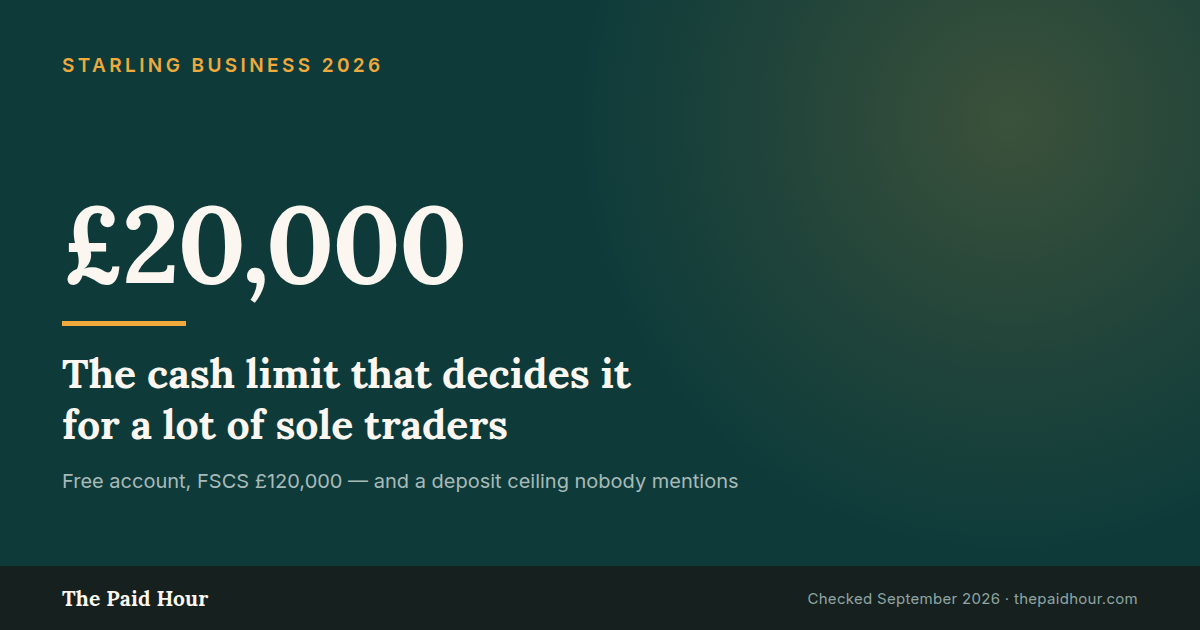
Read the sole trader row again. Twenty thousand pounds of cash a year, and every deposit costs a minimum of £3 regardless of size. Paying in £40 costs you £3 — 7.5% of the deposit.
A mobile hairdresser, a market trader, a driving instructor taking cash from learners — for any of them the annual cap alone can be a hard no. If most of your income arrives by bank transfer or card, none of this touches you.
ATM and card use
Free ATM withdrawals, up to six a day with a £300 total daily limit, in sterling or foreign currency. Starling charges no fees of its own for spending or withdrawing abroad, and sends payments to accounts in 34 countries.
For a freelancer with occasional overseas clients that is decent. For anyone invoicing regularly in euros or dollars, a dedicated multi-currency provider will still beat it on the exchange side.
The features that actually matter day to day
- Spaces. Sub-pots inside the account. The obvious use is dropping a percentage of every payment into a tax space so the January bill is already funded.
- Free invoicing. Built in, no add-on charge. Adequate for straightforward invoices; not a replacement for accounting software.
- Accounting Essentials. Free, and Starling describes it as including an HMRC-recognised Making Tax Digital tool for quarterly updates. If it does what it says, that is a meaningful thing to get bundled at no cost, see our guide to MTD for Income Tax for what quarterly updates involve.
- Business Marketplace. Free integrations with Xero, QuickBooks and FreeAgent, plus services like SumUp and Penfold.
- 24/7 UK support by phone and live chat. Rarer than it should be.
Where Starling is weaker
No branches. Obvious, but worth stating. Everything is app or phone.
Cash-heavy businesses. Covered above. This is the disqualifier.
Account closures. Digital banks have a reputation for freezing or closing accounts with limited explanation when compliance systems flag something. Starling is no worse than its peers here, but a sole trader with one account and no fallback is exposed. Keep a second account somewhere, with anyone.
Verdict
If you are a sole trader paid by bank transfer or card, Starling is close to the obvious answer. Free, licensed, FSCS-protected, with tax pots and free invoicing thrown in, there is not much to argue with.
If you take more than a few thousand pounds a year in cash, the £20,000 annual ceiling and the £3 minimum deposit fee make it the wrong account, and no amount of good app design changes that.
Still deciding whether you need a business account at all? Start with whether sole traders need a business bank account, then the wider comparison of UK business accounts.
What you need to open one
The application is done in the app and the list is short for sole traders: photo ID, a selfie video for identity verification, your UK address, your business details and what the business does.
Have your UTR to hand. You are not always asked for it, but having it saves a round trip. If you have not got one yet, our post on what a UTR number is covers how to get one.
Approval is subject to AML, KYC, fraud and credit checks, so it is not guaranteed and it is not always instant. Do not close an existing account until the new one is open and a test payment has landed.
How it compares to the other free options
Free business banking has become crowded, and the providers differ in ways the pricing pages do not make obvious.
The main dividing line is licensing. Starling and Monzo hold full UK banking licences with FSCS cover. Several popular alternatives are e-money institutions — funds are safeguarded rather than FSCS protected, which is a genuine protection but works differently if the provider fails.
The second is cash. If you handle notes regularly, check the annual cap and the per-deposit minimum on any account before switching. Starling’s £20,000 sole trader ceiling is not unusual, but it is real.
The third is what comes bundled. A free MTD tool and free invoicing genuinely offset software costs for a simple business. For anything more complex you will still want proper accounting software, see our roundup for UK freelancers.
Common questions
Is the Starling business account really free?
There is no monthly account fee on either the sole trader or the limited company account. Cash deposits carry a charge — £3 or 0.7%, whichever is higher, and some add-on services are paid.
Can a sole trader open a Starling business account?
Yes, through Starling’s dedicated sole trader account. The limited company business current account is a separate product and is not open to sole traders.
Is my money safe with Starling?
Starling holds a full UK banking licence, so eligible deposits are protected by the FSCS up to £120,000. That is a stronger position than the safeguarding arrangements used by e-money providers.
How much cash can I pay into a Starling sole trader account?
Up to £5,000 a day and £20,000 a calendar year, with a fee of £3 or 0.7% per deposit, whichever is higher. Limited company accounts have the same daily limit but a £100,000 annual limit.
Does Starling charge for spending abroad?
Starling adds no fees of its own for spending or withdrawing abroad, and supports payments to accounts in 34 countries. ATM withdrawals are limited to six a day totalling £300.
See the Starling business account
Not sold on Starling? Our reviews of Monzo, Mettle and Revolut Business cover the other free options in the same detail.
Want to pay yourself a salary from irregular income?
Freelancer Money System 2026/27. Seven modules and five working sheets that pay you a predictable monthly amount out of unpredictable income: the account structure, the percentages, and where every pot should sit.
- A salary set from your trailing twelve-month low, not the average, with the calculator that finds it
- The day-it-lands allocation split, so tax and costs are moved before you can spend them
- The written drought plan for a bad quarter, the FSCS licence checker, and the surplus waterfall for a good year
Normal budgeting assumes a payday. Freelance income does not have one. The fix is not discipline, it is structure, and structure is a one-afternoon job.
Buying more than one? All ten 2026/27 courses for £107, against £328 at full price.
Sources
- Starling Bank — sole trader account (checked 26 August 2026)
- Starling Bank — business current account (checked 26 August 2026)
This is general information about Starling’s business account, not financial or tax advice. Every price and limit above links to the provider’s own page, with the date it was checked; terms change, so confirm on the live page before you sign up. For your own circumstances, speak to an accountant.