
Straight answer: Work 25 hours or more a month from home and the flat rate is £10, £18 or £26 a month depending on hours, no receipts needed. The alternative is apportioning actual costs, which is more work and sometimes worth it. Under 25 hours, the flat rate is not available at all.
Table of Contents
£10 a month. That’s what most sole traders working 25-50 hours a month from a spare room are entitled to claim, and a lot of them never do, because nobody told them working from home tax relief was this straightforward to get right.
There are two completely different routes to working from home tax relief if you’re self-employed: HMRC’s flat rate, or working out your actual costs and apportioning them. Most freelancers pick whichever route to working from home tax relief they heard about first and stick with it forever, which is a shame, because for a fair number of people the “wrong” one is costing them real money every year.
The two ways to claim working from home tax relief
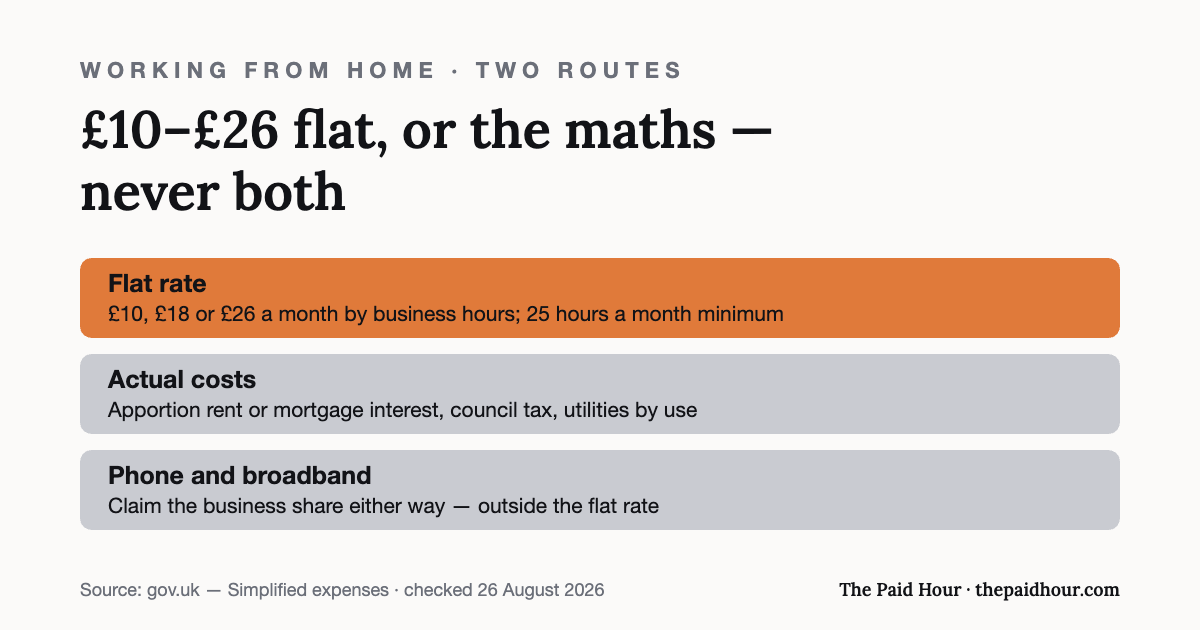
Option one is HMRC’s simplified expenses flat rate, a fixed monthly amount based on how many hours you work from home, no receipts, no calculator. Option two is working out the actual proportion of your household running costs that relates to your business use, which takes more admin but can be worth considerably more if you have a dedicated office space and decent household bills.
You can only use one method per tax year for this specific relief, and you can switch between years if your circumstances change. There’s no obligation to stick with whichever one you picked when you first registered as self-employed. This guide focuses specifically on the home-office side and the actual-costs alternative most people never try, if you also want the current simplified expenses mileage rates for business driving, we’ve covered those separately.
The flat rate: what it actually pays
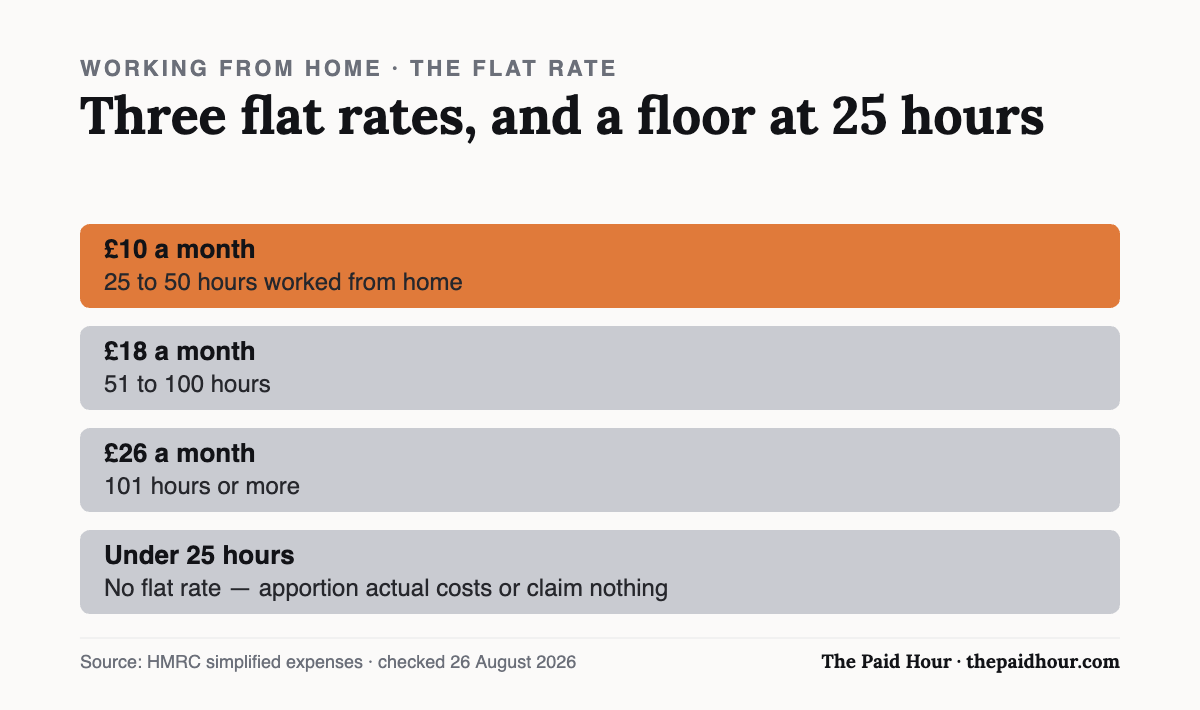
HMRC’s flat rate for working from home tax relief is banded by hours worked per month rather than per week, which confuses a lot of people when they’re estimating. The current rates are confirmed directly on gov.uk’s simplified expenses page:
| Hours worked from home per month | Flat rate you can claim |
|---|---|
| 25 to 50 hours | £10 a month |
| 51 to 100 hours | £18 a month |
| 101 hours or more | £26 a month |
You need at least 25 hours a month working from home to qualify at all. Below that, the flat rate route isn’t available to you and actual costs is your only option if you want to claim anything. The rate can vary month to month depending on how much you worked from home, so a slow August at 30 hours and a busy November at 120 hours are two different figures rather than one annual average.
Multiply it out and the ceiling isn’t huge: £26 a month tops out at £312 a year. That’s the point of the flat rate: it’s designed to be quick and defensible, not to maximise what you claim. If your actual costs would come out meaningfully higher, the flat rate is probably the wrong choice for you.
What the flat rate doesn’t cover
This is where most people go wrong. The flat rate for working from home tax relief specifically excludes telephone and internet costs, you can’t fold your broadband bill into that £18 or £26 a month figure. Instead, you claim the business proportion of your phone and internet bills separately, worked out on their own, alongside whichever flat-rate band you’re using for everything else.
In practice that means most people claiming working from home tax relief through the flat rate are claiming two things every month: the flat-rate figure from the table above, plus a reasonable business percentage of their phone and broadband. Missing the second part is one of the most common ways sole traders under-claim.
The actual costs method, and why it can beat the flat rate
Instead of the flat rate, you can approach working from home tax relief by working out what proportion of your actual household running costs relates to business use and claiming that instead. HMRC’s own internal guidance (BIM47825) accepts a few different ways of doing the apportionment: by number of rooms, by floor area, or by time spent on business use versus everything else, and you’re allowed to apply different methods to different costs if that reflects how the space is used.
The costs you can apportion this way are broader than most people expect: rent or mortgage interest, council tax, buildings and contents insurance, cleaning, and utility bills for heating, lighting and running your equipment. Phone and broadband can be apportioned here too, using the same business-use logic instead of the flat-rate exclusion above.
Note that the list says council tax. Whether working from home can ever bring business rates into it instead is a separate question, and one worth settling before you assume either way.
A simple version: if your home has five rooms and one is used as an office, 20% of the apportionable bills becomes a reasonable starting point. Then you’d typically narrow that further by time if the room isn’t used for business every hour of every day, since a room used for work three days a week isn’t generating business costs the other four.
Two examples that show the difference it makes
Aisha is a freelance copywriter working from a converted box room five days a week, roughly 140 hours a month. On the flat rate, she’d claim £26 a month: £312 for the year. Working it out properly, her flat share comes to a sixth of a six-room flat, and her monthly rent, council tax and utilities add up to around £1,650. A sixth of that is £275 a month, and even scaling it down for the room not being used every waking hour, actual costs comes out well above the flat rate for her. For Aisha, doing the extra sums is clearly worth it.
Tom does his books from the kitchen table three or four evenings a week, maybe 30 hours a month, in a shared house where he only pays a fixed amount toward bills rather than a proportion he can easily isolate. For Tom, untangling actual costs from a shared, informal arrangement would take longer than it’s worth for a modest claim. The flat rate (£10 a month, £120 for the year), is the sensible choice, and working from home tax relief doesn’t need to be complicated to still be worth claiming.
The mortgage and Capital Gains Tax catch nobody mentions
Here’s the one caveat that matters and rarely gets flagged alongside working from home tax relief guides: if you claim mortgage interest as part of an actual-costs claim, and a room in your home is used exclusively for business, not “mostly,” exclusively, with no personal use at all — that can affect Private Residence Relief when you eventually sell the property. HMRC’s own guidance is clear that working from a room which is also used for non-business purposes doesn’t affect this, but a room dedicated solely to the business, all the time, is treated differently for Capital Gains Tax purposes.
In plain terms: keep some personal use in the room, even minimal, if you want to protect the full Capital Gains Tax exemption on your home. Most sole traders working from a spare room that also stores the ironing board, doubles as a guest room, or gets used for anything non-work related are completely unaffected by this. It’s the small minority with a dedicated, business-only office that needs to think about it, and it’s exactly the kind of detail worth raising with an accountant if your situation fits that description, rather than guessing.
Mistakes that cost people money
With working from home tax relief, forgetting phone and internet entirely is the big one on the flat rate side, people assume the £18 or £26 covers everything and leave real money unclaimed. On the actual costs side, the opposite mistake shows up: people apportion the whole bill by room count without adjusting for time, which HMRC can reasonably query if the room clearly isn’t used for business around the clock.
Another one worth naming: switching methods halfway through a tax year and trying to blend both, which just creates a mess when it’s time to fill in your return. Pick one method for the year, apply it consistently, and switch at the start of the next tax year if your circumstances change.
And the quieter mistake: not keeping any record of hours worked from home to support a flat-rate claim, or any record of the room measurements and bill apportionment behind an actual-costs claim. Neither method requires you to submit evidence with your return, but both assume you could produce it if HMRC ever asked.
Keeping records to back up your claim
Neither method requires you to attach evidence to your Self Assessment return, but HMRC can ask you to produce it later, and “I claimed it years ago and can’t quite remember” isn’t a great answer if they do. For self-employed people generally, records need to be kept for at least 5 years after the 31 January submission deadline for the tax year in question, so a 2025/26 return filed by 31 January 2027 means keeping the paperwork until at least the end of January 2032. That applies to whatever backs up your working from home tax relief claim too: hours logged for the flat rate, or bills and room measurements for actual costs.
A simple spreadsheet, or even a dated note on your phone showing roughly how many hours you worked from home each month, is usually enough for the flat rate. For actual costs, keep the bills themselves, or clear photos of them, alongside a note of how you worked out the business proportion at the time, not reconstructed from memory two years later.
If you didn’t claim this in a previous year
Realising you’ve been missing out on working from home tax relief for a year or two isn’t as costly as it first sounds. If you’re still within 12 months of the Self Assessment deadline for that year, you can simply amend the return online and add the claim in. For the 2024/25 tax year, for example, that amendment window runs until 31 January 2027.
Miss that window and the route gets narrower. Generally writing to HMRC to claim overpayment relief, which carries its own separate time limit and isn’t always straightforward for a relatively small home-office claim. In practice, most sole traders are better off treating a missed year as a lesson for the current and future tax years instead of chasing a modest amount from several years back, unless the sums involved are large enough to make the paperwork clearly worth it.
How to actually put this on your Self Assessment return
Whichever method you use, the figure goes into the expenses section of your Self Assessment return alongside your other allowable business costs, there’s no separate box specifically labelled for working from home tax relief. If you’re filling in the full self-employment pages (SA103F) rather than the short version, it typically sits under the general “other allowable business expenses” heading, since HMRC doesn’t provide a dedicated line item for use-of-home costs.
If you’re using accounting software, most UK-focused packages have a specific field or category for this, and it’s worth checking your provider’s own guidance for exactly where it lives in their interface before you submit anything. The number itself, though, is calculated the same way regardless of which software or method you use to file.
Quick answers to the questions people ask
Can I claim working from home tax relief if I also rent an office or co-working desk sometimes? Yes, in principle: the two aren’t mutually exclusive if you split your working hours between home and a separate paid workspace. You’d apportion the home-based hours or costs to reflect only the time spent working from home.
Does it matter if I’m a limited company rather than a sole trader? This guide is specifically about sole traders and the self-employment pages of Self Assessment. Limited company directors claiming use of home as office follow a different mechanism, generally either a flat £6-a-week HMRC-accepted rate paid by the company or a formal rental arrangement between the director and the company, worth checking separately instead of assuming the sole trader rules apply.
What if my hours vary a lot month to month? Track them as they actually happen and apply the correct band for each month rather than guessing an average across the year. A freelancer who works 20 hours in a quiet month and 130 in a busy one isn’t in the same flat-rate band both times, and rounding up the quiet months isn’t something HMRC would support if it were ever queried.
Is it worth switching from flat rate to actual costs partway through building a business? Often, yes. Plenty of sole traders start on the flat rate because it’s simple in year one, then find their household costs and dedicated space have grown enough by year two or three that actual costs would clearly pay more. Worth re-checking the maths annually rather than assuming whatever you picked at the start is still the better option.
What to do before your next return
To settle your working from home tax relief for good, work out roughly how many hours a month you’re genuinely working from home, then run the actual-costs numbers once, rent or mortgage interest, council tax, insurance, utilities, phone and broadband, even if you expect to end up back on the flat rate. It takes half an hour and settles the question properly instead of guessing. If actual costs comes out meaningfully higher, that’s real money left unclaimed every year you don’t switch.
This isn’t personalised tax advice: it’s a description of how the two mechanisms work and what HMRC’s own guidance says about each. If your situation involves a dedicated business-only room, a shared household where bills aren’t easily separated, or anything that touches Capital Gains Tax on your home, it’s worth a proper conversation with an accountant instead of working it out from a general guide alone.
Either way, working from home tax relief is one of the easiest reliefs to under-claim simply by not checking both routes. Pick the method that reflects how you work, keep a basic record behind it, and revisit the choice each year rather than leaving it on autopilot.
If the boxes have outgrown the house, a separate storage unit is claimed at its actual cost on top of the flat rate: see business storage: what it costs and what you can claim.
If you later form a limited company, the home you claim for will not do as its registered office without becoming public. Registered office address: what it costs and who needs one explains the alternatives and the fees.
Filing it yourself this year?
HMRC Tax & Expense Mastery 2026/27. Nine modules and eleven working templates that take a UK freelancer from “do I even need to register” to a correct return, with MTD quarters built in.
- Fifteen expense categories, with the trap inside each one (training, clothing, meals, the seven-year pre-trading rule)
- Home and vehicle: flat rate against actual cost, with the £312 break-even worked out and the mileage lock-in rule
- The year-one payments-on-account cash shock, and the routine that stops it landing twice
HMRC does not send a list of what you forgot to claim. Most freelancers leave several hundred pounds of legitimate expenses on the table every single year, and the return still gets filed.
Buying more than one? The Complete Freelancer System, all five for £87, against £215 at full price.
Need this ready-made? → UK Sole Trader Expense Tracker (Excel) — HMRC expense categories pre-built (£5.99, instant download)
Sources
- gov.uk, Simplified expenses: working from home
- HMRC Business Income Manual. BIM47825 (use of home)
- HMRC helpsheet HS283, Private Residence Relief
The £10/£18/£26 monthly flat rates and the 25-hour condition were re-checked against gov.uk on 26 August 2026. This is general information about how the rules work, not tax advice. The links above go to the primary sources; for your own circumstances, speak to an accountant or contact HMRC directly.