
Straight answer: A partnership is not one registration, it is two, the business itself, done once by the nominated partner, and then every partner separately as an individual. The deadline is worded differently from everybody else’s: 5 October in the business’s second tax year rather than the first. And the part that turns an admin slip into real money is this, if the partnership return is late, HMRC charges the penalty to every partner, not just the one who was supposed to file it. Three people, one missed return, three £100 penalties on day one.
Two freelancers agreeing to work together is, in tax terms, a partnership from the moment the work starts. No paperwork creates it and none is needed to make it real. What the paperwork does is tell HMRC it exists, and partnerships are the one structure where getting that wrong charges everybody, including the partner who did everything right.
If you are still deciding whether a partnership is the right shape at all, sole trader vs limited company covers the alternatives. This guide assumes the decision is made and the clock is running.
Two registrations rather than one
The single most common partnership mistake is registering once and thinking it is done. HMRC needs two separate things:
- The partnership: registered once, by the nominated partner, using the online service or form SA400.
- Each partner: registered individually, using form SA401 (or SA402 where the partner is a company or a trust).
GOV.UK leaves no room for interpretation on the second one: “The other partners need to register separately”, and “All partners also need to send their own tax returns as individuals.” Registering the business does not register the people in it.
What a nominated partner signs up for
One partner has to be nominated, and GOV.UK defines the job in a sentence: being the nominated partner “means you’re responsible for sending the partnership tax return”. It is not a seniority thing or an ownership share. It is a filing duty.
That duty has a knock-on the guidance spells out: the nominated partner should complete the partnership return “as soon as possible, so the other partners are able to use this information to complete their individual Self Assessment tax return”. The partnership return produces each partner’s share of the profit. Until it exists, nobody else can finish their own return. In practice that means the nominated partner’s deadline is not January, it is whenever the other two need their numbers.
Choose the person who will do it, and write down who it is. Our contract checklist covers the wider paperwork worth agreeing while everyone still likes each other.
The deadline nobody reads twice: your second tax year
Every other Self Assessment deadline is expressed as 5 October following the tax year the income arose. The partnership one is not. GOV.UK:
“You must register by 5 October in your business’s second tax year, or you could be charged a penalty.”
Work it through with dates. A partnership that starts trading in, say, November 2025 is in the 2025/26 tax year, its first. Its second tax year begins on 6 April 2026. So the registration deadline for that partnership is 5 October 2026. A partnership that started in June 2026 sits in 2026/27, its second year starts 6 April 2027, and its deadline is 5 October 2027.
The trap is that the two readings collide in exactly the season people are panicking. If your partnership has been going since some point before 6 April 2026 and you have not registered it, the date on the calendar is next month. Each individual partner is on the ordinary 5 October rule for their own registration, the four registration routes are set out in which Self Assessment registration form you need.
How the registrations are actually done
The partnership (SA400). Online through the partnership registration service, or on paper. The guidance is direct: “the nominated partner must complete the form”. To register online you need a Government Gateway user ID and password, plus either a UTR or a VAT reference number for the business.
Each individual partner (SA401). This registers a person for Self Assessment and Class 2 National Insurance in one move, GOV.UK: “Register for Self Assessment and Class 2 National Insurance when you’ve joined a partnership using form SA401.” Have your National Insurance number, your UTR if you have one, the date your self-employment started, the date you joined the partnership, and the partnership’s details including its Company Registration Number if it has one.
Then the restriction that catches a lot of people, quoted from the same page: “Only the nominated partner can register online. If you’re not the nominated partner and are joining a partnership, you must register by post.” Everyone except the nominated partner is on postal timescales. If you are reading this in late September, that is the sentence to act on today.
A partner that is not a person (SA402). Where a company or a trust is a partner, it registers on SA402: “register a new partner who is not an individual for Self Assessment, for example a company or trust”.
The penalty every partner pays
Here is the part that makes partnership filing different in kind, not just in paperwork. GOV.UK’s penalties page says it in seven words:
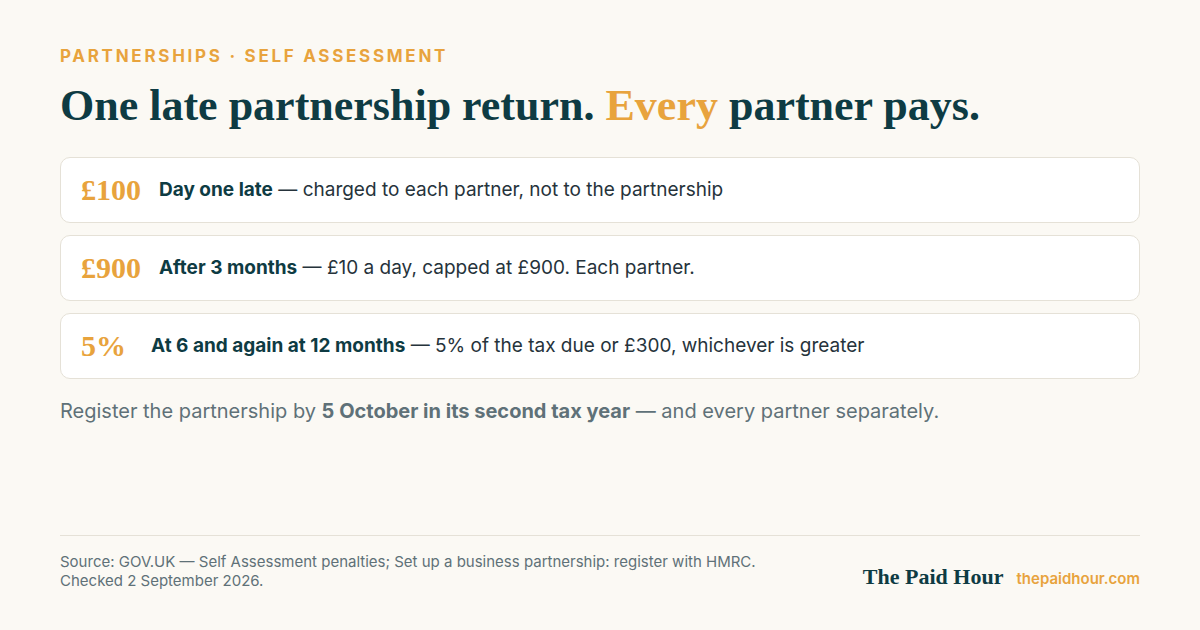
“All partners will be charged a penalty if a partnership tax return is late.”
And the partnership guidance repeats it from the other direction: “If you send the partnership return late, each individual in the partnership will have to pay a penalty.”
The late-filing ladder HMRC publishes is the familiar one, but read it as a per-partner cost:
- Day one late: £100
- After 3 months: £10 a day, up to a maximum of £900
- After 6 months: a further 5% of the tax due or £300, whichever is greater
- After 12 months: another 5% or £300, whichever is greater
A three-person partnership that files its partnership return a day late is £300 down before anyone has discussed it. Six months late and the daily penalties alone have reached £900 each: £2,700 across the three, for one form that one person was supposed to send. Nobody can opt out by having filed their own return on time. That is the reason the nominated partner role should never be handed to whoever objected least.
Individual late filing works the same way for each partner’s own return, and late filing penalties covers that separately.
What gets filed, and when
The partnership files the SA800 Partnership Tax Return. It reports the partnership’s income and divides the profit between the partners. It does not pay any tax — a partnership is transparent for tax, so each partner pays income tax and National Insurance on their share through their own return.
So a normal year looks like this:
- The nominated partner files the SA800 for the partnership
- Each partner takes their profit share from it into their own SA100 return
- Each partner pays their own tax and National Insurance by 31 January
Paper returns are due by 11:59pm on 31 October 2026; online returns and the payment by 11:59pm on 31 January 2027. Because the SA800 has to come first, the practical deadline for the partnership return is weeks earlier than January if the other partners are going to file on time.
The other registration that sneaks up: VAT
A partnership is a single taxable person for VAT, so it is the partnership’s turnover that counts, not each partner’s share. GOV.UK: you must register for VAT “if your VAT taxable turnover is more than £90,000”. Two freelancers who were each comfortably under the threshold alone can cross it the month they start invoicing jointly. The £90,000 VAT threshold explains how the rolling twelve-month test works, and how to register for VAT covers the gap before your number arrives.
If you are already late
Register anyway, today, and register everything, the partnership and every partner. Late registration does not create an instant fine; what it does is move your filing date. HMRC will send a letter or email with a new deadline “3 months from the date on the letter or email”, but the payment date does not move: “You must still pay the tax you owe by 11:59pm on 31 January 2027 or you’ll get a penalty.”
The separate failure-to-notify penalty is calculated from tax left unpaid at 31 January, which is why registering late but paying on time usually comes to very little, the mechanics are in the penalty for registering late. If the problem is the money instead of the paperwork, Time to Pay is the arrangement to ask for before the deadline rather than after.
A five-minute checklist
- Agree, in writing, who the nominated partner is
- Nominated partner registers the partnership (online or SA400)
- Every partner registers individually: SA401 by post unless you are the nominated partner
- Diary the SA800 well before January, because the others cannot file until it exists
- Watch combined turnover against the £90,000 VAT threshold as one business rather than three
- Keep the profit-sharing agreement with the records. HMRC judges the split by the facts
Sources
- Set up a business partnership: register with HMRC, GOV.UK
- Register a partnership for Self Assessment (SA400): GOV.UK
- Register a partner for Self Assessment and Class 2 National Insurance (SA401), GOV.UK
- Register a partner who is not an individual (SA402). GOV.UK
- Partnership Tax Return (SA800), GOV.UK
- Self Assessment tax returns: penalties: GOV.UK
- Self Assessment tax returns: deadlines — GOV.UK
The nominated partner’s duty, the “register separately” and “own tax returns as individuals” requirements, the second-tax-year deadline, the SA400 and SA401 routes and the online-registration restriction, the SA402 definition, the £90,000 VAT threshold, the late-filing penalty ladder and the sentence charging every partner for a late partnership return are all quoted from the GOV.UK pages listed above, read and checked on 2 September 2026. This is general information about how the rules work, not tax advice; for your own circumstances speak to an accountant or contact HMRC.
Running a business with other people? → First Hire & Subcontracting covers who owes what when the work is shared.
Related guides
- Which Self Assessment registration route you need
- Self Assessment deadlines
- Self Assessment late filing penalties
- The £90,000 VAT registration threshold
- Sole trader vs limited company
Do you actually owe HMRC anything yet?
Side Hustle Tax Starter 2026/27. A six-module starter course and six working templates that tell you, in an evening, whether you owe anything at all, and set up the twenty-minute monthly routine that keeps it that way.
- The nine badges of trade as questions you can answer about your own income
- What the platforms send HMRC, the small-seller exemption, and three reply letters for when a letter arrives
- A sales log with a running £1,000 alert, an allowance-versus-expenses sheet, and a tax set-aside calculator at 2026/27 rates
Selling platforms now hand your sales data to HMRC once a year. Selling your own old possessions is never taxable. Buying to resell, making things, or freelancing is. Knowing which side you are on is the whole question.
Buying more than one? All ten 2026/27 courses for £107, against £328 at full price.