
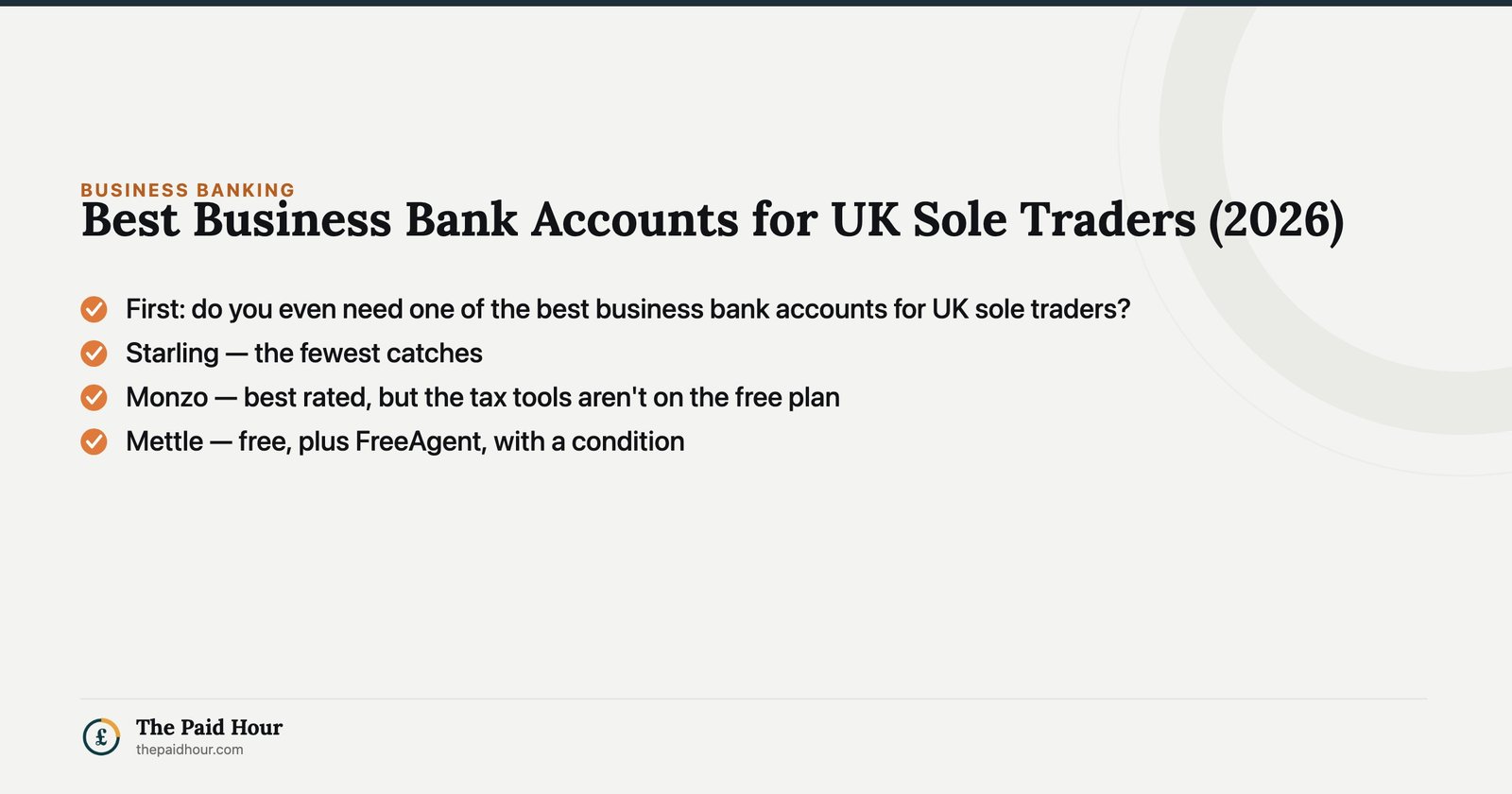
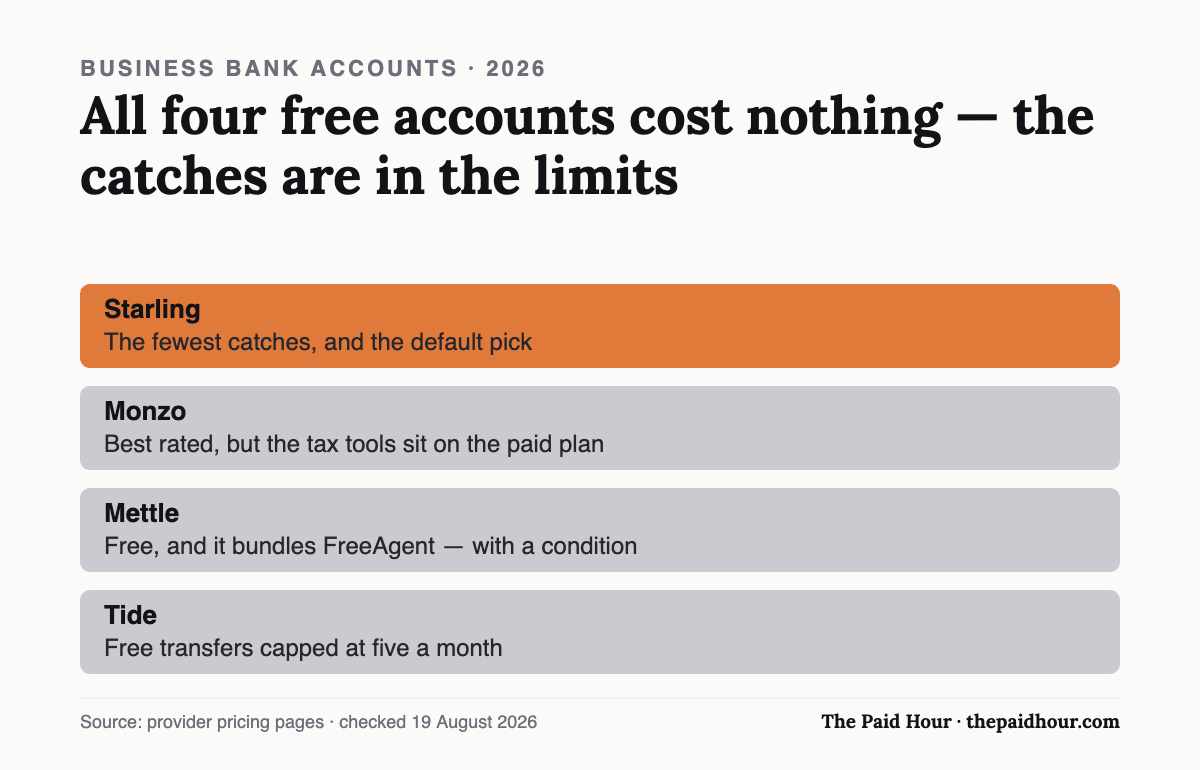
The short version: All four leading free accounts (Starling, Monzo, Mettle and Tide), cost nothing monthly; the differences are in the limits and the tools. Starling has the fewest catches and is the default pick. Monzo’s tax tools sit on the paid plan, Mettle bundles FreeAgent with a condition, and Tide caps free transfers at five a month.
The best business bank accounts for UK sole traders right now are free ones from Starling, Monzo, Mettle and Tide: the real differences are in service quality and transfer limits rather than price.
In short. As a sole trader you’re not legally required to hold a business bank account — HMRC asks you to keep records, not to open a second account. If you want one anyway: Starling is the safest default at no monthly cost, with a free HMRC-recognised Making Tax Digital tool built in. Mettle’s better if you want FreeAgent included. Monzo Lite is free, but the tax features Monzo markets sit on the £9 Pro plan. Tide has a free plan that allows five bank transfers a month.
Disclosure. Some links here are affiliate links and we may get paid if you sign up. Three of the four accounts below cost nothing, and the one we land on is one of the free ones. See our affiliate disclosure.
Every comparison of the best business bank accounts for UK sole traders opens the same way: a table of monthly fees, three of which are zero. That table tells you almost nothing, because the interesting part of a free business account isn’t the price, it’s what the free plan quietly stops you from doing.
First: do you even need a business bank account?
HMRC’s requirement for sole traders is about records rather than accounts. Business records if you are self-employed says you must keep records of your business income and expenses for your Self Assessment tax return. It doesn’t say those transactions have to sit in a separate account.
The confusion comes from limited companies, which do need their own account, because a company is a separate legal entity and its money isn’t your money. A sole trader has no such separation, legally, the business is you.
So this is a practical decision, not a compliance one. Even so, the practical case gets stronger as Making Tax Digital for Income Tax phases in, since you’ll be keeping digital records and sending quarterly updates. Untangling four years of business costs from a personal account you also buy groceries on is the kind of job that eats an evening every quarter.
Starling — the fewest catches
Starling’s sole trader account has no monthly fee and, unusually, no paid tier being dangled in front of you. It’s a fully licensed UK bank, so eligible deposits are covered by the Financial Services Compensation Scheme up to £120,000.
What you get free that others charge for: invoicing, Spaces for setting tax money aside, and an HMRC-recognised Making Tax Digital for Income Tax tool that submits quarterly updates from inside the account. Connections to Xero, QuickBooks and FreeAgent are free too.
The catch is cash. Deposits cost £3 or 0.7%, whichever is higher, and that minimum matters more than the percentage: paying in £50 of cash costs £3, which is 6% instead of 0.7%. Deposits are capped at £5,000 a day and £20,000 a calendar year. If a meaningful share of your income arrives as notes, this is the wrong account for you.
Optional extras are honestly priced: Bulk Payments is £7 a month, and a euro account is £2 a month.
Monzo — best rated, but the tax tools aren’t on the free plan
Monzo came top of the CMA’s August 2026 service quality survey at 85%, and it’s a fully regulated UK bank with the same £120,000 FSCS cover. The free Lite plan includes free instant UK transfers, cash and cheque deposits, and Making Tax Digital software.
The catch is where the line falls. Tax Pots, the feature that automatically sets a percentage of every payment aside for tax, and the reason most sole traders look at Monzo in the first place, isn’t on Lite. Neither is invoicing, nor the accounting integrations with Xero, FreeAgent, Sage and QuickBooks. All three sit on Pro at £9 a month, or £108 a year.
That’s not a bad price for what it does. It’s just not free, and Monzo’s own comparison table is about the only place that makes it obvious.
Mettle — free, plus FreeAgent, with a condition
Mettle is provided by National Westminster Bank plc, so it’s a bank account with full FSCS cover, and it scored 82% in the same survey. The account’s free and includes FreeAgent, which Mettle says is worth at least £150 a year.
The condition is easy to miss: Mettle states that to keep FreeAgent included, you have to make at least one transaction a month from your Mettle account. Skip that, or close the Mettle account and carry on using FreeAgent, and FreeAgent’s normal fees apply. So it works if Mettle is your main account, and quietly stops working if it becomes a dormant second one.
Eligibility is narrower than the others: sole traders and limited companies with up to two owners, one account per person, and a balance limit of £1 million. If FreeAgent’s the draw, our comparison of FreeAgent and Xero for sole traders goes through what you’re getting.
Tide — read the transfer limit before you sign up
Tide’s the one most often listed as simply free. On Tide’s own pricing page, the free plan allows five bank transfers a month. Not five hundred, and not unlimited. Invoicing is capped at three a month, and international card payments carry a 2.75% FX fee.
Thirty transfers a month costs £12.49 on the Smart plan. Unlimited transfers start at £27.49 on Pro. For a freelancer paying a handful of suppliers, a subscription or two, and themselves, five is a limit you’ll hit in the first fortnight.
Tide also scored lowest of the four in the CMA survey, at 69%, and it’s worth being precise about what Tide is: Tide states that it isn’t a bank. It’s an electronic money institution, and its business current accounts are powered by ClearBank, which is where the FSCS cover comes from. Some members instead hold e-money accounts provided by PrePay Technologies, which are safeguarded rather than FSCS-protected. Mettle discloses the same split for its own e-money account. Neither’s hidden, but neither’s on the marketing page either, check which one you’ve actually been given.
Business bank account service quality, side by side
The one independent number here is the CMA’s service quality survey, published every February and August. It asks roughly 1,200 customers of each of the largest providers whether they’d recommend them to another business.
The top three are within three points of each other, which is well inside the range where personal preference matters more than the ranking. The gap down to Tide is the part worth noticing.
So, which business bank account wins?
Out of the best business bank accounts for UK sole traders covered here, Starling comes closest to a default recommendation if you don’t have a specific reason to pick another.
Picking one is not a decision you are stuck with either. Moving a business account to another bank is a more ordinary process than most people expect, and it is worth knowing what it involves before the choice starts to feel permanent.
- Most sole traders: Starling. Free, a real bank, free Making Tax Digital software, and no upgrade path being dangled at you.
- If you take cash: not Starling. The £3 minimum per deposit makes small takings expensive. Monzo Lite handles cash and cheques on the free plan.
- If you want FreeAgent: Mettle, provided it’ll be your main account and you’ll transact from it monthly.
- If you want automatic tax set-aside: Monzo Pro at £9 a month. Budget £108 a year and stop pretending it’s the free plan.
- Tide’s free plan: only if you make fewer than five payments a month. Otherwise price it at £12.49, and it stops being the cheap option.
Where to open a business bank account
Starling
Free, a real bank, and free HMRC-recognised Making Tax Digital software built in. Skip it if you take much cash, deposits cost a minimum of £3.
Visit StarlingMettle
Free, and FreeAgent comes with it — provided Mettle is your main account and you transact from it every month.
Visit MettleMonzo
Monzo Lite is free and handles cash and cheques. The tax tools Monzo advertises sit on the £9 Pro plan, which is £108 a year.
Visit MonzoTide
The free plan allows five bank transfers a month. Past that you’re on £12.49, and it stops being the cheap option.
Visit TideWhat this business bank account comparison is based on
This comparison of the best business bank accounts for UK sole traders is built from each provider’s published pricing and terms and from the CMA’s August 2026 survey, all checked on 19 August 2026. It’s not based on holding all four accounts. Where a limit’s stated above, it’s because the provider states it: the links go to the page it appears on so you can check it yourself before applying.
Fees and plan limits on accounts like these change often. Reading this some months from now? Check the pricing pages below before you decide.
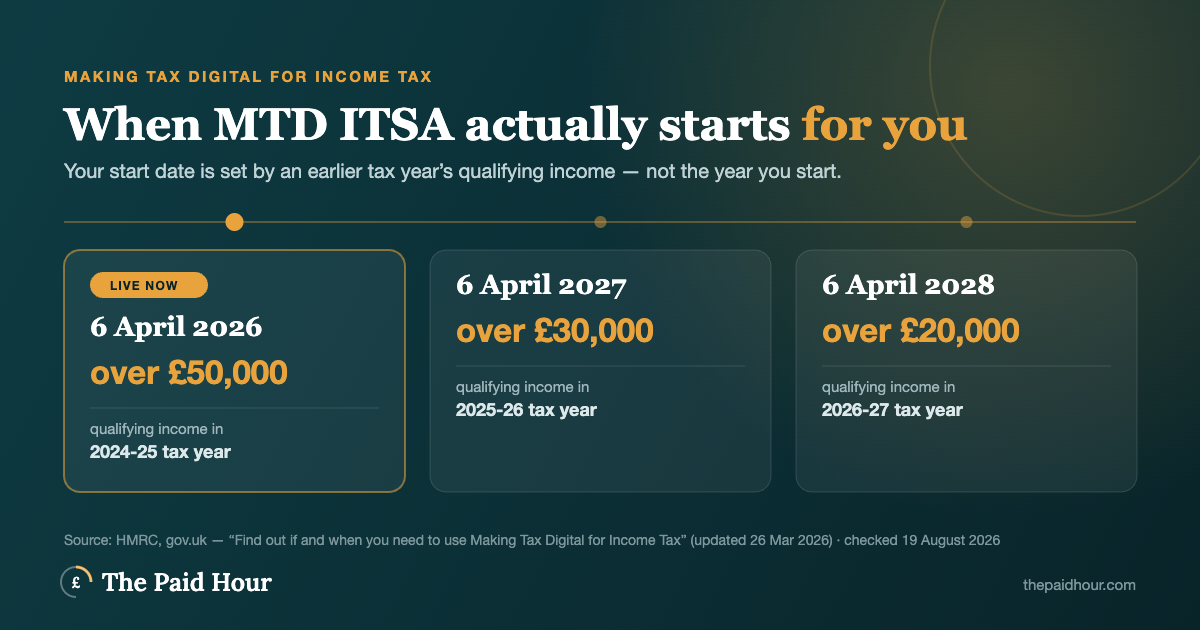
Your MTD ITSA start date is decided by an earlier tax year’s qualifying income. Source: HMRC, checked 19 August 2026.
Want the detail behind each verdict? Read the full reviews: Starling, Monzo, Mettle, Tide and Revolut Business.
Want to pay yourself a salary from irregular income?
Freelancer Money System 2026/27. Seven modules and five working sheets that pay you a predictable monthly amount out of unpredictable income: the account structure, the percentages, and where every pot should sit.
- A salary set from your trailing twelve-month low, not the average, with the calculator that finds it
- The day-it-lands allocation split, so tax and costs are moved before you can spend them
- The written drought plan for a bad quarter, the FSCS licence checker, and the surplus waterfall for a good year
Normal budgeting assumes a payday. Freelance income does not have one. The fix is not discipline, it is structure, and structure is a one-afternoon job.
Buying more than one? All ten 2026/27 courses for £107, against £328 at full price.
Sources
- HMRC, Business records if you are self-employed
- Starling. Sole trader bank account
- Monzo, Business banking plans and pricing
- Mettle by NatWest
- Tide: Plans and pricing
- CMA independent service quality survey, Great Britain, published August 2026
Prices, plan limits and survey figures checked against each provider’s own pages on 19 August 2026. This is general information, not financial or tax advice, which account suits you depends on your circumstances.