
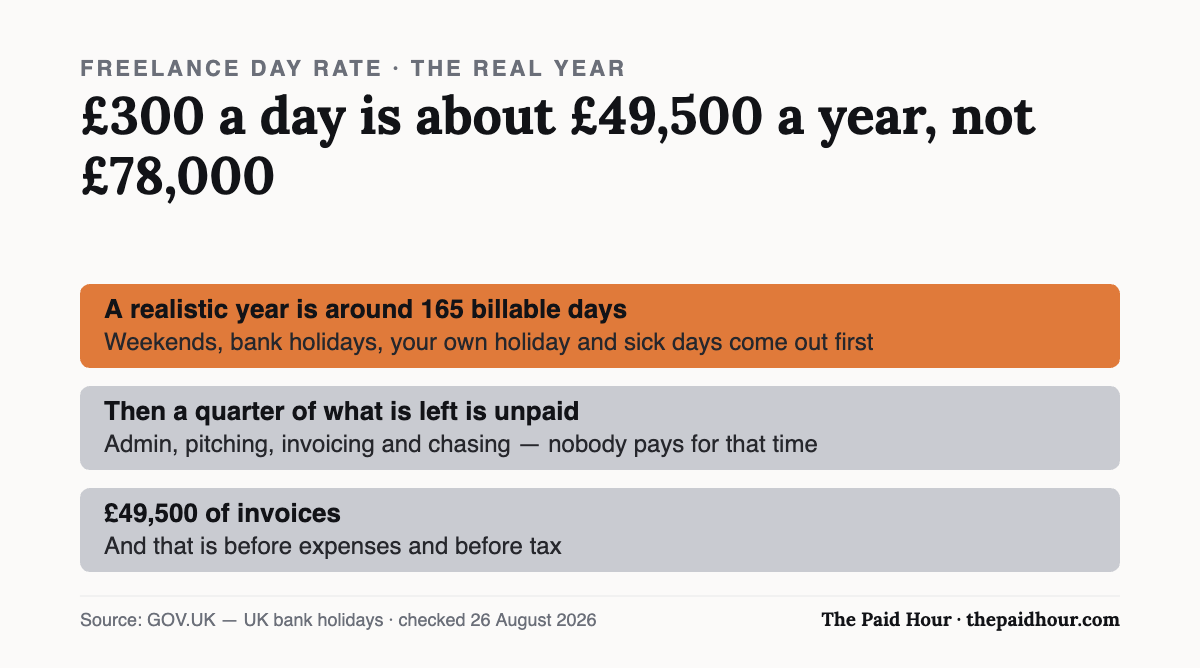
Before you read on: Here’s how to set freelance day rate figures that cover your bills, not just your billable hours. A £300 day rate is not £78,000 a year. Once you take out weekends, bank holidays, your own holiday, sick days and the quarter of your time nobody pays for, a realistic year is around 165 billable days, about £49,500 of invoices, before expenses and before tax.
Almost every freelancer sets their first rate the same way: take the salary they want, divide by something like 250 working days, and there’s the number. It feels rigorous. It’s also how people end up working flat out for a year and wondering where the money went. Knowing how to set freelance day rate figures properly means starting from what you need rather than backing into a number from a salary you used to earn.
The problem isn’t the arithmetic. It’s the number of days going into it. Knowing how to set freelance day rate correctly starts with counting the days you can actually bill.
Where the year goes
Start at 365 and take away what you can’t invoice for.
Work down from 365:
- 365 days in the year.
- Take off 104 weekend days and you’re at 261.
- Take off eight bank holidays in England and Wales (Scotland and Northern Ireland differ) and you’re at 253.
- Take 25 days of holiday: five weeks, roughly what most employees get, and you’re at 228.
- Allow five days for illness or things going wrong. You’re at 223.
So far this is just the calendar. The part that is easy to miss is the next line.
The quarter nobody pays for
Even on days you’re technically “working”, a large share of the time isn’t billable. Finding the next client. Writing proposals that go nowhere. Invoicing. Chasing invoices. Bookkeeping. Your own website. Learning whatever the next job needs. Calls that turn into nothing.
For an established freelancer with steady repeat clients this can be as low as 15%. For someone still building a pipeline it’s often 35% or more. A quarter is a fair middle estimate, and it takes 223 days down to roughly 165.
That’s the number to divide by. Not 250.
What that does to the day rate you quote
Turnover before expenses and tax. Swap in your own billable-day count.
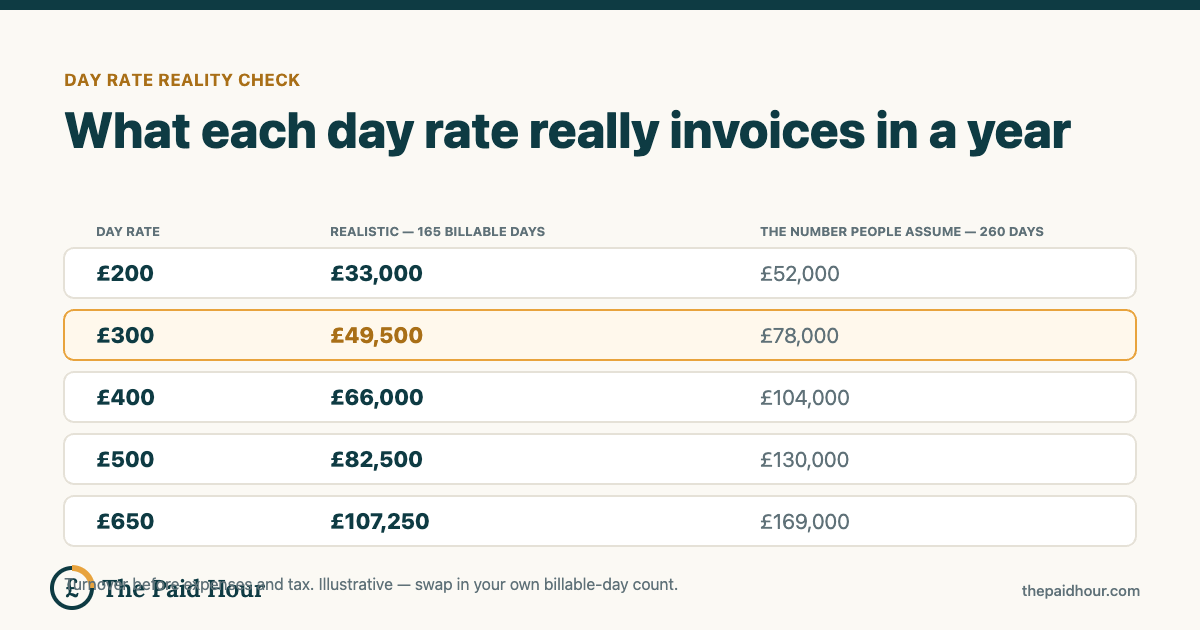
The figure people quote in pubs is the one based on 250 days. The one that actually turns up in your bank account is based on something closer to 165.
And even that smaller number is still turnover rather than income. Out of it come your costs, software, insurance, equipment, accountant, phone, the business share of your home, and then Income Tax and National Insurance on what’s left. Our guide to allowable expenses covers what you can take off, and payments on account explains why the first January bill is bigger than you’d think.
Setting a day rate: working backwards from what you need
A more honest way to set a rate is to start from the bottom and work up.
The method runs backwards from the take-home you need: add the tax on top, add your business costs, and divide the total by your realistic billable days, not the 250 in the calendar. Done properly it almost always lands higher than the number people first guess, which is exactly why guessing is expensive. The Freelance Ops Playbook includes the rate-floor calculator that does this line by line for your own numbers, plus what to do when a client pushes back.
If that number frightens you, the useful response isn’t to lower it. It’s to notice that the £250 you were about to charge would’ve left you short by about £13,000 a year, and you’d only have found out in month eleven.
Day rate or hourly?
Day rates suit work measured in days. Consultancy, development sprints, design projects, anything where you’re blocking out time. Hourly suits short, interruptible tasks and ongoing support.
There is a third way to quote, and it moves the risk instead of the number: a fixed price for the whole job. On a day rate the client pays for the overrun. On a fixed price you do.
If you quote hourly, watch the arithmetic. A day rate divided by eight assumes eight billable hours in a day, and almost nobody has eight billable hours in a day. Six is more realistic, which makes £350 a day about £58 an hour rather than £44.
Whichever you use, quote the same way every time. Switching between hourly and daily mid-negotiation makes it look like you’re guessing, and invites the client to pick whichever’s cheaper.
Should you raise your rate?
Three signals that you’re under-priced:
- Nobody ever pushes back. If every client says yes immediately, you’re leaving money on the table. A healthy rate loses you some work.
- You’re fully booked months ahead. Demand outstripping supply is the textbook signal to raise the price.
- The work has changed but the number hasn’t. If you’re doing more senior work than when you set the rate, the rate’s gone stale.
The mechanics matter less than people think. Tell existing clients in writing, give reasonable notice, a month or two, and apply the new rate to new work rather than retrospectively. Most clients accept it. The ones who leave over a 10% rise were usually going to be difficult about something else anyway.
The mistakes that cost the most
- Dividing by 250. The single most expensive error in freelance pricing.
- Forgetting you get no holiday pay, no sick pay and no employer pension contribution. Your rate has to buy all three.
- Quoting a rate before you understand the scope. Ask what “done” looks like first.
- Discounting for a promise of future work. The future work rarely arrives, and the discount becomes your new rate with that client.
- Never reviewing it. A rate set three years ago is a pay cut in real terms.
One thing this article can’t tell you
What the market pays for your specific skill, in your specific city, at your specific level. That comes from asking: other freelancers in your field, recruiters who place contractors, and the rates quoted on job adverts for equivalent work. The arithmetic here tells you what you need. The market tells you what you can get. Set your rate where those two meet.
Once the rate’s agreed, get it into a contract and onto an invoice properly, see what a UK invoice must legally include, and what you can charge when they pay late.
Two related calls once the number is set: day rate or fixed price per project, and (for contractors), where IR35 changes the arithmetic.
Still writing every document from scratch?
Freelance Ops Playbook. Ten modules and eighteen templates: the rate floor calculation, a pipeline that rejects bad clients early, the twelve-clause contract, onboarding, change orders and a Friday rhythm that holds it together.
- The rate floor calculator, which most people find puts their current rate below cost
- The twelve-clause contract, including the revisions sentence that quietly earns more than any other
- Enquiry log with live pipeline value, thirteen-week cash forecast, three-option proposal, change order, welcome pack
- Free download: Client Onboarding Checklist
One under-scoped project, or one client who “just needs a couple more rounds”, costs more than this playbook several times over. The templates exist so that never happens again.
Buying more than one? The Complete Freelancer System, all five for £87, against £215 at full price.
Sources
- GOV.UK: UK bank holidays
- GOV.UK — Estimate your Self Assessment tax bill
- GOV.UK, Expenses if you’re self-employed
The day counts and rate calculations here are arithmetic based on stated assumptions, change the assumptions and the answers change. Bank holiday counts checked against GOV.UK on 19 August 2026. General information, not financial or tax advice.