

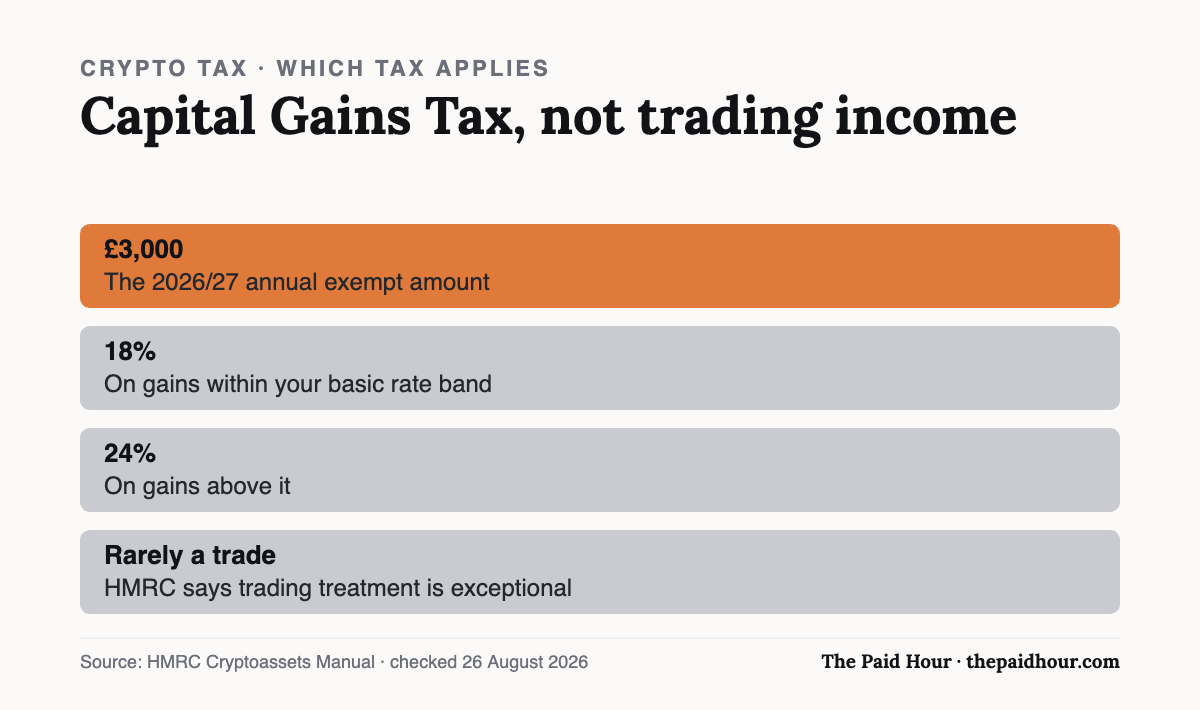
The short version: For almost every UK sole trader, crypto is Capital Gains Tax rather than trading income, HMRC says only in exceptional circumstances would buying and selling tokens amount to a financial trade. The 2026/27 annual exempt amount is £3,000, and gains above it are taxed at 18% within your basic rate band and 24% above it. Being paid in crypto for freelance work is different again: that is trading income at its sterling value on the day, and any later movement in value is a separate CGT event. From 1 January 2026 UK exchanges collect your details and report them to HMRC.
HMRC doesn’t currently see most of what happens in your crypto wallet. That changes from January 2026, when UK exchanges start collecting your details and handing them over automatically. If you’ve been treating crypto as a separate, slightly private corner of your finances, this is the year that stops working.
For sole traders the confusion isn’t really about rates. It’s about which tax applies at all. Crypto tax UK rules split your activity into two completely different regimes. Capital Gains Tax for most people, Income Tax for a smaller group who cross into trading, and getting the split wrong is the single most common mistake HMRC’s own guidance tries to head off. This one matters more than most: get the category wrong and you could be paying the wrong tax entirely, not just the wrong amount.
The question crypto tax turns on
Start here, because everything else depends on the answer: are you investing, or are you running a trade?
Most people assume that buying and selling crypto regularly, or calling themselves a “trader,” tips them into business income. HMRC disagrees, quite firmly. Its Cryptoassets Manual states that only in exceptional circumstances would an individual buy and sell tokens with enough frequency, organisation and sophistication for the activity to count as a financial trade. Using the word “trading” to describe what you do isn’t enough on its own, HMRC applies the same badges-of-trade test used for shares, built on decades of case law: how often you transact, how organised the operation is, whether you’re taking on risk in a business-like way, and whether there’s real commercial structure behind it.
In practice, this means the overwhelming majority of sole traders who happen to also hold or trade crypto are doing so as investors, for tax purposes, even if it doesn’t feel that way day to day. That has a real consequence: your crypto gains and your self-employment income are assessed completely separately. A bad year in your freelance business doesn’t offset a good year in crypto, and vice versa, because one sits under Income Tax and the other under Capital Gains Tax.
This is also the point where your other business filings matter. If your trading income (not your crypto gains) is heading toward the Making Tax Digital for Income Tax threshold, crypto activity that counts as a trade would need to feed into those quarterly updates too: one more reason it’s worth settling the investor-versus-trader question early rather than at filing time.
When you owe Capital Gains Tax on crypto
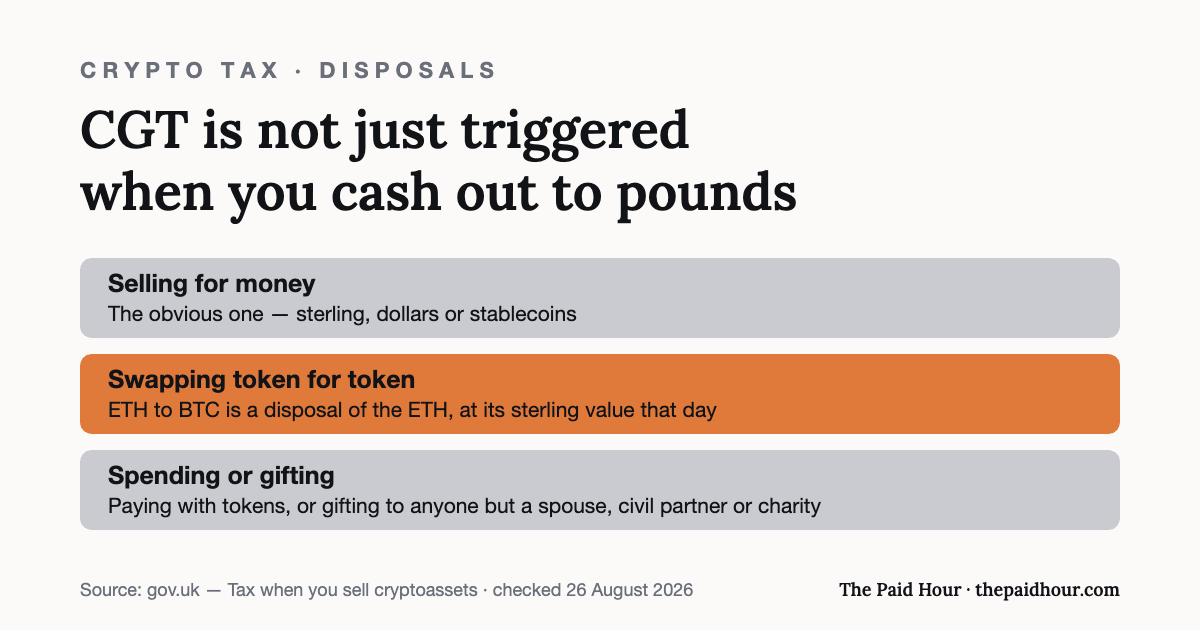
If you’re in the investor camp, and most people are — CGT is triggered by “disposing” of a token, and the definition is broader than most people expect. You’ve made a disposal if you:
- Sell tokens for pounds
- Swap one token for a different one (yes, even crypto-to-crypto trades count)
- Spend tokens on goods or services
- Give tokens away, other than to a spouse, civil partner, or registered charity
That second point surprises people constantly. Swapping ETH for a stablecoin feels like moving money between pockets. Under HMRC rules it’s a disposal of the ETH, calculated against whatever you originally paid for it, regardless of whether any pounds ever touched your bank account.
The rates and the allowance for 2026/27
The tax-free Capital Gains Tax allowance for 2026/27 is £3,000, the same figure as recent years, and worth remembering because it’s shared across all your capital gains, not just crypto. If you’ve also sold shares or a second property this year, they’re eating into the same pot.
Above that allowance, crypto gains are taxed at 18% for the portion that falls within your basic rate Income Tax band, and 24% on anything above it. If you’re already a higher or additional rate taxpayer, the whole gain is taxed at 24%. These are the same rates that apply to shares and most other assets. There’s no special discounted rate for crypto, and no equivalent of Business Asset Disposal Relief, because that relief is for qualifying business assets and crypto holdings don’t count.
One thing HMRC’s own guidance is explicit about: mining costs, like equipment and electricity, can’t be deducted against a CGT bill. If that expense is going to be relieved at all, it has to happen through the Income Tax route instead, which brings us to the next problem.
Mining and staking: three different outcomes rather than one
This is where most generic crypto tax guides get vague, and where sole traders specifically need to pay attention, because the answer depends on how the activity is run, not on the fact that it’s mining or staking at all.
If your mining setup has real scale, organisation, and commercial risk behind it, HMRC treats the tokens you receive as trade receipts, full Income Tax and Class 2/4 National Insurance, same as any other self-employment income, valued in sterling at the point you receive them.
If it doesn’t meet that bar (a spare GPU running in the evenings, say), the tokens are still taxable, just as miscellaneous income instead of trading income. You can deduct reasonable expenses against that income, and there’s a £1,000 trading allowance that can shelter small amounts of casual income like this entirely, if your gross total from this kind of activity stays under it for the year.
Either way, that’s only the first tax event. If you hold onto the tokens after receiving them, any further increase in value is a separate CGT calculation when you eventually dispose of them. Staking rewards follow broadly the same logic and, as of the Autumn Budget 2025, the government has confirmed they’ll continue to be taxed as income rather than moved onto the capital gains side: one of the few points in this area that isn’t currently under review.
Getting paid in crypto for your freelance work
If a client pays your invoice in crypto rather than sterling, that payment is business income, full stop. HMRC’s guidance for businesses is direct on this: tokens received for goods or services have to be accounted for within your taxable trading profits, valued in pounds at the point you received them, exactly as if you’d been paid in any other currency or in kind.
The part people miss is that this creates two separate tax events, not one. The sterling value on the day you’re paid goes through as trading income on your Self Assessment return, same as any other invoice. Then, separately, if the token’s value moves before you convert or spend it, that movement is a Capital Gains Tax matter, measured from the value you already declared as income. Skip the second step and you’re under-reporting even if you got the first part right.
For freelancers with international clients, this is worth flagging alongside your existing currency conversion habits, the accounting is more fiddly than getting paid in dollars or euros, because you also need a defensible sterling valuation at the exact moment of receipt instead of an average for the month. If you already track foreign income from overseas clients, treat crypto payments the same way: convert at the point of receipt and keep the record that proves it.
The DeFi rule that isn’t law yet
There’s a useful change coming for anyone using lending pools or liquidity pools, but it’s important to be precise about where it stands, because a lot of what’s circulating online overstates it.
At Autumn Budget 2025, the government published its response to a consultation on decentralised finance and proposed a “no gain, no loss” treatment for depositing tokens into DeFi lending and liquidity arrangements. Meaning the deposit itself wouldn’t trigger CGT, only a later genuine economic disposal (selling for fiat, or swapping into a fundamentally different asset) would. That would be a real improvement on the current position, where moving tokens into a lending protocol can itself count as a disposal.
But the government’s own wording is clear that no final decision on legislation has been made, and no timeline for draft legislation has been given. Treat this as a direction of travel for policy rather than a rule you can currently rely on. If you’re active in DeFi, keep tracking deposits and withdrawals as disposals under the existing rules until something more concrete is confirmed, and if this affects you meaningfully, it’s worth checking gov.uk directly before filing rather than assuming the proposal has already taken effect.
HMRC is about to start seeing your data automatically
Separately from any of the above, the practical landscape is shifting either way. From 1 January 2026, UK cryptoasset service providers have to start collecting identity and transaction data on their UK-resident users under the domestic extension of the Cryptoasset Reporting Framework. Their first reports, covering the whole of 2026, are due to HMRC by 31 May 2027. Providers that get it wrong, late, inaccurate, or missing reports, face penalties of up to £300 per user affected.
None of this changes what you owe. It changes how likely it is that a mismatch between your tax return and your actual activity gets noticed. If your Self Assessment has been quietly light on crypto gains up to now, 2026 is the year that stops being a low-risk assumption.
Record-keeping that will actually hold up
None of the above is enforceable by you unless the paperwork exists, and HMRC has been specific about what “enough” looks like. For every disposal, keep the date, the type of transaction, the number of tokens involved, their value in sterling at the time, and your pooled cost basis before and after the transaction. Bank statements and wallet or exchange transaction histories back all of this up.
The honest advice here: don’t wait until your tax return is due to reconstruct a year of transactions from memory and screenshots. A simple spreadsheet updated after each significant transaction, or one of the crypto tax tools that exports HMRC-formatted reports, will save you a unpleasant week in January: good record-keeping here is boring by design, and that’s exactly the point.
Where this tips into needing an accountant
Everything above covers the general rules as HMRC currently applies them. It isn’t personalised advice, and it can’t be — your specific mix of self-employment income, any employed income, other capital gains, and the scale of your crypto activity all change the actual numbers.
If you’re anywhere near the line between “investing” and “trading,” if you’re running a mining operation with real equipment behind it, or if crypto income now makes up a meaningful share of what your business earns, that’s the point to bring in an accountant who’s dealt with crypto cases before, instead of working it out from a blog post, including this one. Getting the category right at the start is far cheaper than correcting it after an enquiry.
Mining has enough of its own rules to need separate treatment, the trade-or-hobby test, the £1,000 allowance and the reporting bands are all in the guide to crypto mining tax in the UK.
A loss is only worth something once HMRC knows about it, and the window is four years, the rules are in the guide to claiming crypto losses against tax.
Working out the cost of a disposal has rules of its own, same-day matching, the 30-day rule, then the average. They are set out in the guide to Section 104 pooling.
Exchanges now report to HMRC. Is your pool right?
UK Crypto Tax for the Self-Employed 2026/27. Seven modules and a four-sheet toolkit that computes a Section 104 pool properly and separates what is capital gains from what is income.
- A pool calculator that carries the running average cost and computes the gain on every disposal, same-day and 30-day rules applied first
- The disposals people miss: crypto-to-crypto, spending it, gifting it
- Losses, negligible value claims for dead tokens, and the record pack HMRC expects you to hold for five years and ten months
Under the Cryptoasset Reporting Framework, exchanges have been collecting and reporting UK users’ data since 1 January 2026. The rules did not change. HMRC just stopped having to guess.
Buying more than one? All ten 2026/27 courses for £107, against £328 at full price.
Sources
- GOV.UK, Capital Gains Tax rates and the £3,000 annual exempt amount for 2026 to 2027
- GOV.UK: Check if you need to pay tax when you sell cryptoassets
- HMRC Cryptoassets Manual CRYPTO20250, what is trading
- HMRC Cryptoassets Manual CRYPTO21150. Mining transactions
- HMRC Cryptoassets Manual CRYPTO40350, business income paid in cryptoassets
- GOV.UK: Reporting cryptoasset user and transaction data (first report due between 1 January and 31 May 2027, covering 2026; penalties up to £300 per user)
- GOV.UK — Tax-free allowances on property and trading income (£1,000 trading allowance)
The disposal list was re-checked against gov.uk on 26 August 2026.
Checked against gov.uk on 25 August 2026. General information, not tax advice, crypto sits across two tax regimes at once and the right answer depends on your own mix of income and gains, so for anything close to the line speak to an accountant who has handled crypto cases.