

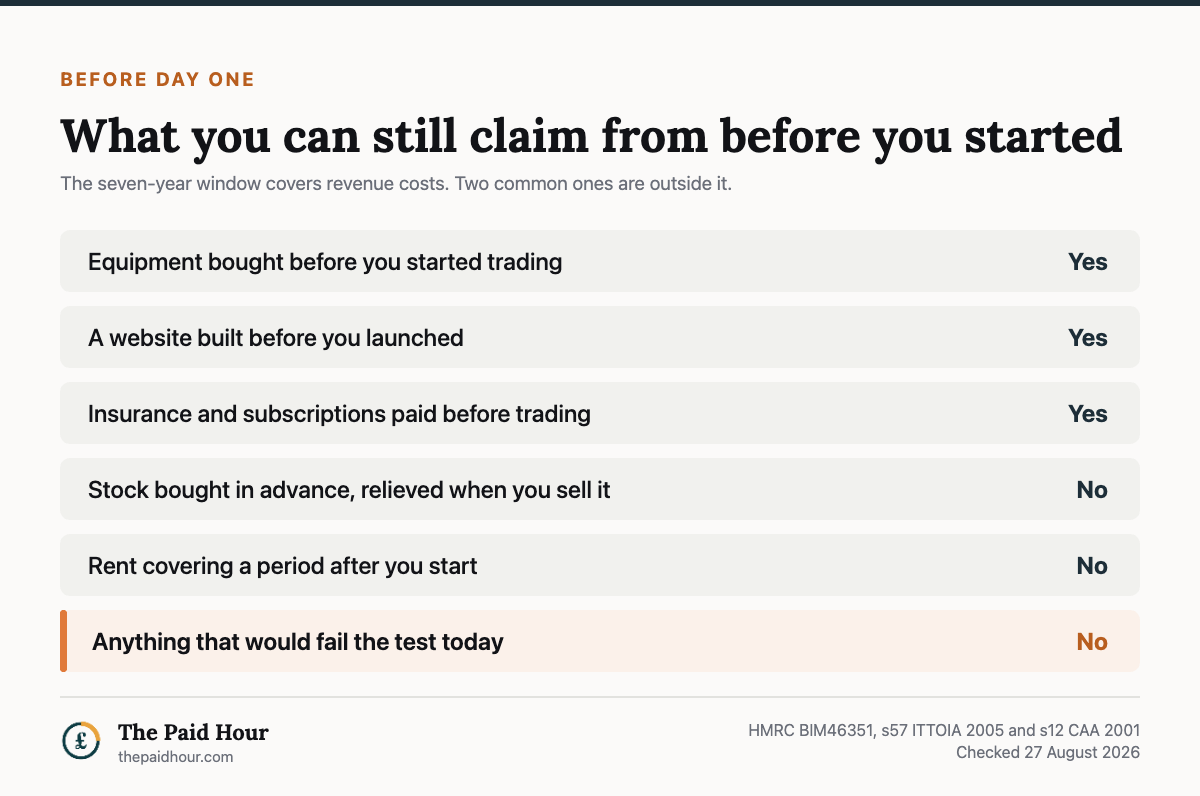
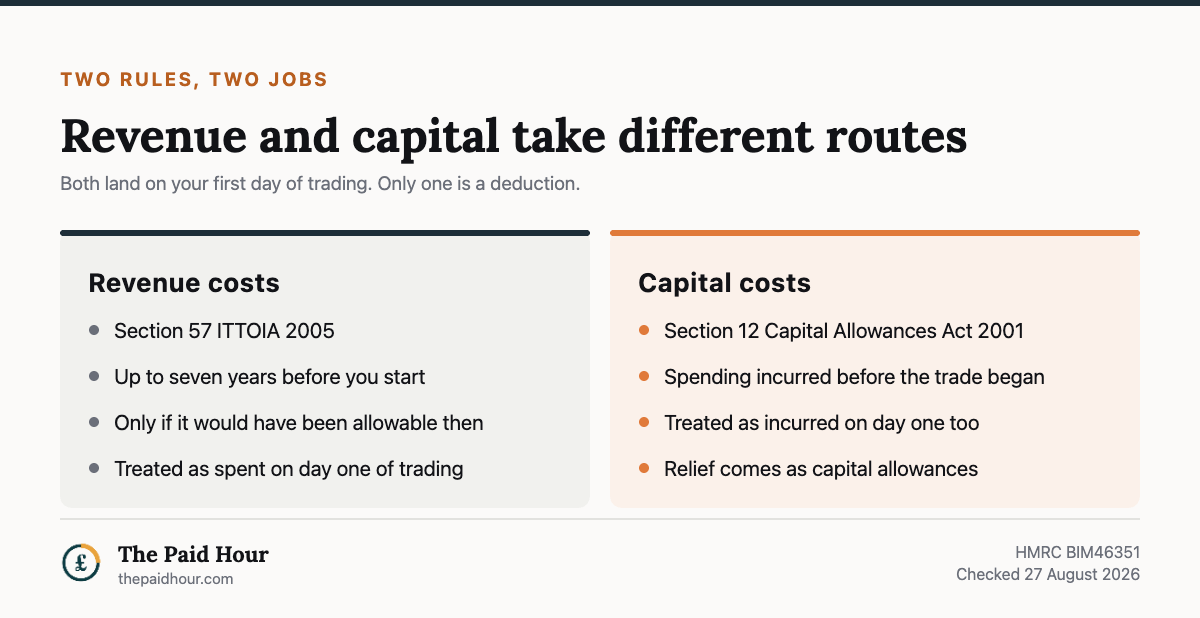
Costs you paid before the business started are not lost. Section 57 of ITTOIA 2005 lets you deduct revenue expenses incurred up to seven years before you began trading, provided they would have been allowable had you already been trading. They are all treated as spent on your first day, so they go into your first set of accounts rather than into an amended earlier return. Equipment takes a different route, capital allowances, and trading stock bought in advance is outside the rule because it gets relieved when you sell it.
Table of Contents
Most people register as self-employed some months after they actually started spending money on it. The domain, the camera, the insurance, the six months of software you paid for while working out whether any of this was a business, all of it lands before day one.
Pre-trading expenses are the rule that gets that money back, and the window is far longer than most people expect.
How far back can you claim pre-trading expenses?
Seven years. HMRC’s manual sets out two conditions and you need both: the pre-trading expenses were incurred within a period of seven years prior to the commencement of the trade, profession or vocation, and it is not otherwise allowable but would have been allowable if incurred after trading began.
That second condition is the whole test, and it is a kinder one than it sounds. You are not being asked to prove you knew you were starting a business at the time. You are being asked whether the cost would pass today.
Pre-trading expenses are all treated as spent on your first day
This is the part that removes the paperwork most people are dreading. Relief is given in the opening year. There is no amended return for the year you actually paid, no separate claim form, no letter to HMRC.
A laptop bought in March 2023 and a business that started trading in June 2026 are, for tax, a laptop bought in June 2026. You add the total to your first accounts and the numbers do the rest.
One consequence worth seeing coming: bunching several years of costs into a single opening period can produce a loss in year one. That is not a problem, but it is a decision. A first-year loss has its own reliefs and its own consequences for payments on account.
Equipment and pre-trading expenses take different roads
Section 57 covers revenue costs. It does not cover capital spending, and buying a laptop is capital spending.
The equivalent provision for that is section 12 of the Capital Allowances Act 2001, which treats capital expenditure incurred before the trade begins as incurred on the first day of trading. Same landing point, different relief: capital allowances rather than a deduction from profit.
The two pre-trading expenses that do not qualify
Trading stock bought in advance. Not because HMRC is being difficult, but because the cost of stock is already relieved when you sell it. Putting it through as a pre-trading expense would relieve it twice.
Rent and similar costs paid in advance for a period after you start. Same reasoning. Those are ordinary expenses of the trade once it is running, so they get relieved in the ordinary way.
The rule catches the money that would otherwise fall down the gap. It does not accelerate money that was always going to be relieved.
Wholly and exclusively still applies to pre-trading expenses
Backdating does not soften anything. The spending has to pass the same test it would pass today, applied to the facts as they were then.
So the camera you bought for the family holiday and later used for client work is not a pre-trading expense. It was a personal purchase at the time, and the seven-year rule does not rewrite that. The camera bought while you were building a portfolio to sell from is a different fact pattern entirely. Nothing here rescues costs that failed the disallowable expenses test to begin with.
When did the trade actually start?
Here is the awkward part, and it is worth being straight about it. Claiming several years of pre-trading costs is, implicitly, a statement that the trade started when you say it started. If HMRC takes a different view of that date, the claim moves with it.
The start of a trade is a question of fact, whether you were carrying on an activity in an organised, commercial way, and the same reasoning that separates a hobby from a business settles it. Preparing to trade is not trading. The first day you were open for business usually is.
Pick the date you can defend, write down why, and use the same date on your registration with HMRC. Two different start dates on two different documents is an argument you do not need.
Pre-trading expenses and the trading allowance
The £1,000 trading allowance and deducting expenses are alternatives, not a combination. Take the allowance and you deduct nothing, including everything you spent before you started.
Budget update, 28 October 2026: the trading allowance rises from £1,000 to £3,000 from 6 April 2027, and the Self Assessment reporting threshold for trading income moves to £3,000 with it. For the 2026/27 tax year the £1,000 limit still applies. GOV.UK policy paper.
For most people setting up, that arithmetic points one way. Set-up years are the years with the highest costs and the lowest income, which is exactly when £1,000 is the worse deal.
The VAT window is a different window
If you are registering for VAT at the same time, do not carry the seven years across. Regulation 111 of the VAT Regulations 1995 runs on its own clocks: four years for goods, and only six months for services.
The goods limb also has a condition the income tax rule does not. The goods have to still be on hand at the date of registration and be used in the newly registered business, so consumables you have already got through are out.
Six months is the one that bites. Design work, legal advice, accountancy, a year of software bought while you were setting up. Those are services, and for most new businesses the VAT on them has expired long before turnover comes anywhere near the registration threshold. Three clocks, one pile of receipts: seven years for income tax on revenue costs, four years for VAT on goods you still have, six months for VAT on services.
Keeping receipts from before you started trading
Receipts going back seven years, which is longer than most people keep anything, and the reason each one belongs to the business. If you are reading this before you start, that is the useful moment: a folder now is worth an afternoon of bank-statement archaeology later.
Once trading, the normal retention rules take over. The wider list of what qualifies is in allowable expenses for UK freelancers.
Claiming everything you are owed?
HMRC Tax & Expense Mastery 2026/27. Nine modules and eleven working templates that take a UK freelancer from “do I even need to register” to a correct return, with MTD quarters built in.
- Fifteen expense categories, with the trap inside each one (training, clothing, meals, the seven-year pre-trading rule)
- Home and vehicle: flat rate against actual cost, with the £312 break-even worked out and the mileage lock-in rule
- The year-one payments-on-account cash shock, and the routine that stops it landing twice
HMRC does not send a list of what you forgot to claim. Most freelancers leave several hundred pounds of legitimate expenses on the table every single year, and the return still gets filed.
Buying more than one? The Complete Freelancer System, all five for £87, against £193 bought separately.
Sources
- BIM46351: pre-trading expenditure, HMRC Business Income Manual
- BIM37007: wholly and exclusively, overview, HMRC Business Income Manual
- Expenses if you are self-employed, GOV.UK
- Set up as a sole trader, GOV.UK
- Tax-free allowances on property and trading income, GOV.UK
- VIT32000: input tax incurred before registration, HMRC VAT Input Tax manual
The seven-year window, the two conditions and the treatment of stock and advance rent are quoted from HMRC’s Business Income Manual at BIM46351, which cites section 57 ITTOIA 2005 for revenue costs and section 12 of the Capital Allowances Act 2001 for capital ones. The four-year and six-month VAT windows and the goods-on-hand condition are from HMRC’s VAT Input Tax manual at VIT32000, which cites regulation 111 of the VAT Regulations 1995. All pages read on 27 August 2026. This is general information about how the rules work, not tax advice. Check your own position with HMRC or an accountant before you file.