
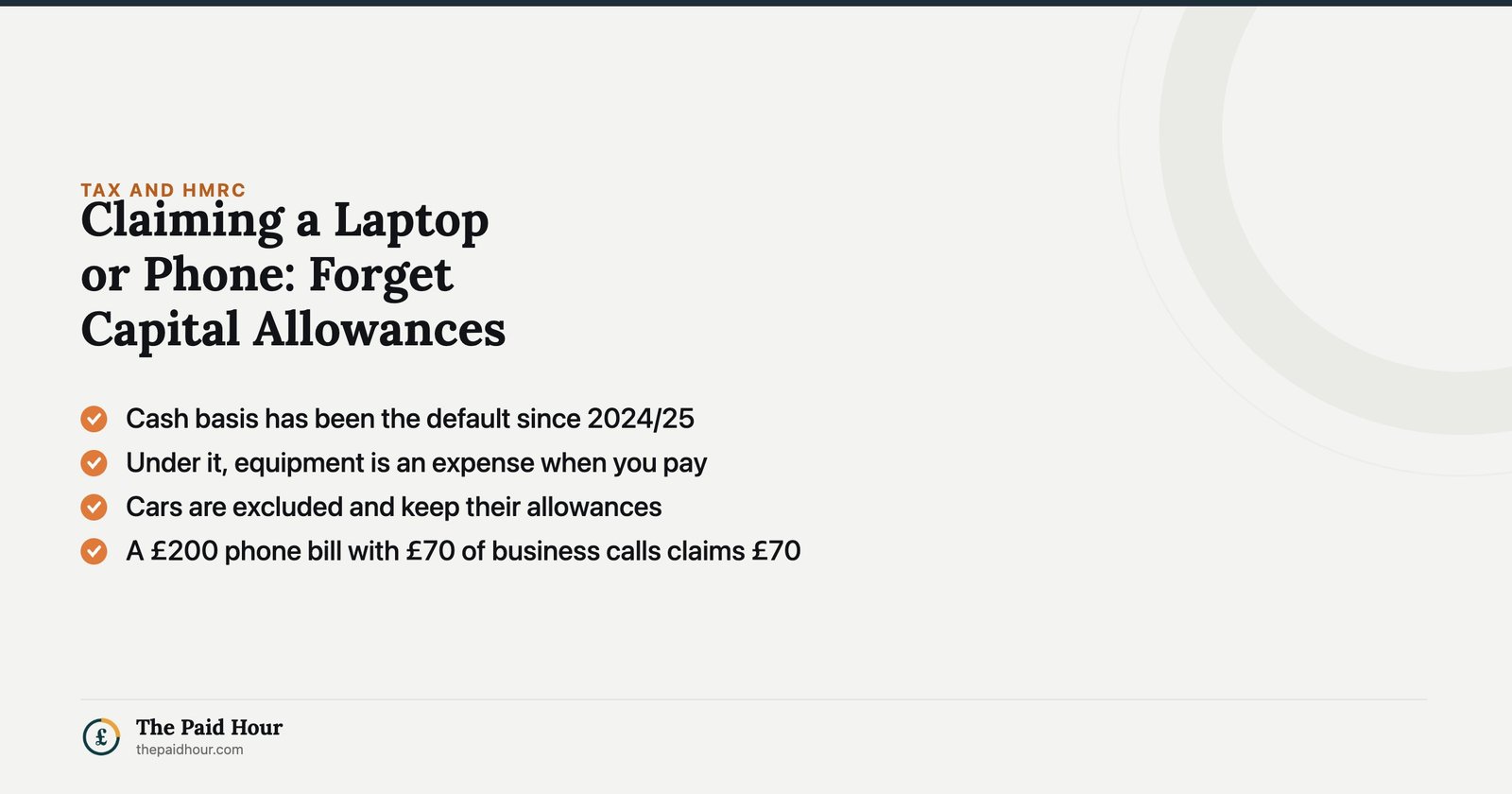
What matters here: Most articles about claiming a laptop walk you through capital allowances. For most sole traders that is now the wrong route. Since the 2024/25 tax year the cash basis has been the default, and under it equipment is simply an expense in the year you pay for it, no pools, no writing down, no rates. Cars are the exception and keep their own treatment. Phones and broadband are split by use: HMRC’s own example claims £70 of a £200 bill.
Table of Contents
Can you claim a laptop when you are self-employed? Yes. The interesting question is how, and the answer changed for most people two tax years ago without much noise.
The old answer went: a laptop is capital, not an expense, so you claim capital allowances, and the annual investment allowance gives you 100% of it in year one anyway. All true, and for a growing number of sole traders, irrelevant.
Which accounting basis are you actually on?
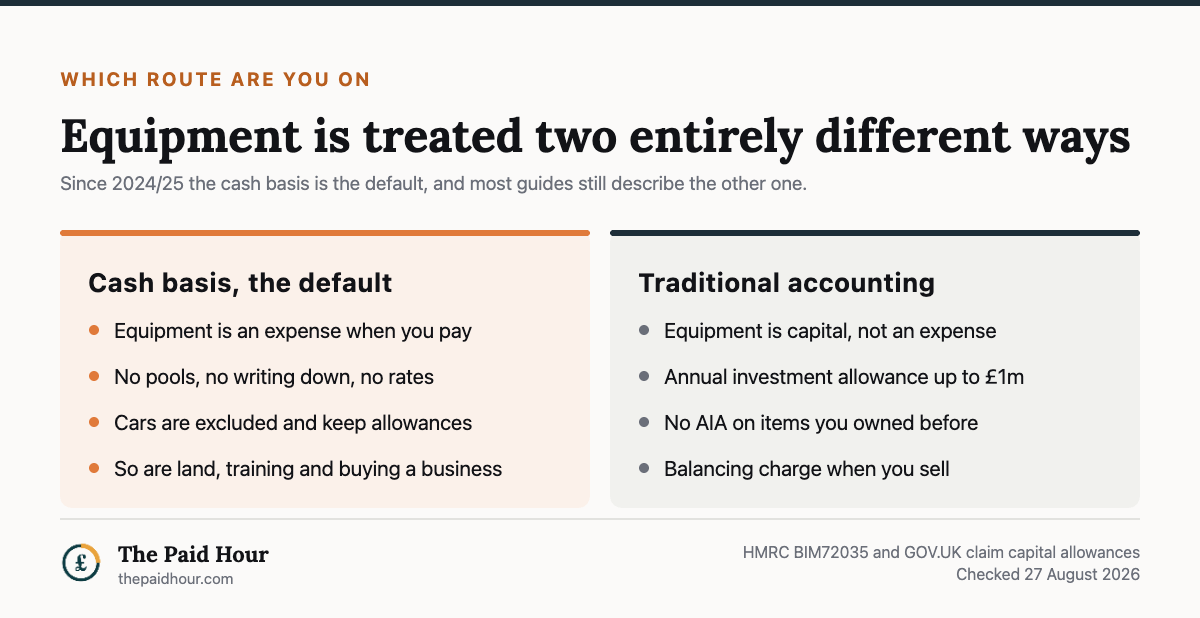
Since 2024/25, cash basis has been the default for sole traders and partnerships. Nobody wrote to tell you. If you have never made a positive choice to use traditional accounting, you are almost certainly on it.
That matters here more than anywhere else, because the two bases do not treat equipment slightly differently. They treat it in completely different systems.
On the cash basis, a laptop is just an expense
Buy it, pay for it, deduct it. There is no pool to open, no percentage to apply and nothing to carry forward. HMRC’s manual sets out what is left out of that treatment rather than what is in, and the exclusions are narrow: buying or selling a business, education and training, land, non-qualifying intangibles, financial assets, anything not acquired for continuing use in the business, anything that will not lose 90% of its value within twenty years, and cars.
A laptop, a camera, a set of tools, a desk, a printer: none of those are on the list. They are expenses.
The training exclusion is worth noticing, because it does not mean training is unrelieved — training has its own rule and is usually a straightforward deduction. It means it does not come through this door.
On traditional accounting, it is capital
Here the laptop is an asset and the relief is the annual investment allowance, which has stood at £1 million a year since January 2019. Practically, that means 100% in the year you buy it, which lands in the same place as the cash basis for most people — just by a longer route and with more to keep track of.
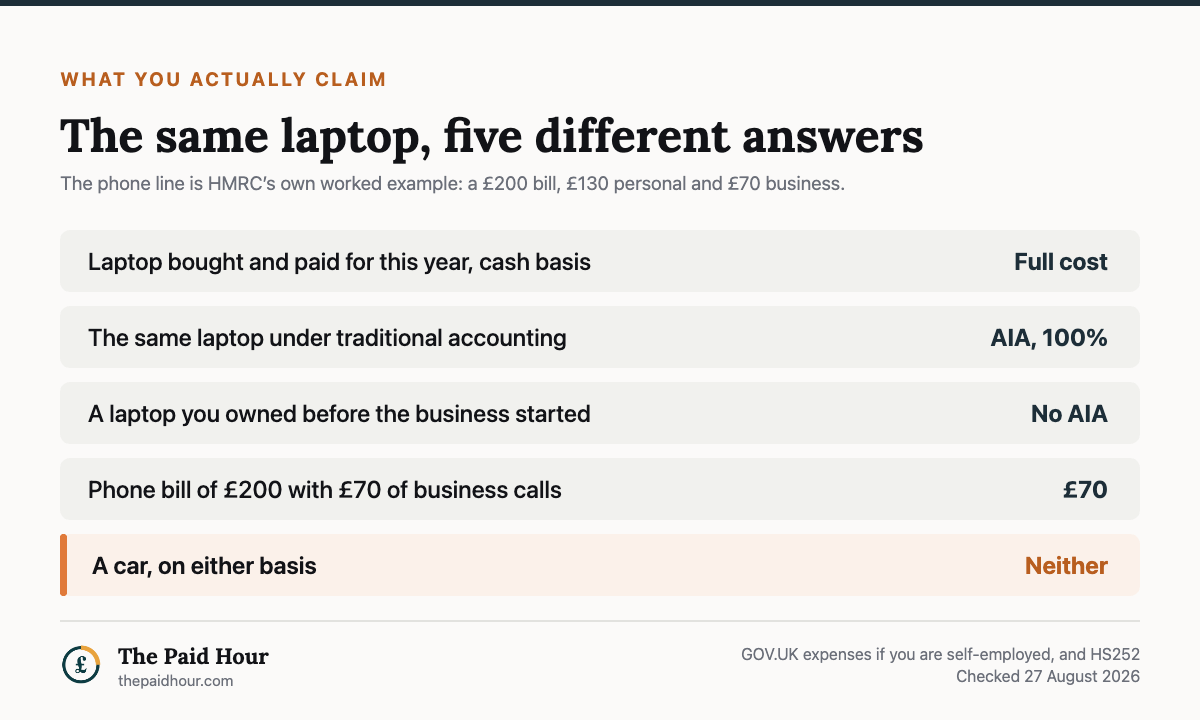
Three things you cannot use AIA on, in HMRC’s own words: business cars, items given to you or the business, and items you owned for another reason before you started using them in your business.
The laptop you already had
This catches nearly everyone, because nearly everyone starts a business on a machine they already own.
It is not a purchase by the business, so there is no AIA, and on the cash basis there is no payment in the period to deduct. What it can get is a writing down allowance, and the honest position is that the value used is not what you paid for it two years ago. Get that figure from HMRC or an accountant rather than from any article — it is the one number in this area where guessing costs you either relief or credibility.
The related rule, which is more generous than people expect, is that costs from before you started trading can still come through, see the pre-trading expenses rule. That covers what you bought for the business before it began. It does not convert a personal laptop into a business purchase.
Phones, broadband and the business share
A phone bill is not equipment and it does not go near either system. It is a running cost, and unlike a coat it splits, because the business calls are a definite, identifiable part of it.
GOV.UK gives the example plainly: a £200 annual mobile bill, £130 of personal calls and £70 of business calls, claim £70. Nobody is asking for a spreadsheet of every call, but you do need a reasonable method you can describe. Broadband follows the same logic through the working from home rules, and the flat rate for use of home is the alternative if apportioning is more trouble than it is worth.
The handset itself is equipment. The contract is a running cost. They are two different claims on one purchase, which is why phone bills confuse people more than laptops do.
Private use cuts every route
Whichever basis you are on, you claim the business share. HMRC is direct about how that works under capital allowances: items used for both business and private purposes, cars included, do not go in the main or special rate pool. Each gets its own single asset pool and the allowance is cut to the business proportion.
A laptop used 70% for work gives 70% of the relief. That is not a penalty, it is the same principle running through every allowable expense. What matters is picking a percentage you can defend and using the same one consistently, rather than the one that happens to suit this year’s profit.
The 40% allowance you will probably never use
From 1 January 2026 there is a new 40% first-year allowance on main rate expenditure, and it was written partly for unincorporated businesses, who had been shut out of full expensing.
For a sole trader buying a laptop it changes nothing. The annual investment allowance already gives 100% up to £1 million, so a 40% allowance is only relevant above that. Second-hand assets are excluded from it and so are cars. It is a genuine improvement to the system and almost certainly not one that affects you.
Cars are the exception to all of it
A car cannot be expensed under the cash basis and cannot take the annual investment allowance under traditional accounting. HMRC’s manual keeps capital allowances available on a car under the cash basis, provided the mileage rate has not been claimed on it, which is the same one-way door that runs through the mileage allowance.
Vans are not cars. A van is main rate plant, takes the annual investment allowance, and behaves like the laptop rather than the car.
What to keep
The invoice with your name or the business name on it, the date you paid, the business-use percentage, and one line saying how you arrived at it. On traditional accounting, also whatever the item eventually sells for, that is what a balancing charge is calculated from.
Five years after the filing deadline is the retention rule, and a laptop bought this year may still be in your accounts when that clock runs out.
Claiming everything you are owed?
HMRC Tax & Expense Mastery 2026/27. Nine modules and eleven working templates that take a UK freelancer from “do I even need to register” to a correct return, with MTD quarters built in.
- Fifteen expense categories, with the trap inside each one (training, clothing, meals, the seven-year pre-trading rule)
- Home and vehicle: flat rate against actual cost, with the £312 break-even worked out and the mileage lock-in rule
- The year-one payments-on-account cash shock, and the routine that stops it landing twice
HMRC does not send a list of what you forgot to claim. Most freelancers leave several hundred pounds of legitimate expenses on the table every single year, and the return still gets filed.
Buying more than one? The Complete Freelancer System, all five for £87, against £215 at full price.
Sources
- BIM72035: cash basis — capital expenditure — HMRC Business Income Manual
- Cash basis: overview — GOV.UK
- Claim capital allowances: annual investment allowance — GOV.UK
- Expenses if you are self-employed: office, property and equipment — GOV.UK
- HS252 Capital allowances and balancing charges 2026 — GOV.UK
- Capital allowances: new first-year allowance and reducing main rate writing-down allowances — GOV.UK
The cash basis exclusion list and the treatment of cars under it are from HMRC’s Business Income Manual at BIM72035, last updated 3 July 2026. The £1 million annual investment allowance, its start date of 1 January 2019 and the three AIA exclusions are GOV.UK’s wording. The £200 phone bill example is GOV.UK’s own. The single asset pool for private use is from helpsheet HS252. The 40% first-year allowance and its exclusions are from the measure published on 26 November 2025. All pages read on 27 August 2026. This is general information about how the rules work, not tax advice — check your own position with HMRC or an accountant before you file.