
In short: Coworking space rent, day passes, meeting rooms and the add-ons are ordinary business premises costs and go in box 21 with rent, rates, power and insurance. The part people miss is what a coworking space does to two other claims. A place you go to regularly is a predictable place of work, which makes the journey there a commute rather than business travel, and every hour in a coworking space is an hour not worked at home, which can drop your use-of-home flat rate a band or take you under the 25-hour minimum entirely.
Is a coworking space tax deductible? Yes, and it is one of the least controversial expenses a sole trader has. It is space you rent to do the work in. Nobody at HMRC is going to argue about it.
The reason it is worth a page of its own is that the membership changes the arithmetic on two things you were already claiming, and neither of those is on the invoice.
What coworking space costs you can put through
Business premises costs are on GOV.UK’s list of allowable expenses, and the notes to box 21 of the self-employment pages spell out what belongs there: rent for business premises, business and water rates, light, heat, power, property insurance, security, and the business use of your home.
A desk membership is rent for business premises. So is a day pass, a meeting room booked for an afternoon, and the storage locker.
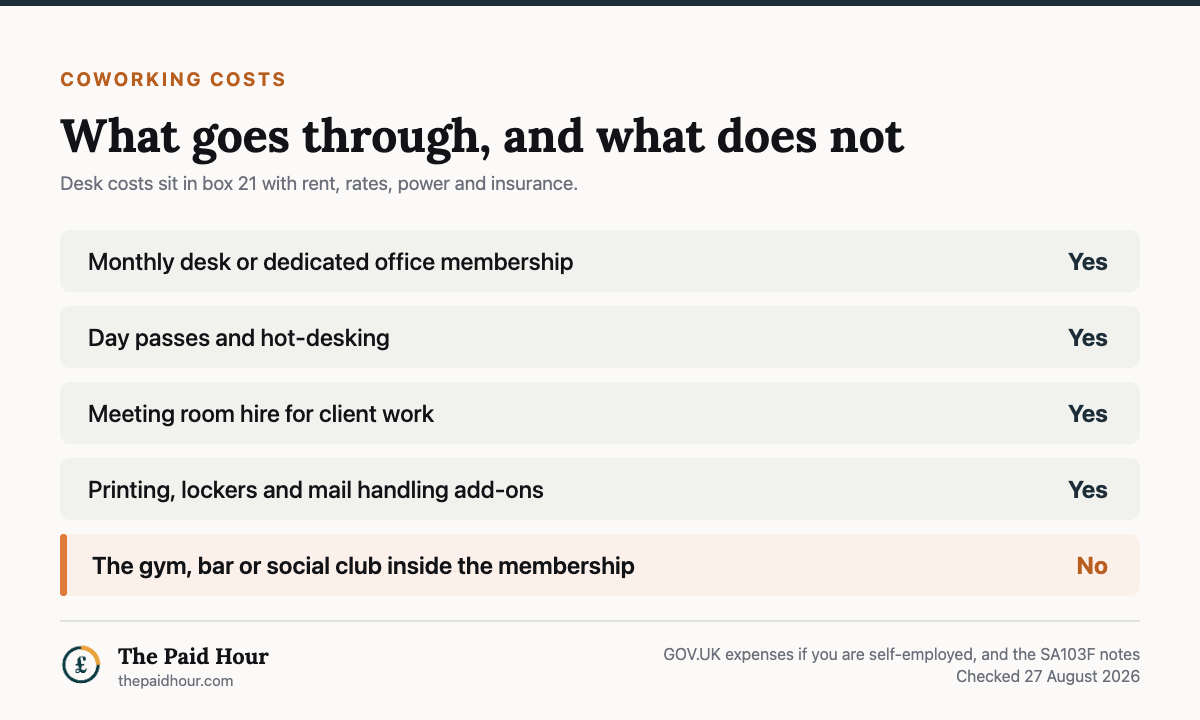
The one line to watch is a membership that bundles things you would otherwise buy for yourself. The gym downstairs, the members’ bar, the events programme. Box 21 excludes the costs of any non-business part, and a benefit you would have paid for personally is exactly that.
A regular coworking space becomes your base of operations
Here is the expensive part, and almost nobody mentions it when they are selling you the membership.
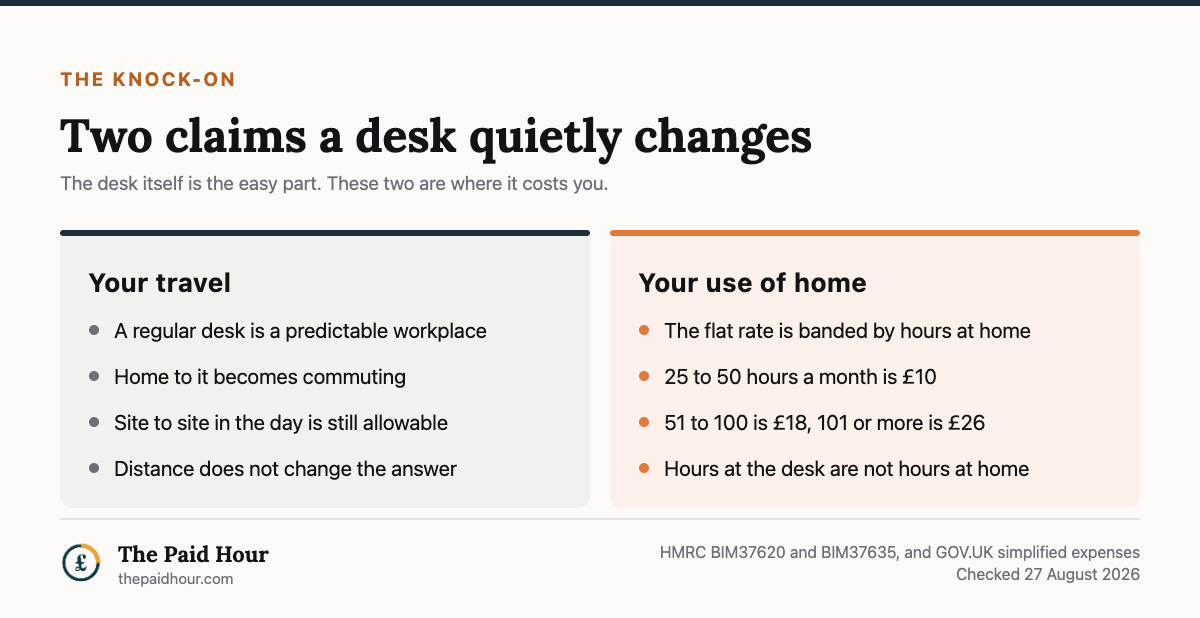
Whether a journey from home is business travel or commuting turns on how predictable your places of work are. A trade carried on at temporary sites, with no fixed base, gets its travel. A trade with a settled pattern around one location does not, and that is what a desk you go to three days a week creates.
The case law is not about coworking, because it predates it, but the reasoning transfers cleanly. A milk round arranged around one depot was refused even though all the paperwork was done at home. Doing your admin somewhere does not make it the base; having a settled place you go to does.
So a freelancer who was claiming mileage for client visits keeps those. The new drive to the desk is not one of them. This is a judgement about your own facts rather than a rule HMRC has written about coworking, and the more your desk looks like an office you go to, the harder that journey is to defend.
Every hour in a coworking space is an hour not at home
The second knock-on is arithmetic rather than principle. The simplified flat rate for working from home is banded by hours worked at home each month: £10 for 25 to 50 hours, £18 for 51 to 100, £26 for 101 or more. Below 25 hours a month you cannot use it at all.
Take a three-day-a-week desk and the hours at home fall by roughly 100 a month. A full-time freelancer who was comfortably in the £26 band lands in the £18 or £10 one. Take a five-day desk and the claim usually disappears.
That is not a loss so much as a swap. You are paying rent instead of using your spare room, and the rent is a far bigger deduction than £26 a month. The mistake is carrying on claiming the old band because nothing on the invoice told you to stop.
Phone and internet sit outside the flat rate either way. GOV.UK is explicit that the home flat rate does not include telephone or internet expenses and that you claim the business proportion of those separately. That does not change when you rent a desk, even if the desk comes with wifi.
The business rates on a coworking space are not yours
A hot desk or a membership is a licence to use space in someone else’s building. The rates bill belongs to the operator, and it is in your monthly fee whether you can see it or not.
That is one genuine simplification over working from home, where a room used exclusively for business can in some circumstances attract a rates liability of its own. The mechanics of that are in business rates when working from home.
Can you claim both a coworking space and use of home?
Yes, if you work in both places. There is no rule that says a business gets one workspace, and plenty of people write proposals at the kitchen table on Monday and take calls from a booth on Wednesday.
What you cannot do is claim the home hours you did not work. The flat rate is a proxy for a real cost, not an allowance you are entitled to for owning a house. Count the hours honestly and the two claims sit together without difficulty. Count them the way you did last year and one of them is wrong.
What to keep
The invoices, obviously. Beyond that, a note of the pattern: which days you are at the desk, roughly what hours you still work at home, and, if the membership bundles anything non-business, what proportion you have treated as personal and why.
None of that takes more than a line a month, and it is the difference between a claim you can explain and one you are reconstructing. Five years after the filing deadline is the retention rule; the wider list is in allowable expenses for UK freelancers, and the other flat rates in simplified expenses.
Filing it yourself this year?
HMRC Tax & Expense Mastery 2026/27. Nine modules and eleven working templates that take a UK freelancer from “do I even need to register” to a correct return, with MTD quarters built in.
- Fifteen expense categories, with the trap inside each one (training, clothing, meals, the seven-year pre-trading rule)
- Home and vehicle: flat rate against actual cost, with the £312 break-even worked out and the mileage lock-in rule
- The year-one payments-on-account cash shock, and the routine that stops it landing twice
HMRC does not send a list of what you forgot to claim. Most freelancers leave several hundred pounds of legitimate expenses on the table every single year, and the return still gets filed.
Buying more than one? The Complete Freelancer System, all five for £87, against £215 at full price.
Sources
- Expenses if you are self-employed, GOV.UK
- Self-employment (full) SA103F and notes, GOV.UK
- Simplified expenses if you are self-employed: working from home, GOV.UK
- BIM37620: travel costs, base of trade operations, HMRC Business Income Manual
- BIM37635: predictability of places of work, HMRC Business Income Manual
The box 21 wording is quoted from HMRC’s notes to the SA103F self-employment pages, reference 12/25. The £10, £18 and £26 flat rates, the 25-hour minimum and the exclusion of telephone and internet are GOV.UK’s wording. The travel reasoning applies HMRC’s published position on the base of trade operations and predictability of places of work to a coworking desk; HMRC has not published guidance specifically about coworking, and that section is stated as a judgement rather than as a rule. All pages read on 27 August 2026. This is general information about how the rules work, not tax advice. Check your own position with HMRC or an accountant before you file.