
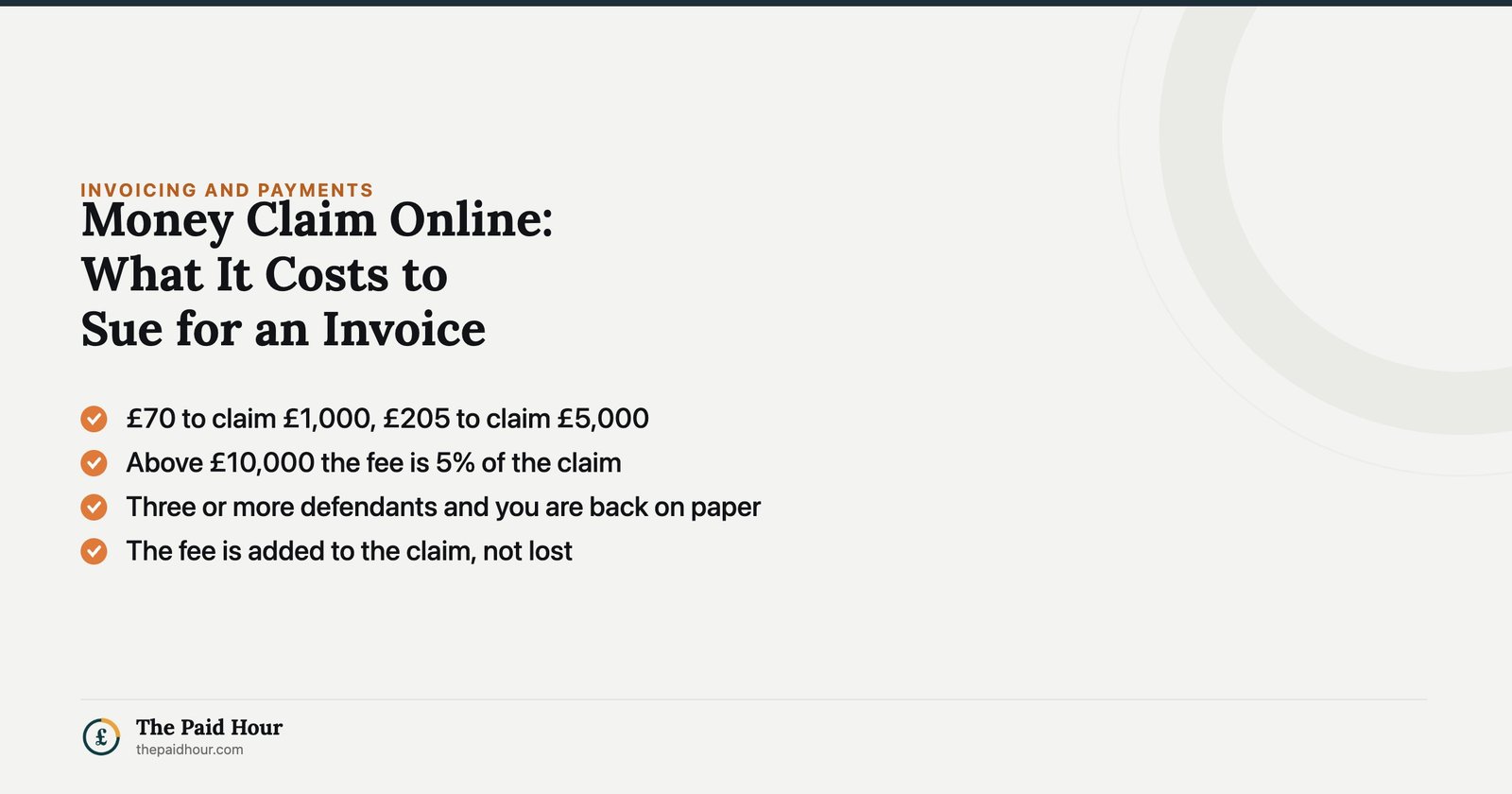
Straight answer: A money claim is what used to be called small claims court, and for an unpaid invoice it is cheaper than people expect: £70 to claim £1,000, £205 to claim £5,000, and above £10,000 the fee becomes 5% of the money claim. You add the fee to what you are claiming, so it is recoverable rather than spent. Four things push you off Money Claim Online and onto paper. And the thing worth knowing before you start: a judgment is a piece of paper saying you are owed money. Getting the money is a separate step with its own costs.
Most freelancers never get here, and that is usually right, a properly chased invoice and a formal letter settle the great majority of unpaid work.
But it is worth knowing what the next step involves, because the belief that going to court is ruinously expensive stops people using a service that costs less than a day’s work.
What a money claim costs to issue
The fee steps up in bands, and the bands are not proportional, the jump from £5,000 to £10,000 more than doubles it.
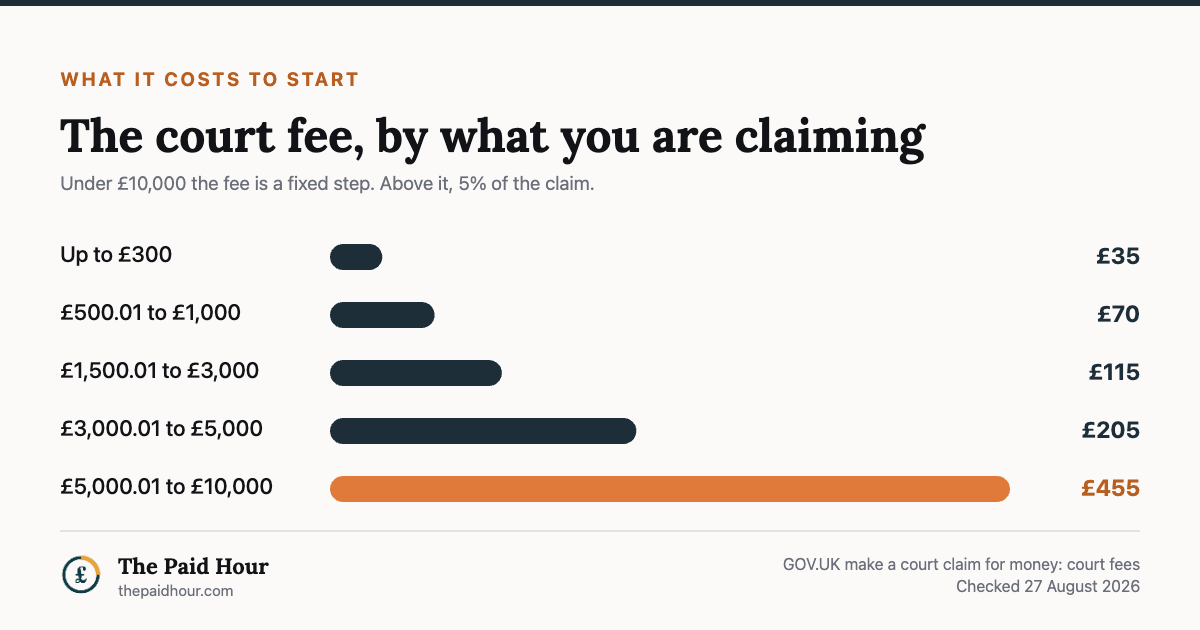
Above £10,000 the fee is 5% of the claim, you multiply the amount by 0.05 and round down to the nearest penny. Above £200,000 it is capped at £10,000, which is not a number this site’s readers will meet often.
The fee is the same whether you claim online or on paper.
Why the money claim fee is advanced rather than spent
You add the court fee to the amount you are claiming. So a £1,000 invoice becomes a claim for £1,000 plus the £70 plus interest, and if you win, the defendant is the one who has paid for the process.
That changes the arithmetic completely. It is not £70 spent to chase £1,000; it is £70 advanced against a claim of £1,070-odd, recoverable if the claim succeeds and lost only if it does not.
Add the statutory interest and fixed compensation as well. Most freelancers are entitled to both and most never ask, which quietly turns a claim into a smaller one than it should be.
When you cannot use Money Claim Online
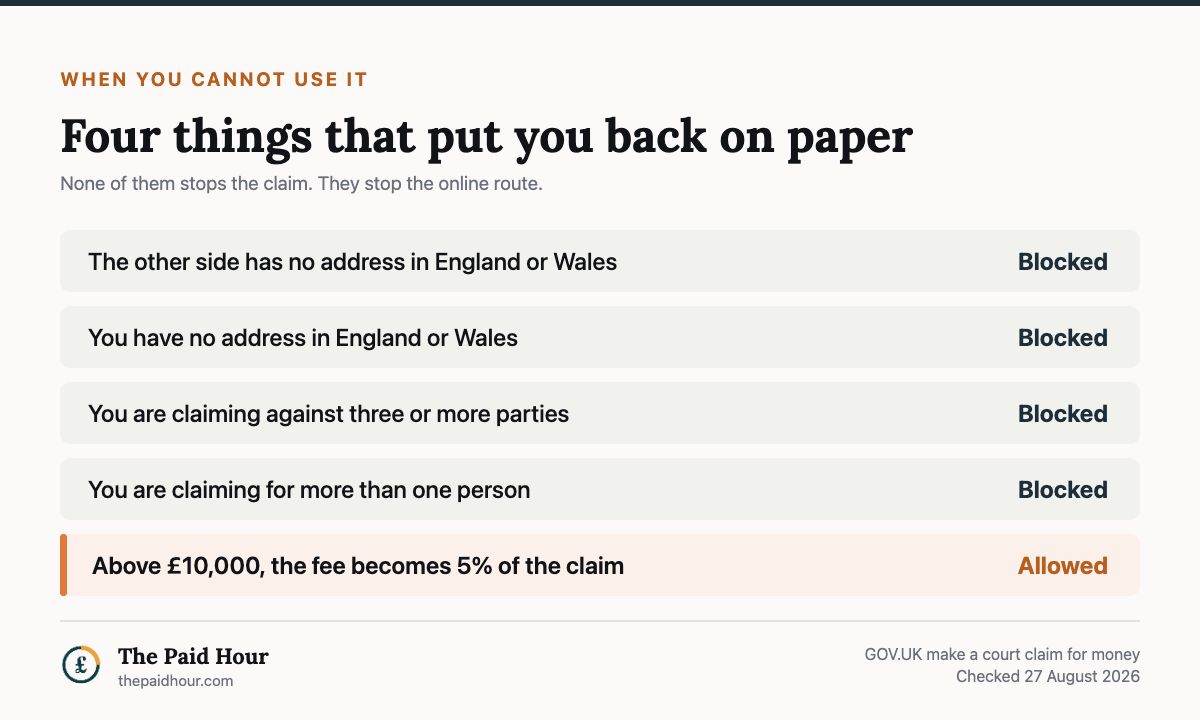
Four conditions, and the one that catches freelancers is the address. If the client is based in Scotland, Northern Ireland or abroad, the online route is closed, which is a good reason to know where a client is before you take the work rather than after.
None of these stops you claiming. They stop you claiming online. Paper is slower and identically priced.
What happens after you file a money claim
The claim is served and the defendant is told the date by which they must respond. GOV.UK does not publish a fixed number of days for this: the date comes with the paperwork, so read it instead of assuming.
Three things can happen. They pay, which is the common outcome and often happens within days of the claim landing. They admit part or all of it and propose terms. Or they defend it, and the claim goes into the small claims process, usually with mediation offered first.
And there is a fourth: nothing. If they do not respond, you can request judgment in default, which is the point at which a great many unpaid invoices finally get dealt with, because a judgment against a company is public.
Winning is not being paid
This is the part that gets left out of every encouraging article about small claims, and it is the part that decides whether the whole exercise was worth it.
A judgment is a court order saying the money is owed. It is not the money. If the defendant still does not pay, enforcement is a separate application with a separate fee — bailiffs, an attachment of earnings, a charge on property, or an order to obtain information about what they have.
Against a solvent business that simply was not paying, a judgment usually ends the argument on its own. Against a company with no assets, or one that is about to fold, you can win comprehensively and collect nothing, and the fees you advanced go with it.
So the question to ask before filing is not am I right. It is can they pay. Ten minutes on Companies House looking at the client’s accounts is the most useful research in this entire process, and almost nobody does it.
When it is not worth it
Below about £300 the fee is a large proportion of the debt, and while it is recoverable, so is your time, and your time is not.
Where the client disputes the work rather than simply not paying, the calculation is different again. A defended small claim is a hearing, evidence and a day of your life, and the outcome turns on what you can prove rather than on what happened. That is where a written contract stops being paperwork and starts being the case.
And check the debt is still in time. Once the limitation period has run there is nothing to file.
What to keep
The invoice, the contract or the emails that formed the agreement, every reminder you sent, and the letter before action with its date and proof of posting.
Then the evidence that the work was done and accepted, the delivered files, the sign-off, the message saying it looked good. That is the half people forget, because at the time it was just a conversation. Everything in what a UK invoice must include is also evidence, and it all wants keeping for the usual period.
Before you file, read what the court fees and a hearing really cost in our guide to small claims court costs, and why your own time and any solicitor are not recoverable.
Ready to stop chasing and start recovering?
Late Payment Recovery & Legal Safeguards. The seven-stage escalation ladder with dates, every letter written for you, an interest calculator that adds what the law owes you, and the Money Claim Online walkthrough with real fees.
- Reminder letters for stages one to four, then a Letter Before Action that complies with the Pre-Action Protocol (company and individual versions)
- Auto-calculating statutory interest and compensation statement: £40 to £100 per invoice plus interest at base rate plus 8%
- Payment plan with a default clause, particulars of claim wording, hearing bundle index, and the client scorecard that fires slow payers
A solicitor charges around £40 plus VAT for a single letter before action. This is every letter in the sequence, the interest you are legally entitled to claim, and the court route, for one fee.
Buying more than one? The Complete Freelancer System, all five for £87, against £215 at full price.
Sources
- Make a court claim for money: GOV.UK
- Make a court claim for money: court fees: GOV.UK
- Make a court claim for money: make your claim: GOV.UK
- Late commercial payments: charging interest and debt recovery: GOV.UK
The fee table, the 5% calculation above £10,000 and the four conditions that block the online service are quoted from GOV.UK’s guidance on making a court claim for money. GOV.UK does not publish a fixed response period for the defendant: it says you will be sent a letter or email giving the date, so no day count is stated here. Court fees change; check them before filing. All pages read on 27 August 2026. This is general information about how the process works, not legal advice: for a defended claim, or a substantial one, take advice from a solicitor.