
Before you read on: The small claims track has its own costs rule, and it is unusually restrictive. Rule 27.14 lets a small claims court order the fixed costs of issuing the claim, the court fees you paid, travel and staying away from home, a capped sum for loss of earnings, and a capped expert’s fee. Legal fees are not on that list. You can hire a solicitor and you will be paying for them out of whatever you win. That is not an oversight, the small claims track is built so that people can run their own cases without being outspent.
Table of Contents
The usual worry about taking a client to court is that the other side will turn up with a lawyer and you will not. On the small claims track that worry is largely misplaced, and the reason is in the costs rule.
If they bring a solicitor, they pay for that solicitor. Win or lose. So do you.
What a small claims court can order
Rule 27.14 works by exclusion, it says the court cannot order costs except for a short list.
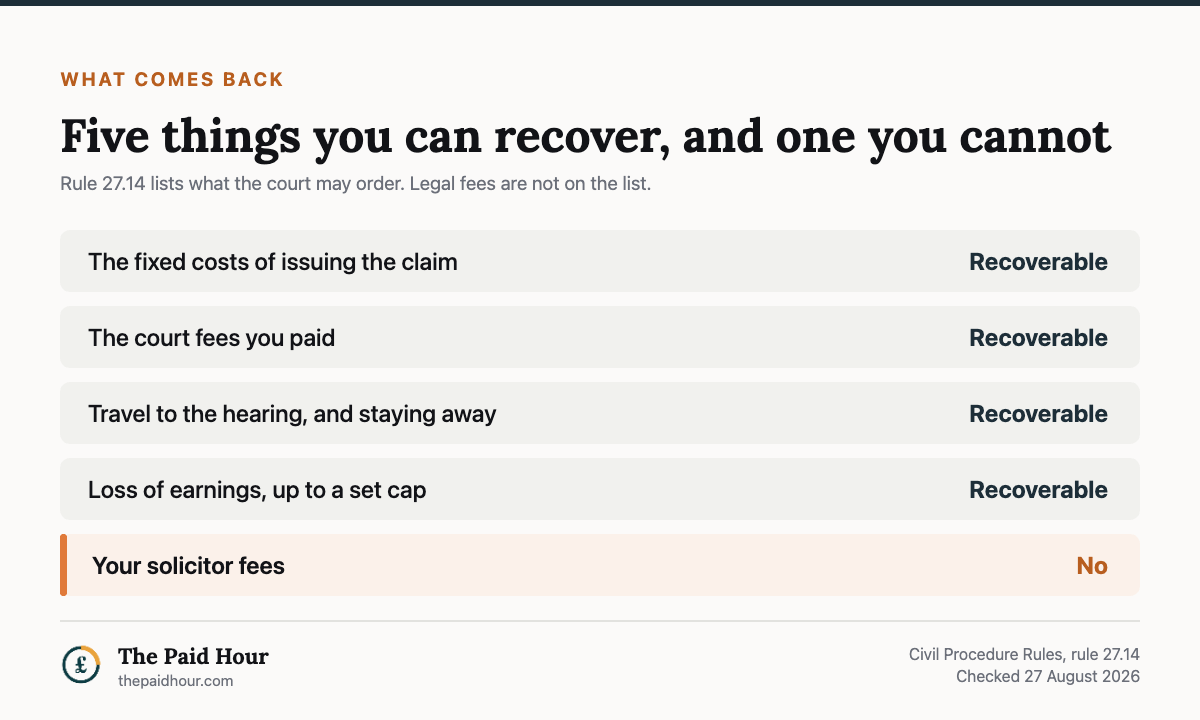
The fixed costs of issuing. The court fees. Expenses reasonably incurred in travelling to and from a hearing or in staying away from home. A capped sum for loss of earnings or loss of leave. A capped expert’s fee. And, separately, further costs against a party who has behaved unreasonably.
The caps on loss of earnings and expert’s fees are set in Practice Direction 27A rather than in the rule itself, and they change. Look them up rather than taking a figure from any article, including this one.
The loss of earnings line matters more to you than most
An employee attending a hearing usually takes a day’s leave. A freelancer attending a hearing loses a day’s income, and there is no leave to take.
The rule recognises that, which is fair. What it does not do is make you whole, the sum is capped, and for anyone billing at a normal freelance day rate the cap will be well below the real cost of the day.
Put that in the calculation before you file. A hearing on a £900 claim can cost you most of what you are claiming in time you cannot bill.
Who can speak for you at a small claims hearing
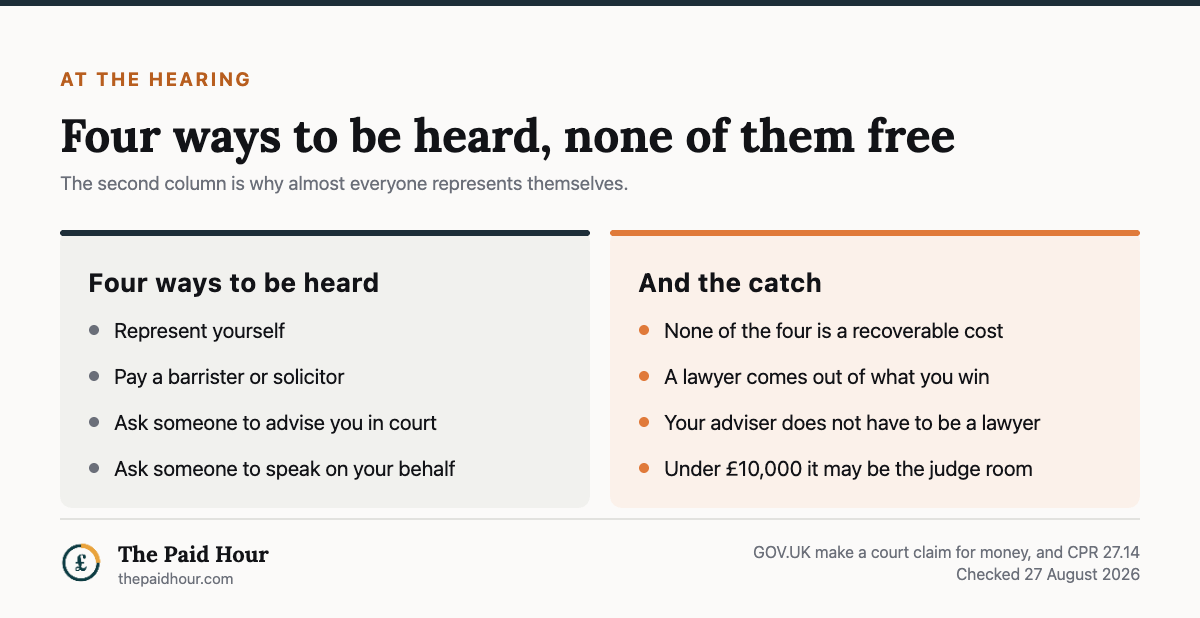
GOV.UK gives four options, and the third is the one almost nobody knows about: you can ask someone to advise you in court, and they do not have to be a lawyer. You can also ask someone to speak on your behalf.
For a freelancer who finds the prospect of speaking in a hearing worse than the money involved, that is a real option: a friend who is calm under pressure, sitting next to you.
And the setting is less intimidating than the phrase court hearing suggests. For claims under £10,000 the hearing may be held in the judge’s room rather than a courtroom.
The unreasonable behaviour exception
There is one door out of the costs restriction: the court can assess and order further costs against a party who has behaved unreasonably.
People reach for this more often than it works. The rule anticipates the most common attempt and closes it: a party’s rejection of an offer in settlement will not of itself constitute unreasonable behaviour, though it can be taken into account.
So turning down a low offer and then winning does not get you your costs. What can amount to unreasonable behaviour is conduct — failing to engage rather than turning up, running a defence with nothing behind it.
Which is also, incidentally, the answer to the worry about the other side’s lawyer. If they behave badly, the costs rule has something to say. If they simply lose, it does not.
So what does a small claims case actually cost
Three things, and only one of them comes back.
The court fee, which you add to the claim and recover if you win. A hearing fee, if the case is defended and listed, published with the other court fees, and also recoverable. Your time, which is not recoverable beyond the capped loss-of-earnings sum and which is, for a freelancer, the largest item on the list.
Add a solicitor and you have added a cost that no outcome will return. For a four-figure invoice that is rarely the right trade; for a defended claim about whether the work was any good, it sometimes is.
The small claims mistake worth avoiding
Most claims never reach a hearing. They are paid when the claim form arrives, settled through mediation, or decided in default because the other side ignored it.
The expensive version is the defended claim where the dispute is about the quality or scope of the work instead of the fact of the debt. That is the one that costs a day, produces an argument about what was agreed, and turns on documents.
Which is the strongest argument for a written contract that anyone will ever make to you. Not because it prevents the dispute, because it decides it in an afternoon rather than over a year.
What to keep
Receipts for travel and any overnight stay, because those are expressly recoverable and nobody keeps them.
Evidence of what the day cost you, a diary showing the work you moved, an invoice you could not raise. And the whole paper trail of the debt itself, from the invoice through every reminder to the letter before action. The hearing is decided on documents far more than on what anyone says on the day.
Ready to file? Our step-by-step guide to Money Claim Online covers the fee bands, what to write, and what happens after you submit.
Owed money right now?
Late Payment Recovery & Legal Safeguards. The seven-stage escalation ladder with dates, every letter written for you, an interest calculator that adds what the law owes you, and the Money Claim Online walkthrough with real fees.
- Reminder letters for stages one to four, then a Letter Before Action that complies with the Pre-Action Protocol (company and individual versions)
- Auto-calculating statutory interest and compensation statement: £40 to £100 per invoice plus interest at base rate plus 8%
- Payment plan with a default clause, particulars of claim wording, hearing bundle index, and the client scorecard that fires slow payers
A solicitor charges around £40 plus VAT for a single letter before action. This is every letter in the sequence, the interest you are legally entitled to claim, and the court route, for one fee.
Buying more than one? The Complete Freelancer System, all five for £87, against £215 at full price.
Sources
- Civil Procedure Rules Part 27: the small claims track
- Make a court claim for money: what happens at the hearing: GOV.UK
- Make a court claim for money: court fees: GOV.UK
- Make a court claim for money: GOV.UK
The list of recoverable costs, the wording on travel and staying away from home, and the sentence that a party’s rejection of an offer in settlement will not of itself constitute unreasonable behaviour are quoted from rule 27.14 of the Civil Procedure Rules. The caps on loss of earnings and expert’s fees are set in Practice Direction 27A and are deliberately not quoted here, check the current figures directly.
The four ways to be represented, and the point that a hearing under £10,000 may be held in the judge’s room, are from GOV.UK. All read on 27 August 2026. This is general information about how the process works, not legal advice: for a defended claim, take advice from a solicitor.