
Quick answer: Statutory Sick Pay requires an employer, so as a sole trader you have none. What exists instead: New Style ESA if you have the NI record, Universal Credit with its Minimum Income Floor caveat, Maternity Allowance for new parents, and income protection insurance if you want a private layer.
Self-employed sick pay does not exist by that name, there is no automatic safety net waiting for you. One of the least-discussed parts of going self-employed: get too ill to work, and there’s no employer sitting there paying you Statutory Sick Pay. Here’s what exists instead, and what doesn’t.
Table of Contents
Statutory Sick Pay: not available to you
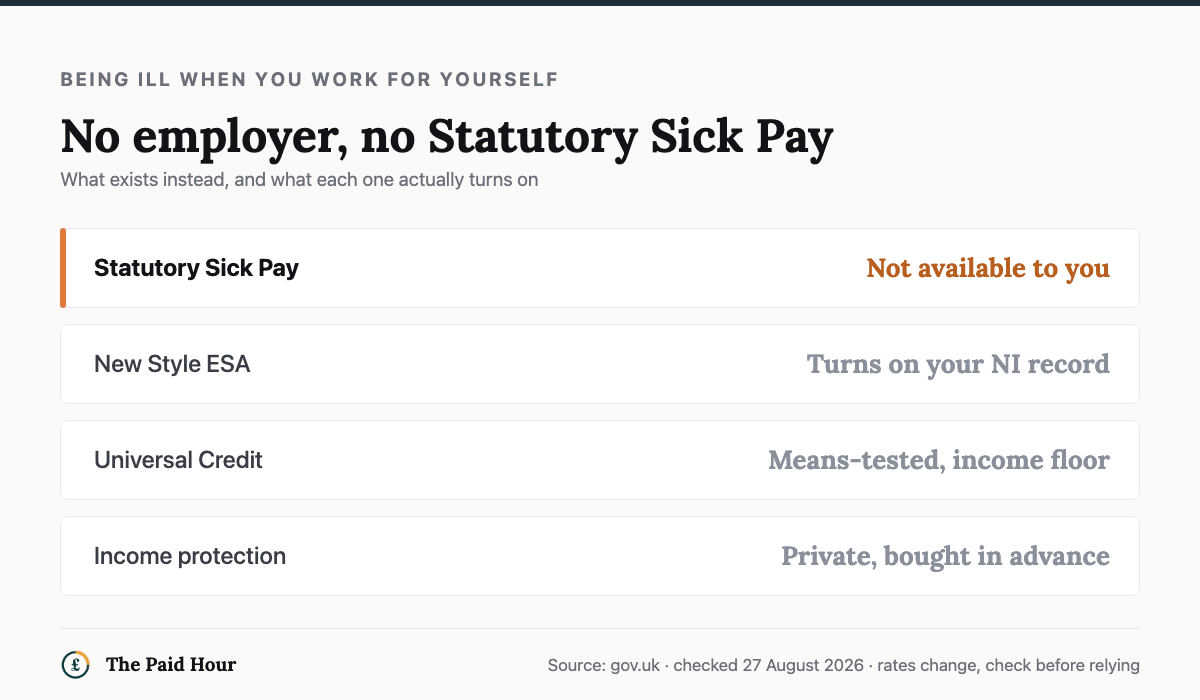
Worth stating plainly, because it surprises people who’ve come from employment: Statutory Sick Pay (SSP) is only for people classed as an employee, paid by their employer, currently up to £123.25 a week for up to 28 weeks. There’s no self-employed equivalent of SSP paid by HMRC or anyone else, none at all. (Source: gov.uk, Statutory Sick Pay)
What you can claim instead
New Style Employment and Support Allowance (ESA) is the closest equivalent going. To qualify, you generally need to be under State Pension age, have a health condition that limits your ability to work, and have enough National Insurance contributions or credits from working. As an employee or self-employed, in roughly the last 2 to 3 years. ESA can’t be claimed alongside SSP or Jobseeker’s Allowance, but it can be claimed alongside Universal Credit, with your UC payment adjusted accordingly. (Source: gov.uk, ESA eligibility)
Universal Credit is the other main route if illness cuts into your income, and it’s covered in more detail below.
Maternity Allowance for the self-employed
Statutory Maternity Pay isn’t available to you, which is usually the case for the self-employed, so Maternity Allowance is the equivalent:
- Maximum rate: £194.32 a week (or 90% of your average weekly earnings if that’s lower), paid for up to 39 weeks.
- To qualify: you need to have been registered as self-employed for at least 26 of the 66 weeks before your baby is due. That is the whole qualifying test for the self-employed route. The £30-a-week earnings condition you will see quoted elsewhere belongs to the employed route: GOV.UK attaches it only to people who have been employed. What decides your rate is National Insurance.
- Paying Class 2 National Insurance (£3.65/week) for 13 or more of those 66 weeks secures you the full rate; pay less and your payment can drop to a minimum of £27/week, though you can make voluntary Class 2 contributions to bring it back up.
(Source: gov.uk (Maternity Allowance, what you’ll get; gov.uk), Maternity Allowance eligibility)
Worth double-checking your own eligibility directly on gov.uk before relying on these figures for a specific claim — the self-employed Class 2 rule is spelled out clearly on the payment-amount page, but isn’t repeated in as much detail on the general eligibility page.
Universal Credit and the “Minimum Income Floor”
Claim Universal Credit while self-employed, and you need to know about the Minimum Income Floor (MIF): UC assumes you’re earning at least what someone on the National Living or Minimum Wage would earn in a similar role, after notional tax and NI, even if your actual profit that month is lower. Real earnings below that assumed floor, and your UC gets calculated using the higher assumed figure rather than your real one, which can mean a lower payment than actual earnings alone would suggest.
There’s a carve-out to know about: people new to self-employment, or returning to it, get a 12-month start-up period where the MIF isn’t applied at all, and your UC is based on your real earnings instead. (Source: gov.uk, Universal Credit and self-employment, quick guide)
A private option to be aware of: income protection insurance
No self-employed sick pay means some freelancers look at income protection insurance instead, a private policy that typically replaces roughly 50 to 65% of income if illness or injury stops you working, after a waiting period, commonly 4, 13, or 26 weeks, or even a full year depending on the policy. This is different from critical illness cover (a lump sum for specific serious conditions) or private medical insurance (which pays for treatment rather than lost income). (Source: MoneyHelper, what is income protection insurance)
We’re not recommending a specific policy or provider here: it’s a “get quotes and compare” decision based on your health, your income, and how much waiting period you can financially absorb.
The takeaway
Self-employed, and the honest summary is this: no SSP, but ESA and Universal Credit exist as fallbacks; Maternity Allowance exists and is worth planning your Class 2 contributions around if a family’s on the horizon; and private income protection is the closest you’ll get to “what sick pay would have given me,” if that gap worries you.
This is general information, not personalised financial or benefits advice. Check your specific entitlement on gov.uk or via Citizens Advice. Retirement is another gap worth planning for early since self-employed sick pay is not the only thing missing, see our guide on pensions when you are self-employed.
No employer, no sick pay, no pension. Built yours yet?
Pension & Safety Net for the Self-Employed 2026/27. Eight modules and four working sheets that turn “I should sort my pension out” into a plan you can finish in an afternoon, with the tax relief doing a third of the work.
- Your State Pension forecast, qualifying years, and when voluntary Class 2 is worth paying and when it buys nothing
- The Self Assessment step that recovers higher-rate relief, which most people never claim
- Sick pay, income protection and critical illness: what each actually pays, and the underwriting traps for the self-employed
There is no statutory sick pay for the self-employed at all. Higher-rate pension relief is not automatic either. Both are fixable in an afternoon, and both are still costing most freelancers money.
Buying more than one? All ten 2026/27 courses for £107, against £328 at full price.
Read next
- Self-Employed State Pension Forecast: Fix the Gaps
- How to Budget With Irregular Income as a Freelancer
- Business Savings Accounts for Your Tax Pot
- Business insurance for the self-employed: what is worth buying
Self-employed sick pay: common questions
Can you get sick pay if you are self-employed?
Not Statutory Sick Pay. SSP is paid by an employer, and HMRC’s eligibility rules require you to be classed as an employee. A sole trader has no employer, and there is no self-employed version of SSP paid by HMRC or anyone else. What exists instead is New Style ESA and Universal Credit. (gov.uk, SSP eligibility, checked 3 September 2026.)
Can I claim SSP if I am self-employed?
No, not on your self-employed income. The one exception is if you also hold a PAYE job alongside the self-employment: that employer can pay SSP on those employed earnings, on the normal employee rules. It changes nothing about the self-employed side.
What is the self-employed equivalent of sick pay?
New Style Employment and Support Allowance is the closest thing. It pays up to £75.65 a week under 25 or £95.55 a week at 25 and over during the assessment phase, which lasts up to 13 weeks, then up to £95.55 in the work-related activity group or £145.90 in the support group. It is based on your National Insurance record from roughly the last two to three years, not on your savings. (gov.uk. ESA rates, checked 3 September 2026.)
Is there a sickness benefit for the self-employed?
Two, and they work differently. New Style ESA is contribution-based, so it depends on your NI record and not your household income. Universal Credit is means-tested and can be claimed alongside it, but once your start-up period ends the Minimum Income Floor can assume you earn more than you do.
How much is statutory sick pay for the self-employed?
Nothing. There is no rate to look up, because the scheme does not apply to you. The figures worth planning around are the ESA rates above and whatever an income protection policy would pay.
Sources
- gov.uk: Statutory Sick Pay
- gov.uk, Employment and Support Allowance: eligibility
- gov.uk: Maternity Allowance: eligibility
- gov.uk — Maternity Allowance: what you will get
- gov.uk, Self-employed National Insurance rates
Every figure on this page was re-checked against GOV.UK on 27 August 2026. The £123.25 Statutory Sick Pay rate is GOV.UK’s own, on a page last updated 14 August 2026; the £194.32 maximum and £27 minimum Maternity Allowance rates come from Maternity Allowance: what you will get; and the £3.65 weekly Class 2 rate is the published rate for 2026 to 2027.
No New Style ESA amount is quoted here on purpose: the GOV.UK page carrying those rates has not been updated recently enough to rely on, and a benefit rate that might be a year out of date is worse than no figure at all. That the self-employed cannot claim SSP but can apply for New Style ESA was re-checked the same day. This is general information about how the rules work, not tax advice. The links above go to the primary sources; for your own circumstances, speak to an accountant or contact HMRC directly.