
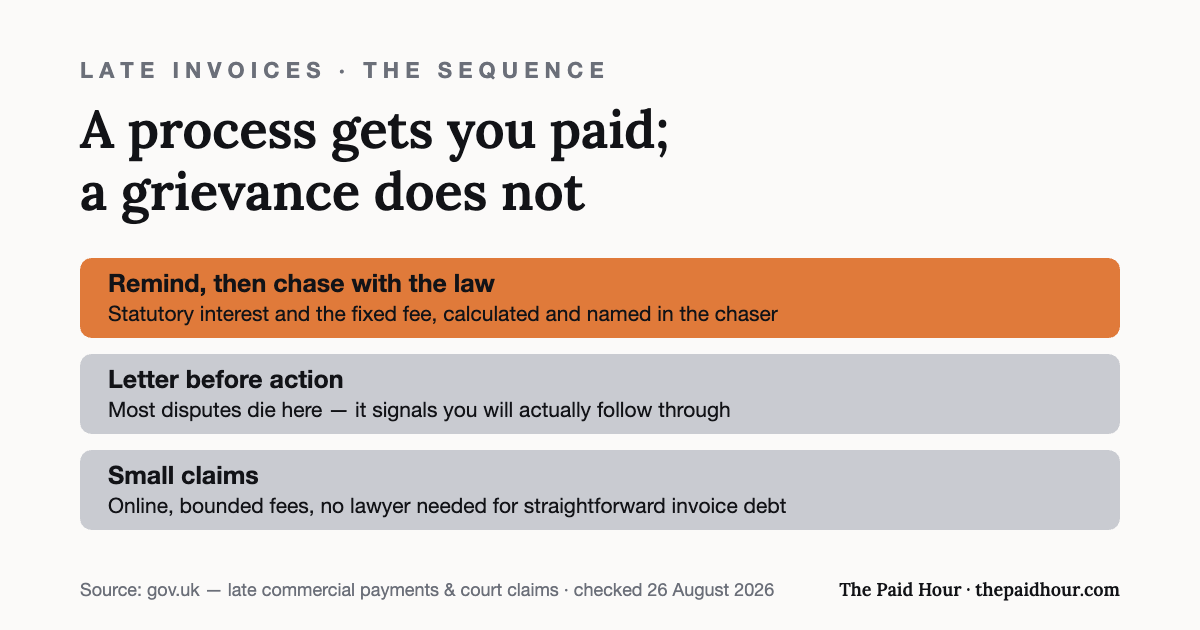
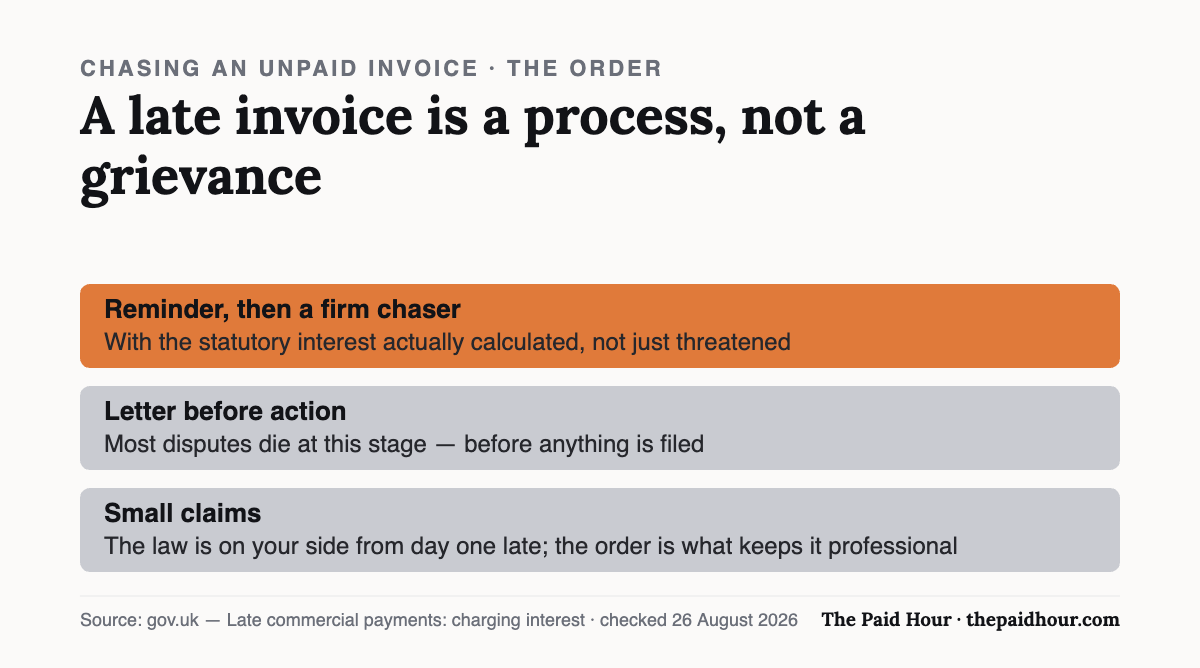
Straight answer: A late invoice is a process rather than a grievance: polite reminder, firm chaser with statutory interest calculated, letter before action, then small claims, most disputes die at the letter stage. The law is on your side from day one late; the playbook below keeps you professional while using it.
Chasing unpaid invoices UK freelancers deal with is a cash flow problem the moment one goes late, and an admin headache the longer you leave it. This post is the practical side: what to do, in what order, when a business client goes quiet on an invoice.
For the underlying law (the exact statutory interest rate and fixed compensation amounts you’re entitled to), read our companion piece, Late Payment Interest: What UK Freelancers Are Entitled To. This post assumes those rights exist under the Late Payment of Commercial Debts (Interest) Act 1998 and focuses on the chase itself.
Scope note: this all applies to business-to-business invoices. The 1998 Act’s interest and compensation rights don’t apply to individual consumers paying you personally (legislation.gov.uk).
What’s the right order to chase unpaid invoices?
Escalate gradually when chasing unpaid invoices UK clients are late on, a paper trail showing reasonable chances to pay matters if this ever reaches court.
The sequence runs from a friendly nudge, through a firmer follow-up, to written notice that statutory interest is accruing, then a formal Letter Before Action, and finally court or a collection agency. Each stage has a timing, a template and a check before you escalate, the full day-by-day ladder, with the exact wording for every email and letter, is in the Late Payment Recovery course.
Keep every email and letter, this is exactly what a judge wants to see if it goes that far.
When should I add statutory interest to unpaid invoices?
You’re entitled to statutory interest and fixed compensation the moment a qualifying B2B debt goes late: you don’t need to ask or wait for a court to award it (legislation.gov.uk). The practical question is when to put it in writing.
Don’t add it silently to the original invoice. After one or two polite reminders go unanswered, send a separate follow-up statement itemising the original amount and due date, interest accrued so far, the fixed compensation for that debt band (currently £40, £70, or £100, see the interest post for how the bands work), and a new total and deadline. This puts the client on formal notice and dates exactly when interest started, useful evidence later.
Check your contract first: if your terms already set a different late payment remedy, that can override the statutory scheme, but only if it’s a “substantial remedy,” not a token clause (legislation.gov.uk).
What does a formal Letter Before Action need to say?
A Letter Before Action (or “Letter of Claim”) is the final written warning stage in chasing unpaid invoices UK freelancers escalate before court proceedings. Courts expect it to broadly follow the Pre-Action Protocol for Debt Claims. Include:
In outline, it identifies both parties and the invoices, summarises what has already been chased, states the statutory interest and compensation now owed, and sets a final deadline (14 days is standard), with a clear statement that court proceedings follow without further notice. It also needs to comply with the Pre-Action Protocol to carry weight; the compliant fill-in template is part of the course.
Send it by email and recorded post if the amount is meaningful, so you have proof of delivery.
When are unpaid invoices worth small claims court?
This is usually the last resort in chasing unpaid invoices UK freelancers can escalate to on their own, without hiring a solicitor.
In England and Wales, claims up to £10,000 go through the small claims track — designed to be usable without a solicitor (Small Business Commissioner). File online via Money Claim Online. Court fees scale with the amount claimed: e.g. £70 for £500.01–£1,000, up to £455 for £5,000.01–£10,000 (gov.uk), and you can usually add the fee plus your statutory interest and compensation to the claim.
It’s worth it when the debt is clear-cut and undisputed, the amount justifies your time and the fee, and the client looks solvent (a quick Companies House or Gazette check for insolvency notices first is sensible, chasing a company in administration rarely pays off). For disputed or high-value debts, get a solicitor’s view first; many offer free initial consultations.
Before court, try the free Small Business Commissioner complaints and mediation service for B2B late payment disputes, it stops helping once legal proceedings start, so use it first (Small Business Commissioner).
What if they still don’t pay after a court judgment?
This is the final stage of chasing unpaid invoices UK freelancers sometimes have to go through. A County Court Judgment (CCJ) confirms the debt is owed and damages the debtor’s credit record, but isn’t payment itself. You may need enforcement (a warrant of control, attachment of earnings, or third-party debt order) if they don’t pay voluntarily. For persistently unresponsive debtors, a no-win-no-fee debt collection agency is sometimes a better use of your time than further court action, weigh it against the size of the debt.
Related reading on unpaid invoices
This is general information rather than legal advice. For a disputed or high-value debt, or an insolvent client, speak to a solicitor before taking legal action.
Sources
- Late Payment of Commercial Debts (Interest) Act 1998, s.2, scope
- Late Payment of Commercial Debts (Interest) Act 1998, s.5A: fixed sum compensation
- Late Payment of Commercial Debts (Interest) Act 1998, s.8, contract terms and substantial remedy
- gov.uk. Make a court claim for money
- gov.uk, Court fees for money claims
- Small Business Commissioner: Legal action for late payments
- Bank of England — Bank Rate
The statutory interest and fixed sums were re-checked against gov.uk on 26 August 2026.
Related: how long you can chase an unpaid invoice, six years in England, Wales and Northern Ireland, five in Scotland, and a written acknowledgement restarts the clock.
Owed money right now?
Late Payment Recovery & Legal Safeguards. The seven-stage escalation ladder with dates, every letter written for you, an interest calculator that adds what the law owes you, and the Money Claim Online walkthrough with real fees.
- Reminder letters for stages one to four, then a Letter Before Action that complies with the Pre-Action Protocol (company and individual versions)
- Auto-calculating statutory interest and compensation statement: £40 to £100 per invoice plus interest at base rate plus 8%
- Payment plan with a default clause, particulars of claim wording, hearing bundle index, and the client scorecard that fires slow payers
A solicitor charges around £40 plus VAT for a single letter before action. This is every letter in the sequence, the interest you are legally entitled to claim, and the court route, for one fee.
Buying more than one? The Complete Freelancer System, all five for £87, against £215 at full price.
Read next
- Letter Before Action: 30 Days or 14, Depending Who Owes
- Small Business Commissioner: Free, 12 Months, Not Binding
- Free download: Unpaid Invoice: Your First Three Moves