

What matters here: A statutory demand costs nothing to send. No court issues it, no fee is payable, and GOV.UK says in as many words that you do not need a lawyer. That is the whole appeal, and the whole danger. It only bites on a debt of £750 or more owed by a limited company, or £5,000 or more owed by a sole trader or any other individual. They then get 21 days. An individual can apply to have the demand set aside within 18 days; a company cannot apply at all. And if they simply ignore it, the only thing waiting behind it is a petition that costs you £1,852 or £2,952 to present.
Table of Contents
Somebody in a freelancing group tells you to send a statutory demand. It sounds official, it sounds free, and by the sound of it the money turns up within three weeks. Two of those three are true.
What almost nobody explains is what the thing actually is. A statutory demand is not a strongly worded reminder. It is the first formal step of insolvency, and what gives it force is not the letter at all. It is what you are willing to do on day 22.
The cheapest letter in debt recovery
GOV.UK is unusually blunt about who may send one: “Anyone who is owed money (the creditor) can make a statutory demand. You do not need a lawyer.” No court seals it. No fee is charged. You fill in the form, you get it into the debtor’s hands, and the clock starts.
Set that against everything else in the chase. A letter chasing an unpaid invoice is a request. A county court claim costs a fee and takes months. A statutory demand costs nothing and arrives with the word insolvency attached to it.
That asymmetry is the whole appeal, and it is also the trap. You are not asking to be paid. You are asserting, in a document a judge may later read, that this business or this person cannot pay their debts as they fall due. Say that about a solvent company and you have made a claim you might have to defend.
Your client decides whether you have this tool at all
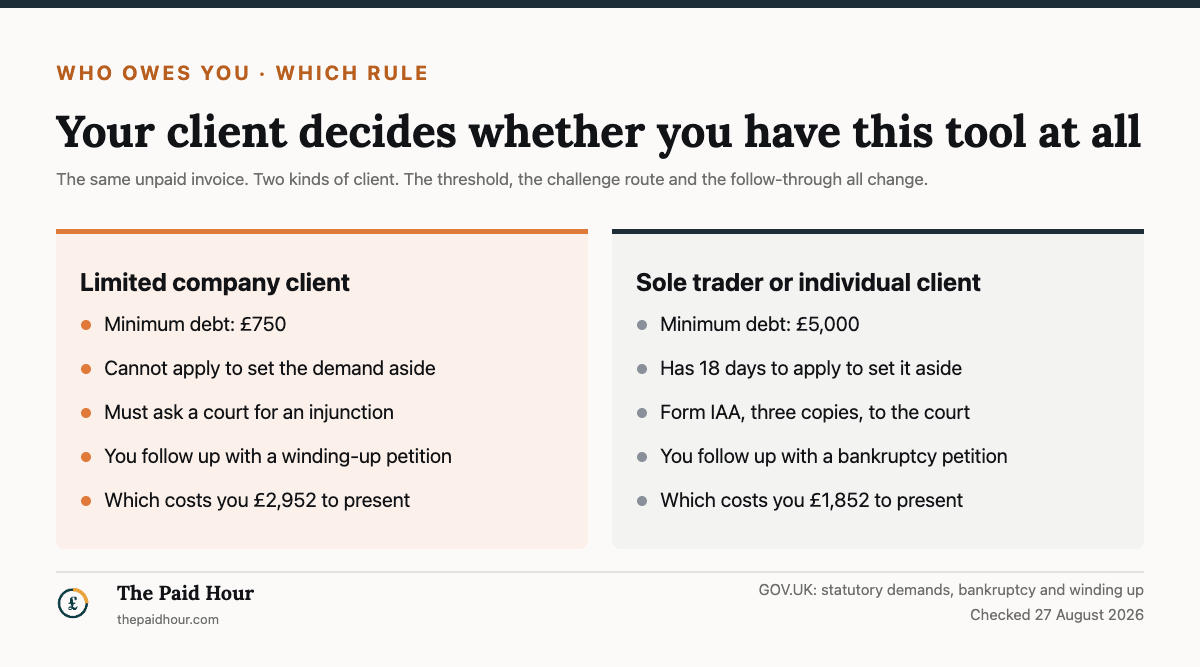
There are two thresholds and they are nowhere near each other. A statutory demand can be used to start winding up a company that owes you £750 or more. To start bankruptcy proceedings against an individual, which covers a sole trader, and covers a member of a partnership. The debt must be £5,000 or more.
Most freelance invoices land in the gap between those numbers. A £2,000 invoice is a live statutory demand against a limited company client and a dead one against a sole trader client. Same work, same invoice, same amount outstanding. The legal form of whoever owes it decides whether the tool exists.
So the first move is not to draft anything. It is to establish exactly who you contracted with. The name on the invoice, and whether it ends in Limited or Ltd. Ten minutes on Companies House settles that, and it is the same ten minutes that tells you whether the company has anything worth chasing.
One further limit sits on top of both. If the debt is more than six years old, GOV.UK says you cannot usually make a statutory demand. The same six years that governs how long you have to chase an unpaid invoice in the first place.
Twenty-one days, and what a debtor does with them
Once a statutory demand has been served, the debtor has 21 days to do one of two things: pay the debt, or reach an agreement to pay it.
The second option deserves more attention than it gets. An agreement to pay ends the statutory demand just as effectively as the money landing. For a client who is slow rather than broke, that is usually what happens, three instalments, in writing, first one on Friday. It makes a duller story than a court hearing. It also gets you paid.
Take it. A signed payment plan from a business that is still trading beats a judgment against an empty shell every time.
An individual can kill it, a company cannot, and that is not good news
Serve an individual and they have a cheap, well-signposted way out. GOV.UK gives them 18 days to apply to challenge the statutory demand if they were in the UK when they received it, or 21 to 34 days if they were abroad. They download form IAA, make three copies, and take or post them to the court named on your demand. If the court accepts the debt is disputed, the statutory demand is set aside and you are back at the start, minus your costs.
Serve a company and the guidance says something that looks, at first glance, like a gift: “You cannot challenge a statutory demand if it was served on a company.” No set-aside application. No 18-day window. Nothing for them to fill in.
Read the next line and it inverts. The company’s route is to apply to stop its creditors winding it up. An injunction, brought by solicitors, on the footing that you are threatening insolvency proceedings over a debt that is in dispute. Where a court agrees, the bill for that application is yours, and this is not an area where courts have been gentle about it.
Which gives the rule that matters more than every threshold and deadline above. A statutory demand is for a debt nobody is arguing about. If your client has ever written back to say the work was late, wrong, or not what they ordered, put the form down and use the ordinary route. A debt does not stop being disputed because you are certain you are right.
What actually happens on day 22
Nothing. That is the part the free template packs leave out.
An expired statutory demand does not get you paid, does not create a debt any court has recognised, and does not land on a credit file. All it does is unlock the next step, and the next step has a price list.
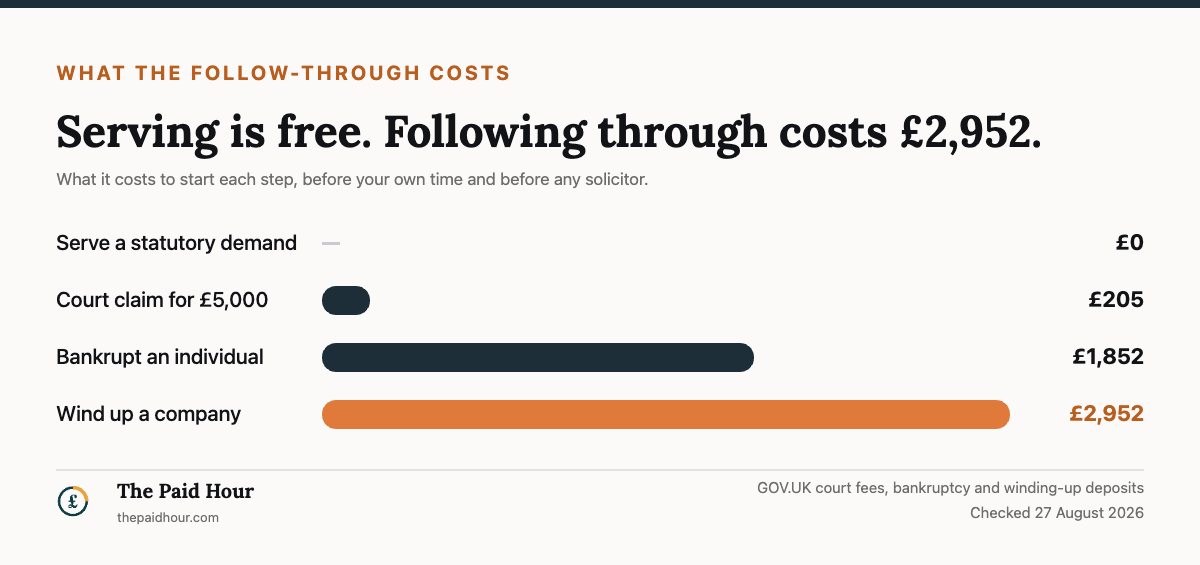
Bankrupting an individual takes £352 in court costs and a £1,500 petition deposit: £1,852 before anybody has been paid to help you. Winding up a company takes £352 in court fees and a £2,600 deposit, so £2,952. Listing the options open to anyone who is owed money, GOV.UK adds the line that belongs on the front of every template pack: “The costs are high and you may not get any of your money back.”
Put that next to an ordinary claim. Suing for £5,000 through the courts costs £205, and that fee is added to the claim rather than spent. Winding up a company over £750 costs roughly fourteen times as much to start as suing for £5,000 does, and what comes out of a liquidation goes to the liquidator, then the staff, then HMRC, then the bank, and then, if anything is left, to you.
That is the arithmetic nobody puts in the template. You spend £2,952 to join a queue.
So it is a bluff, and bluffs cost something
Worth being honest about why these get sent. A winding-up petition is public. It is advertised, banks freeze accounts on sight of one, and a company with any life left in it will clear a five-figure invoice rather than let that start. The threat is real, and pointed at the right debtor it is the most effective thing in this entire area of law.
But a statutory demand only carries that weight while the debtor believes you will follow through. Call it, watch nothing happen, and they have learned exactly what your letters are worth. You will need those letters again.
Decide before you serve, then, not on day 22. If £2,952 against this particular debt is not a number you would actually spend, a statutory demand is not your tool, and there is nothing embarrassing about that. A claim for the money is slower and cheaper and ends in something you can enforce.
Serving a statutory demand so that it counts
No court is involved, so nobody serves it for you, and how it gets delivered is part of whether it works at all.
For an individual, GOV.UK describes service as “giving it to the individual who owes you money (you should try all their known addresses)”. For a company it is “leaving it at the registered office of the company or partnership that owes money (or the main place of business if they do not have a registered office)”, or handing it to a director, company secretary, manager or principal officer.
Post is the fallback, not the plan: “You can only send it by registered post or put it through a letterbox if it cannot be delivered in person.” Email does not serve a statutory demand, whatever the client’s contract says about notices.
Write down what you did and when. If you ever do petition, service has to be certified, GOV.UK asks a creditor proving a £5,000 debt to confirm it by filling in a certificate of service, form N215. Proof of delivery is the part people improvise and then regret.
When to reach for something else
- The debt is disputed. Use a court claim, where the job of deciding who is right belongs to a judge rather than to you.
- A company owes you under £750, or a sole trader under £5,000. The threshold is not met and the statutory demand is empty. An ordinary claim has no minimum.
- The client is solvent but slow. A firm letter and the interest you are already entitled to will usually move it, at no cost and no risk.
- The client is already insolvent. A statutory demand achieves nothing against a company in liquidation. Register the claim with the insolvency practitioner instead.
- Either of you sits outside England and Wales. Different rules and different courts. Take advice before spending anything.
Before any of it, check the paperwork carries its own weight: that the invoice includes everything a UK invoice must include, that your contract records what was owed and when, and that you have added statutory interest and compensation to the figure you are demanding. On the next job, take a deposit.
Sources
- Statutory demands, GOV.UK
- How to serve a statutory demand, GOV.UK
- Challenge a statutory demand, GOV.UK
- Apply to bankrupt someone who owes you money, GOV.UK
- Prove you are owed £5,000 or more, GOV.UK
- Wind up a company that owes you money, GOV.UK
- Options if you are owed money, GOV.UK
The £750 and £5,000 thresholds, the 21-day period, the 18-day and 21-to-34-day challenge windows, form IAA, form N215, the service wording and the six-year limit are all quoted from the GOV.UK pages listed above. The £352 court fee with a £1,500 deposit for a bankruptcy petition, and the £352 with a £2,600 deposit for winding up, are the figures those pages carried when they were read on 27 August 2026, court fees and deposits change, so check them again before you spend anything. This is general information about how the process works, not legal advice. For a substantial debt, or any debt the other side is arguing about, speak to a solicitor before serving anything.
Owed money right now?
Late Payment Recovery & Legal Safeguards. The seven-stage escalation ladder with dates, every letter written for you, an interest calculator that adds what the law owes you, and the Money Claim Online walkthrough with real fees.
- Reminder letters for stages one to four, then a Letter Before Action that complies with the Pre-Action Protocol (company and individual versions)
- Auto-calculating statutory interest and compensation statement: £40 to £100 per invoice plus interest at base rate plus 8%
- Payment plan with a default clause, particulars of claim wording, hearing bundle index, and the client scorecard that fires slow payers
A solicitor charges around £40 plus VAT for a single letter before action. This is every letter in the sequence, the interest you are legally entitled to claim, and the court route, for one fee.
Buying more than one? The Complete Freelancer System, all five for £87, against £215 at full price.