
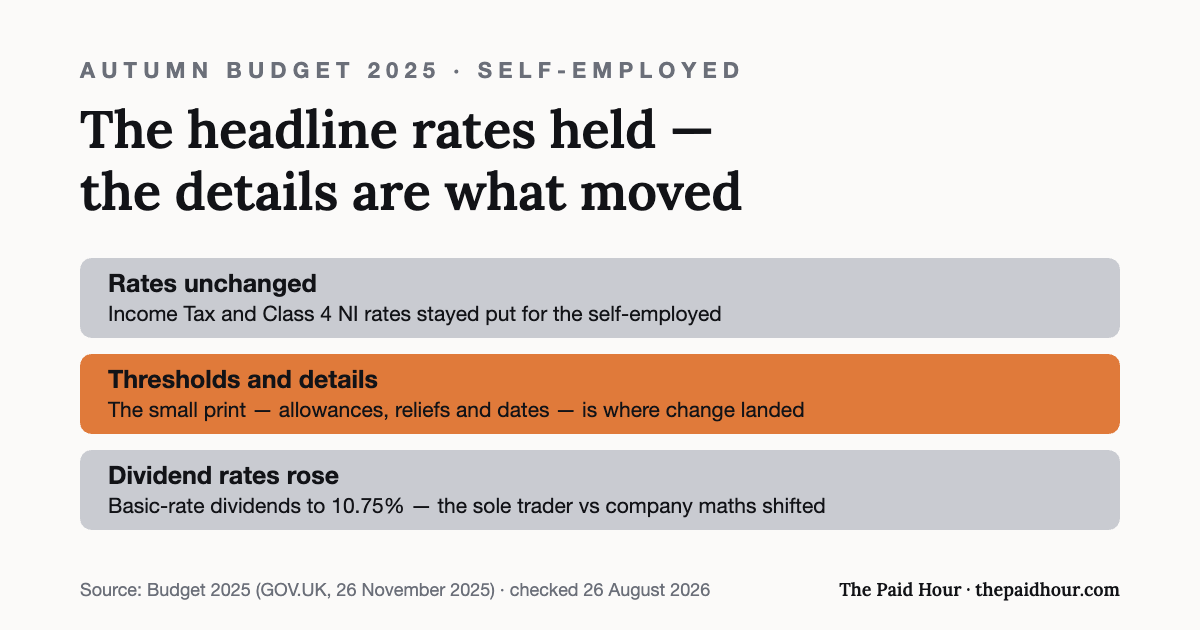
Quick answer: The Autumn Budget 2025 landed on 26 November 2025, and for the self-employed the honest summary is: little changed on the headline rates, and the details that did change are the ones worth reading. This post covers only what affects a sole trader, dated and sourced.
Table of Contents
Rachel Reeves delivered the Autumn Budget 2025 on 26 November 2025, and if you’re self-employed and only half-watched the coverage, here’s the honest version: most of the headline noise doesn’t touch your day-to-day tax bill directly. But a few things do matter if you work for yourself, and one of them is a bigger deal than most people realise yet, because it doesn’t bite for another few years.
Here’s what changed for the self-employed under Autumn Budget 2025, what didn’t, and, this bit matters, exactly when each change takes effect. Some of this is live from April 2026. Some of it doesn’t land until 2027, 2028, or even 2031. Treating any of it as already-in-force would be wrong, so dates are doing a lot of work in this post.
Autumn Budget 2025 self-employed headline: your tax-free allowance is frozen for five more years
This is the change that affects almost every self-employed person reading this, and it’s not really a change at all, it’s an extension of something already happening. The Personal Allowance has been stuck at £12,570 since 2021, and the higher-rate threshold at £50,270. That freeze was due to thaw in April 2028. Under Autumn Budget 2025, it’s now been pushed back to April 2031.
Nobody’s tax rate has gone up. That’s the bit worth being blunt about: the 20%, 40% and 45% income tax bands are exactly where they were. What’s happened is quieter and, over time, costs more, as your day rate or turnover creeps up with inflation, more of your profit gets dragged into tax you didn’t used to pay, purely because the thresholds haven’t moved.
Accountants call it fiscal drag. It’s a tax rise that never has to be voted through as one, which is presumably the point. Say your turnover grows 4% a year purely to keep pace with inflation: your tax-free slice of that income shrinks in real terms every single year the allowance stays frozen, even though the rate on paper never moves.
If you want the full breakdown of where the 2026/27 bands sit, we’ve covered that separately in our Income Tax Rates for 2026/27 guide.
Put another way: Autumn Budget 2025 didn’t raise a single income tax rate on paper, and most coverage the next morning led with exactly that line. It’s technically true and slightly misleading at the same time — the freeze extension is a tax rise in every practical sense for anyone whose income moves in line with inflation, which is most self-employed people over a five-year stretch.
What this means for Class 2 and Class 4 National Insurance
Same story, different tax. The Lower Profits Limit for Class 4 National Insurance is aligned to the Personal Allowance, and the Upper Profits Limit to the higher-rate threshold, so both of those are frozen alongside income tax, out to April 2031.
The rates themselves haven’t moved: it’s still 6% on profits between £12,570 and £50,270, and 2% above that. Nothing new to plan around here beyond the same drag effect described above. We go into the full rate table in our Self-Employed National Insurance guide.
Dividend tax is going up, this one’s real, and it’s from April 2026
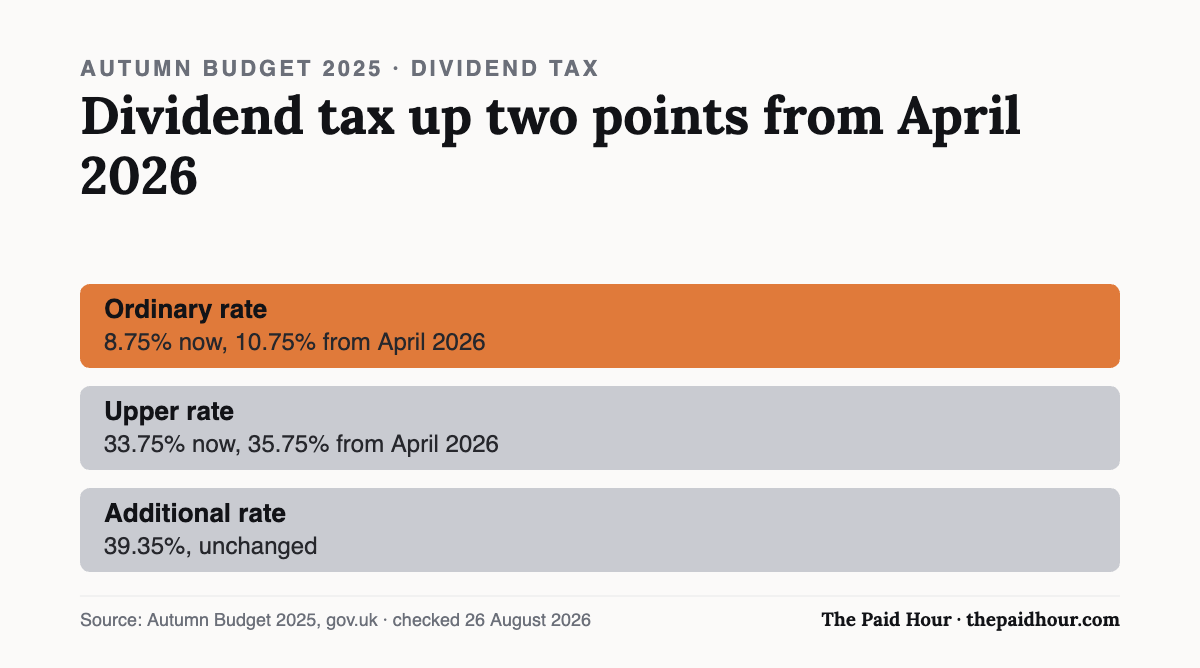
If you trade through a limited company and pay yourself in dividends, this is the Autumn Budget 2025 change to actually plan around. From April 2026, dividend tax rises by two percentage points across the two main bands:
| Band | 2025/26 rate | From April 2026 |
|---|---|---|
| Ordinary rate (basic) | 8.75% | 10.75% |
| Upper rate (higher) | 33.75% | 35.75% |
| Additional rate | 39.35% | 39.35% (no change) |
Two points on this. First, it doesn’t touch sole traders directly, if you’re not running a limited company, you’re not drawing dividends, so this one doesn’t apply to you.
Second, if you are weighing up sole trader versus limited company for next tax year, this narrows the gap slightly in favour of staying unincorporated, though it rarely flips the decision on its own, the gap was wide enough before this that two percentage points on dividends alone won’t usually be the deciding factor. We’ve run the actual numbers in our sole trader vs limited company dividend comparison if you’re weighing that up.
A rough worked example: a director drawing £40,000 in dividends above the £500 tax-free dividend allowance, sitting in the basic-rate band, is paying roughly £800 more a year in dividend tax from April 2026 than they were the year before, purely from the rate change. Before any other Autumn Budget 2025 measure is factored in.
The VAT threshold did not change in the Autumn Budget 2025
There was a fair bit of chatter before the Budget about whether the VAT registration threshold might be raised to help small businesses, or cut to bring more of them into the VAT system. Neither happened under Autumn Budget 2025.
It stays at £90,000 of taxable turnover in any rolling 12-month period, the level it was set at in April 2024, and nothing in the Budget documents touches it. If you’re bumping up against that number, the rule hasn’t moved, and our VAT registration threshold guide covers what to do when you get close.
Making Tax Digital: no new rule, but a useful concession
Making Tax Digital for Income Tax was already scheduled to start in April 2026 for sole traders and landlords with qualifying income over £50,000, dropping to £30,000 from April 2027 and £20,000 from April 2028. None of that changed in this Budget, it’s the existing rollout rather than a new one.
What the Budget did add is a bit of breathing room for the first people into the system. If you’re joining MTD for Income Tax from April 2026, HMRC won’t issue penalty points for late quarterly updates for your first four submissions, and you get an extra 15 days before late-payment penalties apply.
Your actual end-of-year tax return deadline (31 January 2028, for the 2026/27 tax year) still carries normal penalties if you miss it: this concession is only about the new in-year quarterly habit rather than the annual filing itself.
Smaller Autumn Budget 2025 changes to know about
- Buying equipment or a van for the business: the main rate of writing-down allowance drops from 18% to 14% from April 2026, but a new 40% first-year allowance starts in January 2026 for qualifying plant and machinery. If you were planning a big equipment purchase anyway, doing it before the writing-down rate drops, or structuring it to use the new first-year allowance, is worth a proper look with an accountant instead of guessing.
- Mixed income (employed plus self-employed): the government has signalled it wants people with both PAYE and self-employment income to make larger in-year tax payments through PAYE, rather than settling everything at Self Assessment. This is only at the “consultation expected in 2026” stage for a change pencilled in for 2029. Nothing to act on yet, but worth watching if you have a side hustle alongside a day job.
- Property income: if you’re a sole trader who also rents out a property, separate (higher) tax rates apply to that income from April 2027: 22% basic rate instead of 20%, 42% higher instead of 40%. This doesn’t touch your trading profit, only rental income.
What to do before April 2026
If you run a limited company and take dividends, this is the one Autumn Budget 2025 change worth an actual decision before the tax year turns over. Talk to your accountant about whether it makes sense to draw a larger dividend before 5 April 2026 at the current rate, versus after 6 April 2026 at the higher one, the right answer depends on your other income and how close you are to a band threshold, so there isn’t a single rule that applies to everyone.
If you’re a sole trader, there’s nothing to action from this Budget specifically. The frozen thresholds are already priced into how much you’re setting aside for tax each quarter, assuming you’re following the standard guidance of putting 25-30% of profit aside. The only thing worth doing is not assuming your tax-free amount will rise just because a few more years have passed, plan on £12,570 staying put through 2031.
If you’re within a year or two of the MTD for Income Tax thresholds, the penalty concession is to be aware of but not worth relying on as a reason to be casual about deadlines: it only covers your first four quarterly submissions, and it doesn’t touch the payment side of things at all.
How Autumn Budget 2025 compares to the last couple of fiscal events
If you’ve been self-employed for a few years, you’ve sat through several of these now, and it’s worth saying plainly: this one is quieter than some. There’s no single measure here on the scale of the 2023 abolition of Class 2 National Insurance as a compulsory charge, or the sweeping changes to IR35 rules a few years before that.
What Autumn Budget 2025 does instead is extend decisions that were already made — the allowance freeze existed before this Budget, it’s just longer now. That’s a pattern worth recognising: a lot of fiscal policy in recent years has been about extending existing freezes and thresholds rather than announcing new headline rates, because it draws less attention while still raising revenue.
So does the Autumn Budget 2025 change anything for you right now?
For most self-employed people, not much, not yet. Your income tax rate is the same. Your Class 4 NI rate is the same. The VAT threshold is the same.
The one thing worth diarising is the dividend tax rise landing in April 2026, and only if you run a limited company. Everything else from Autumn Budget 2025 is either a threshold staying put while your income grows around it, or a rule that doesn’t start for another year or two.
The freeze extension is the one to keep an eye on longer-term. It’s not a headline you’ll see anyone shout about, but out of everything in Autumn Budget 2025, it’s the change most likely to quietly cost self-employed people more over the next five years than anything else announced.
Full detail on every measure is in the official Budget 2025 document on GOV.UK, if you want to check anything here against the source.
Filing it yourself this year?
HMRC Tax & Expense Mastery 2026/27. Nine modules and eleven working templates that take a UK freelancer from “do I even need to register” to a correct return, with MTD quarters built in.
- Fifteen expense categories, with the trap inside each one (training, clothing, meals, the seven-year pre-trading rule)
- Home and vehicle: flat rate against actual cost, with the £312 break-even worked out and the mileage lock-in rule
- The year-one payments-on-account cash shock, and the routine that stops it landing twice
HMRC does not send a list of what you forgot to claim. Most freelancers leave several hundred pounds of legitimate expenses on the table every single year, and the return still gets filed.
Buying more than one? The Complete Freelancer System, all five for £87, against £215 at full price.
Sources
A record of the measures as announced; reviewed 26 August 2026 against the linked gov.uk documents. This is general information about how the rules work, not tax advice. The links above go to the primary sources; for your own circumstances, speak to an accountant or contact HMRC directly.