
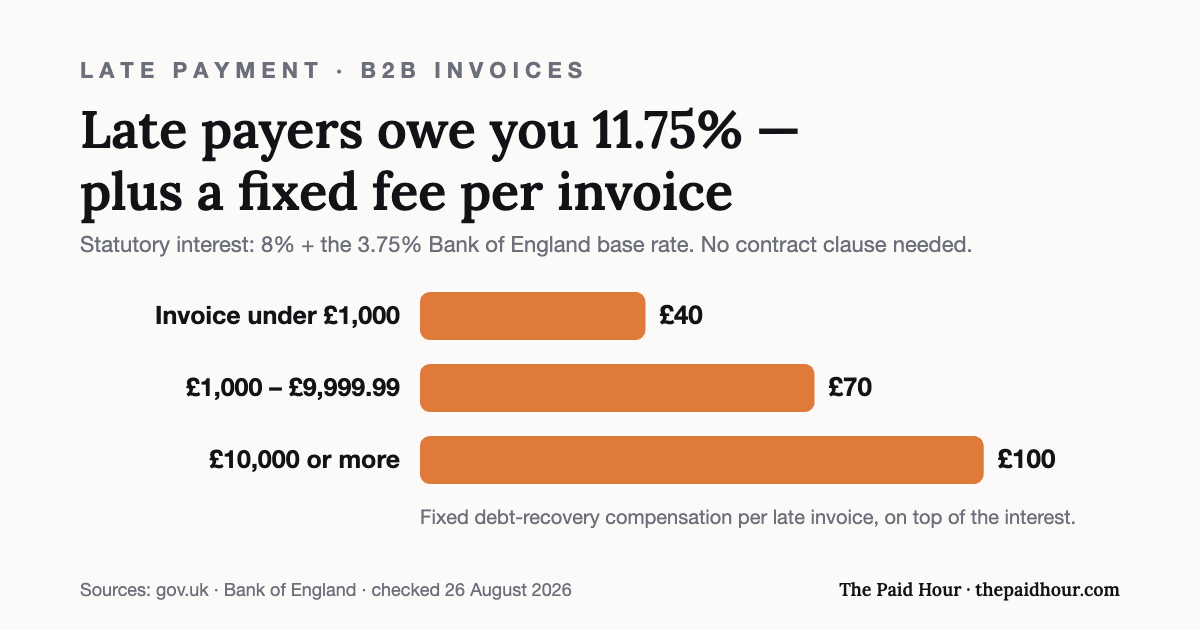
The one-paragraph answer: When another business pays you late, the law gives you statutory interest at the Bank of England base rate plus 8 percentage points (11.75% with base at 3.75%), plus fixed compensation of £40, £70 or £100 per invoice depending on its size, plus reasonable recovery costs on top. No contract clause needed. The right is automatic.
Table of Contents
Most freelancers chase late invoices with a sequence of increasingly apologetic emails, and never once mention that the law is entirely on their side.
You are not asking a favour. You are collecting a debt that has been earning interest since the day after it fell due, whether you claimed it or not.
What the law gives you on late payment, automatically
The Late Payment of Commercial Debts (Interest) Act 1998 covers business-to-business transactions. It hands you three things whether or not your contract mentions any of them:
- Statutory interest: gov.uk puts it as “8% plus the Bank of England base rate for business to business transactions”. Simple interest rather than compounded.
- A fixed sum per invoice, by size of debt.
- Reasonable recovery costs above that fixed sum, “you can also claim for reasonable costs each time you try to recover the debt”, which covers things like a collection agency’s fee.
One exclusion worth knowing: you cannot claim statutory interest where the contract sets a different rate of interest. Check the contract before you invoice for it.
What late payment comes to in money
At 11.75%, on a simple daily basis. The fixed sum is per invoice and does not depend on how late it is.
One worked example: a £2,500 invoice paid 60 days late carries £48.29 of statutory interest plus the £70 fixed sum: £118.29 on top of the invoice. The same arithmetic scales with the debt and the delay; the Late Payment Recovery course includes the per-invoice calculator that produces the exact figure, ready to paste into the chasing email.
Arithmetic from the published rate, rounded to the penny. Nobody retires on it. That is not the point, the point is that it converts a request into an entitlement, and the tone of the email changes with it.
The base rate moves, and with it the 11.75%. Check the current figure before you put it on an invoice.
Fixed late payment compensation, by debt size
| Size of debt | You can charge |
|---|---|
| Up to £999.99 | £40 |
| £1,000 to £9,999.99 | £70 |
| £10,000 or more | £100 |
Per invoice rather than per client and not per chase. Five overdue invoices of £900 each is five separate £40 entitlements, not one. For a freelancer billing in small monthly amounts, that adds up faster than the interest does.
When an invoice becomes a late payment
If the contract sets a payment date, that date governs. But it cannot run forever: gov.uk states that an agreed payment date “must usually be within 30 days for public authorities or 60 days for business transactions”. A longer term between businesses needs to be expressly agreed and not grossly unfair to you.
Where the contract says nothing, the default is stricter than most people assume: “the law says the payment is late 30 days after either: the customer gets the invoice, or you deliver the goods or provide the service (if this is later).”
Read the first half of that again. It is 30 days from when the customer gets the invoice. An invoice sitting unopened in a spam folder has not been received, and that is your problem instead of theirs, which is the practical reason for everything in the next section.
What actually gets you paid
The law is the backstop. These are the things that move money.
- Invoice the day the work lands. Not at month end. Every day you sit on it is a day added to their clock rather than yours.
- Put a real date on it. “Due 18 September 2026” is much harder to misread, and much harder to dispute, than “net 30”.
- Send it to the person who pays rather than the person who hired you. The single most common cause of a late invoice is that it never reached accounts payable. Ask for that address at the start of the job, not at the end.
- Chase on day one. A short note the morning after the due date clears most of them, because most late payments are administrative instead of deliberate.
- Escalate on a schedule, not on mood. Day 1 reminder, day 7 phone call, day 14 formal notice naming statutory interest, day 30 letter before action.
Naming the exact figure and the Act tends to move an invoice up the payment run, because the person reading it now has to explain to someone why the company is accruing a statutory liability. That is a different conversation from “just checking in”.
If it still does not arrive
A letter before action: a formal, dated demand setting out what is owed, the interest and fixed sum claimed, and a deadline before proceedings start. It costs nothing and settles a surprising number of disputes on its own.
After that, Money Claim Online handles debts up to £10,000 without a solicitor and relatively cheaply, with court fees recoverable if you win. It is slow enough to be a genuine last resort, but being visibly willing to use it is what makes everything earlier in the list credible.
Interest is only worth adding while the debt is still recoverable at all, and that window is six years in England, Wales and Northern Ireland, five in Scotland.
The 60-day late payment cap coming down the track
All of the above is the law as it stands. It is about to change, and in the freelancer’s favour, the biggest shift in late payment law in more than 25 years, on the government’s own description.
The Commercial Payments Bill was introduced in the House of Lords on 19 May 2026. It had its second reading on 9 June and finished committee stage on 21 July. It has since moved to report stage: that is the stage shown as current on the Bill’s own Parliament page, checked 27 August 2026, with the current print HL Bill 45 dated 21 July 2026, and it has not reached the Commons. So none of this is law today. Nothing below changes what you can charge on an invoice this week.
What it does when it lands: it amends the 1998 Act: renaming it the Commercial Payments and Interest on Late Payment Act 1998, and caps payment terms in commercial contracts at 60 days, or 30 days where the purchaser is a public authority not already covered by the Procurement Act 2023, with limited exemptions.
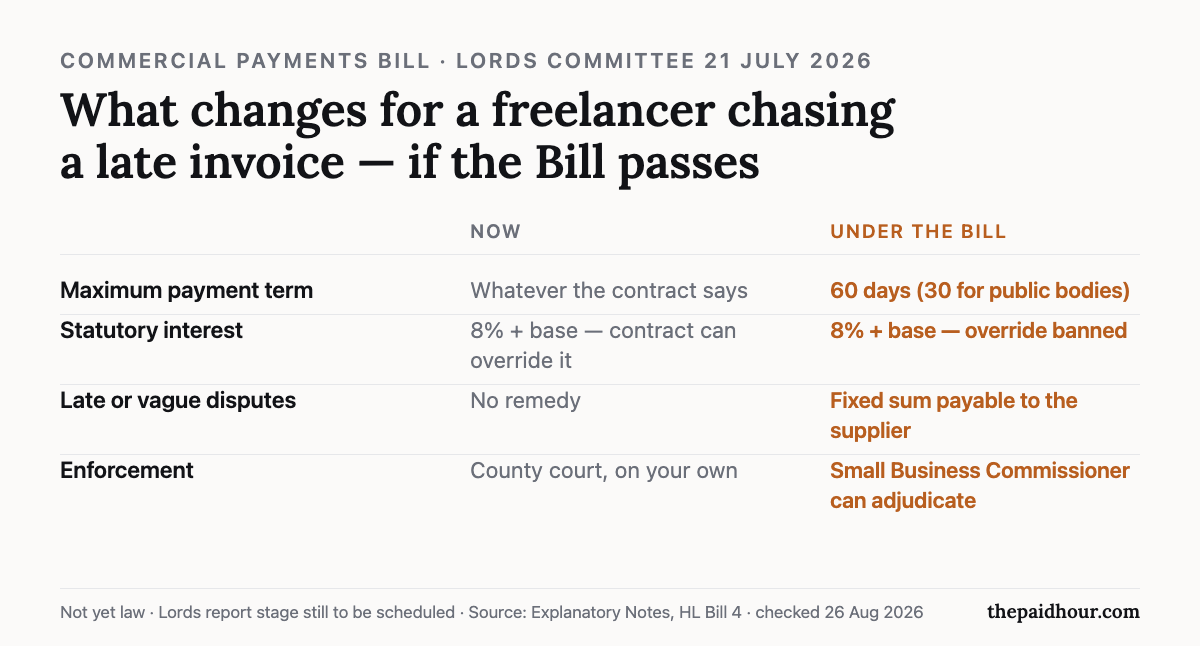
The clause that matters most to a sole trader is the quietest one. Right now, a contract that sets its own rate of interest knocks out your statutory 11.75% entirely, which is why the exclusion in the section above exists, and why some client contracts include a token 1% clause. The Bill prohibits contractual terms that exclude or vary the right to statutory interest. If it passes in that form, that clause stops working, and the 8%-above-base right becomes something a client cannot draft their way out of.
Two more worth knowing. A purchaser who raises a dispute late, or without enough information to make sense of it — the “we have queries on this invoice” email that arrives on day 58, would owe you a fixed sum for doing so. And the Small Business Commissioner gets teeth: powers to investigate persistent late payers, to impose financial penalties, and to adjudicate payment disputes between small and large businesses outside the court process, with binding interim decisions. For an invoice too small to be worth a county court claim, an adjudicator is a different proposition entirely.
The government has said there will be a lead-in period and a transition, and that none of it applies retrospectively, contracts and disputes get judged by the rules in force at the time. Practically: keep charging under the 1998 Act as it is, and do not write “60-day maximum” into a contract on the strength of a Bill that still has both Houses to get through.
The uncomfortable part
There is a reason freelancers charge statutory interest far less often than they could. The client who is late this month is also next month’s income, and no article can make that judgement for you.
But do the calculation honestly. A client who routinely pays 60 days late is taking an interest-free loan from you as a condition of the work. If you would not lend them the money outright, you are already lending it. The question is only whether you are being paid for it.
And if late payment is really a cash flow problem rather than a client problem, remember the tax bill runs on its own timetable regardless. payments on account do not wait for your invoices to clear. Getting the invoice itself right helps more than people expect, and the record-keeping side sits with your allowable expenses.
Prevention beats statute: a contract with the payment terms in writing is what makes chasing rarely necessary.
Taking a deposit up front is the cheapest protection there is against any of this, and it has its own paperwork, see invoicing deposits and part-payments.
None of this works if the invoice itself is weak. Statutory interest runs from the date the debt became late, and that date is fixed by what the invoice said and when it arrived, what a UK invoice must legally include covers the elements that decide it.
Client gone quiet on an invoice?
Late Payment Recovery & Legal Safeguards. The seven-stage escalation ladder with dates, every letter written for you, an interest calculator that adds what the law owes you, and the Money Claim Online walkthrough with real fees.
- Reminder letters for stages one to four, then a Letter Before Action that complies with the Pre-Action Protocol (company and individual versions)
- Auto-calculating statutory interest and compensation statement: £40 to £100 per invoice plus interest at base rate plus 8%
- Payment plan with a default clause, particulars of claim wording, hearing bundle index, and the client scorecard that fires slow payers
A solicitor charges around £40 plus VAT for a single letter before action. This is every letter in the sequence, the interest you are legally entitled to claim, and the court route, for one fee.
Buying more than one? The Complete Freelancer System, all five for £87, against £215 at full price.
Sources
- gov.uk: Late commercial payments: charging interest and debt recovery
- gov.uk, Charging interest on a commercial debt
- gov.uk. Claim debt recovery costs on late payments
- Late Payment of Commercial Debts (Interest) Act 1998
- Bank of England: Bank Rate
- gov.uk, Make a court claim for money
Interest rate (8% + base rate, Bank of England 30 July 2026) and the fixed sums re-checked against gov.uk on 26 August 2026. The Commercial Payments Bill measures and its stage history read from the Explanatory Notes and the Parliament bill page on 26 August 2026, the Bill is not law and its contents can change before it is.
Checked 25 August 2026. Bank Rate was held at 3.75% on 30 July 2026, giving a statutory rate of 11.75%, it changes with the base rate, so confirm the figure that applies to your invoice before claiming it. General information about how the Act works, not legal advice; for a disputed or substantial debt, take advice from a solicitor.