

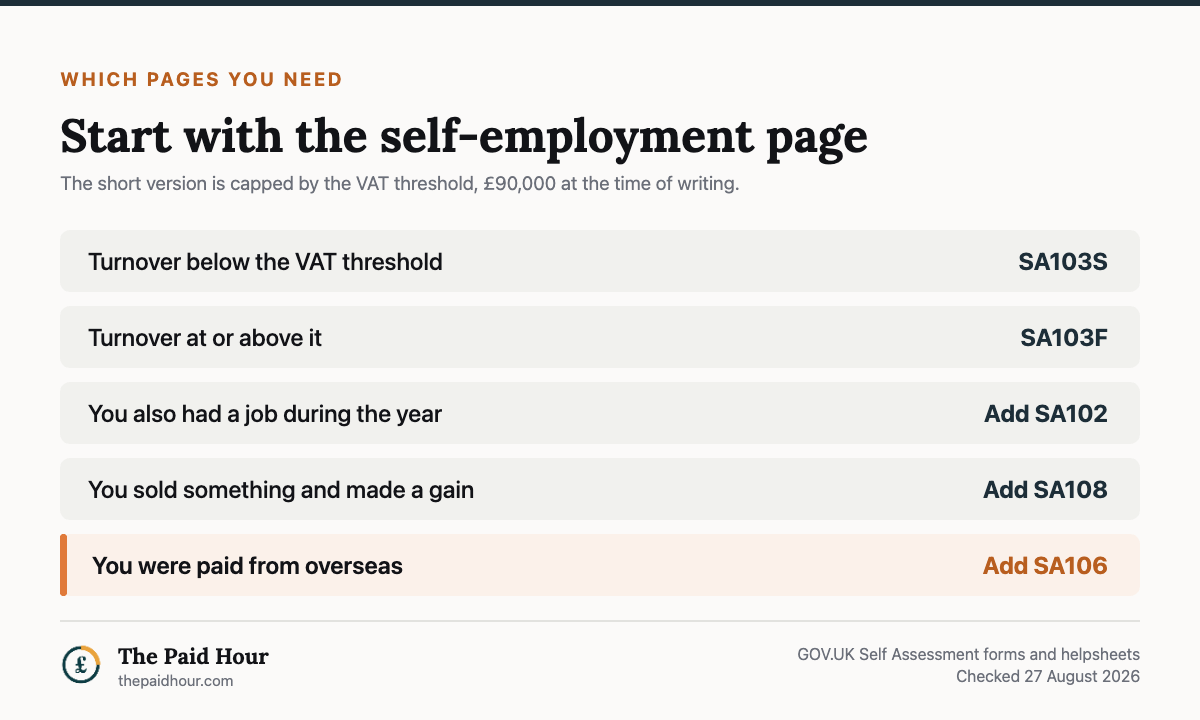
The SA100 is the main return; everything specific to how you earn sits on a supplementary page behind it. A sole trader needs SA103, and there are two versions. The short SA103S if your turnover was below the VAT threshold for that year, the full SA103F at or above it. Add SA102 if you also had a job, SA105 for rental income, SA106 for foreign income, SA108 for gains. Worth knowing before you read any guide: almost every box number quoted online belongs to the full page.
Self Assessment supplementary pages are the part of the return that nobody explains, because if you file online the system quietly chooses them for you by asking questions at the start.
That works until it does not. Answer one of those questions wrong and supplementary pages you needed never appear, and you will not notice, because you cannot miss something you were never shown.
What the supplementary pages are
The SA100 covers you as a person, the basics, interest, dividends, allowances, the declaration. Each additional way of earning has its own page bolted on behind it.
- SA102: employment, if you were an employee or a company director.
- SA103S / SA103F: self-employment, short or full.
- SA104S / SA104F: partnership income, short or full.
- SA105: UK property income.
- SA106: foreign income or gains.
- SA108: capital gains.
- SA109: residence, called residence and foreign income and gains (FIG) regime from 2026.
There is also the SA200 short tax return, which you cannot go and get. HMRC’s wording is blunt: only fill it in if HMRC sends it to you, and you cannot download it.
Short or full supplementary pages: the VAT threshold line
HMRC ties the short self-employment page to a figure it already publishes elsewhere: you can use SA103S if your annual business turnover was below the VAT threshold for the tax year.
Which is a quietly elegant piece of form design. One threshold doing two jobs, and a slightly awkward one to write about, because the threshold can change. At the time of writing it is £90,000. Check the figure for the year you are filing rather than the year you are in.
Note what it is measuring. Turnover, not profit. A business billing £95,000 and taking home £30,000 is on the full page.
Why supplementary pages matter when you read about expenses
Here is the practical consequence, and it explains a lot of confusion.
Every article that tells you insurance goes in box 21, or professional fees in box 28, or interest in box 25, is describing the full page. Those numbers do not exist on the short one. If you are on SA103S and go looking for box 30, you will not find it, and nothing has gone wrong.
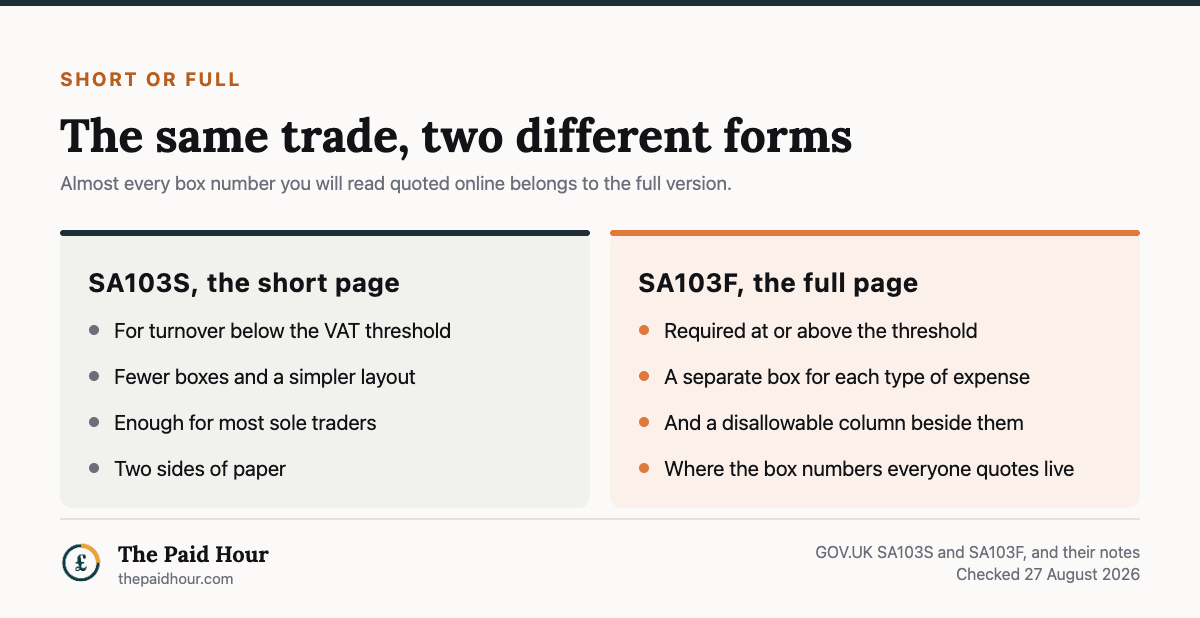
The full page also carries something the short one does not: a disallowable column running alongside the expense boxes. You enter the whole cost on one side and the private or blocked portion on the other, which is HMRC showing its working rather than asking you to hide yours.
The rules about what is allowable are identical either way. Only the number of boxes changes. What goes in them is in allowable expenses for UK freelancers and disallowable expenses.
More than one trade means more supplementary pages
If you carry on two separate trades (a photographer who also runs a small shop, say) that is two sets of self-employment pages, not one set with the figures added together.
Combining them is a common shortcut and it distorts everything downstream: the turnover test for short or full, the losses, the position if one trade stops. Two trades, two SA103s.
Whether two activities really are two trades is a judgement, and it is the same judgement that separates a hobby from a business. Different customers, different skills, separate records and separate bank activity all point towards two.
The supplementary pages sole traders most often miss
SA102, employment. If you had a job for even part of the year, that income belongs on the return too. Being employed and self-employed at the same time is one return, two pages.
SA106, foreign income. Paid by a client abroad, or holding money in an overseas account. Being paid in dollars does not make income foreign by itself, but the page exists for a reason and foreign income has its own rules.
SA108, capital gains. Selling equipment the business used, disposing of a property, or crypto. This is the one people forget entirely, because a gain does not feel like income and there is no invoice to remind you.
Filing online, and the questions that decide it
Online, you never see a page called SA103. You answer a short set of questions and the system builds the return from your answers.
That is easier and it moves the risk. The error is no longer a missing form, it is a question answered too quickly at the start of an evening when you wanted to be finished. Read that first screen properly. It is the only part of the process where a wrong answer removes a whole section without telling you.
And if you are filing on paper, the deadline is earlier than the online one. Both are in the Self Assessment deadlines.
Records worth keeping
A list of which pages you filed, year by year. It takes one line and it answers the question that starts most Self Assessment problems: what did I do last time?
If you are filing for the first time, the ground rules are in your first Self Assessment, and whether you need to file at all is in do I need to file a tax return.
Claiming everything you are owed?
HMRC Tax & Expense Mastery 2026/27. Nine modules and eleven working templates that take a UK freelancer from “do I even need to register” to a correct return, with MTD quarters built in.
- Fifteen expense categories, with the trap inside each one (training, clothing, meals, the seven-year pre-trading rule)
- Home and vehicle: flat rate against actual cost, with the £312 break-even worked out and the mileage lock-in rule
- The year-one payments-on-account cash shock, and the routine that stops it landing twice
HMRC does not send a list of what you forgot to claim. Most freelancers leave several hundred pounds of legitimate expenses on the table every single year, and the return still gets filed.
Buying more than one? The Complete Freelancer System, all five for £87, against £193 bought separately.
Sources
- Self Assessment forms and helpsheets, GOV.UK
- Self-employment (short) SA103S, GOV.UK
- Self-employment (full) SA103F and notes, GOV.UK
- Residence and foreign income and gains (FIG) regime etc, SA109, GOV.UK
- Register for VAT, GOV.UK
The list of supplementary pages and the wording that the SA200 short tax return cannot be downloaded are from GOV.UK’s Self Assessment forms and helpsheets page. The condition that annual business turnover was below the VAT threshold for the tax year is quoted from GOV.UK’s SA103S page, last updated 6 April 2026. The SA109 title for 2026 is GOV.UK’s. The VAT threshold figure is the one published on GOV.UK’s register for VAT guidance and applies at the date below, not necessarily to the year you are filing. All pages read on 27 August 2026. This is general information about how the rules work, not tax advice. Check your own position with HMRC or an accountant before you file.