
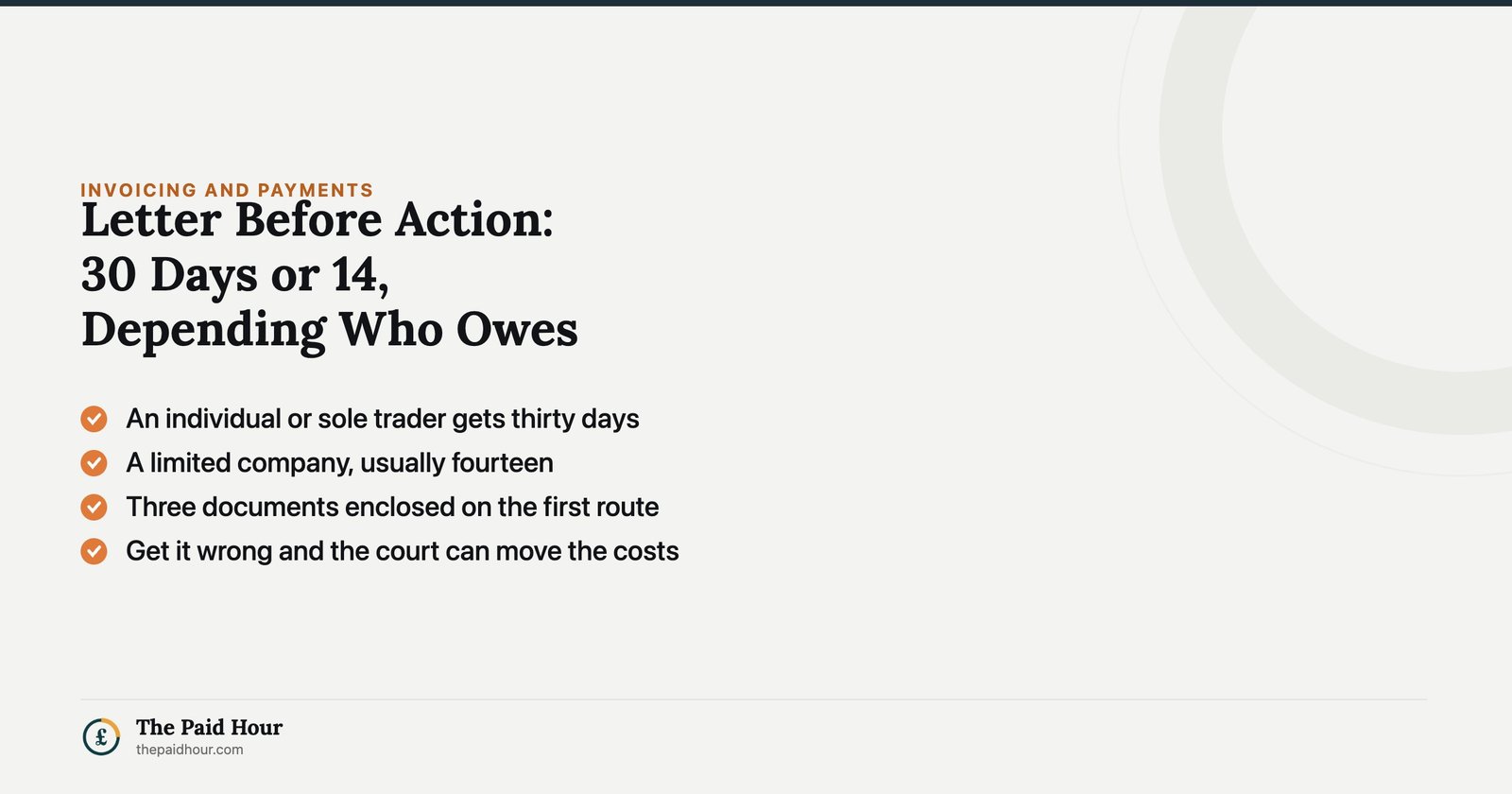
The one-paragraph answer: There are two sets of pre-action rules, and which one your letter before action falls under depends entirely on who owes you the money. If the client is an individual or a sole trader, the Pre-Action Protocol for Debt Claims applies: a Letter of Claim with specified contents, three documents enclosed, and 30 days to reply. If the client is a limited company, that protocol does not apply at all, the Practice Direction on Pre-Action Conduct does, and a reasonable time is 14 days in a straightforward case. Send the wrong letter before action and it is not fatal, but a court can move the costs because of it.
A letter before action is the last step before court, and the point at which most unpaid invoices get paid. It is also where freelancers most often use the wrong template, because the one that comes up first is written for consumer debt.
Worth thirty seconds to work out which rulebook you are under before you write anything.
Work out who owes you first
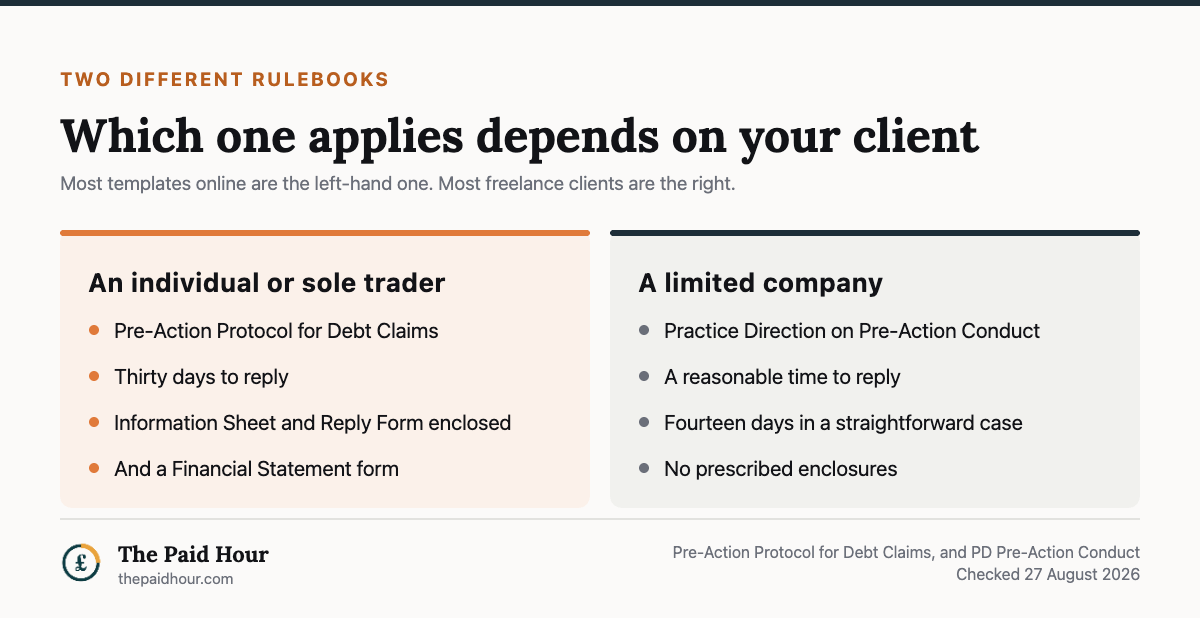
The scope of the debt protocol is one sentence and it settles the question: it applies to any business, including sole traders and public bodies, claiming payment of a debt from an individual (including a sole trader).
Two halves worth reading separately. You, as the creditor, can be anything, the protocol expressly covers a sole trader chasing money. The debtor, though, has to be an individual.
So if you invoiced a person or another sole trader, you are inside it. If you invoiced Something Ltd, you are not, and the thirty days and the enclosures do not apply to you at all.
Check the invoice rather than your memory. “Ltd” or “Limited” on the client’s name is the test, and it is the same distinction that runs through sole trader versus limited company.
If the client is an individual
The protocol is prescriptive, which is helpful. There is no judgement to exercise, only a list to satisfy.
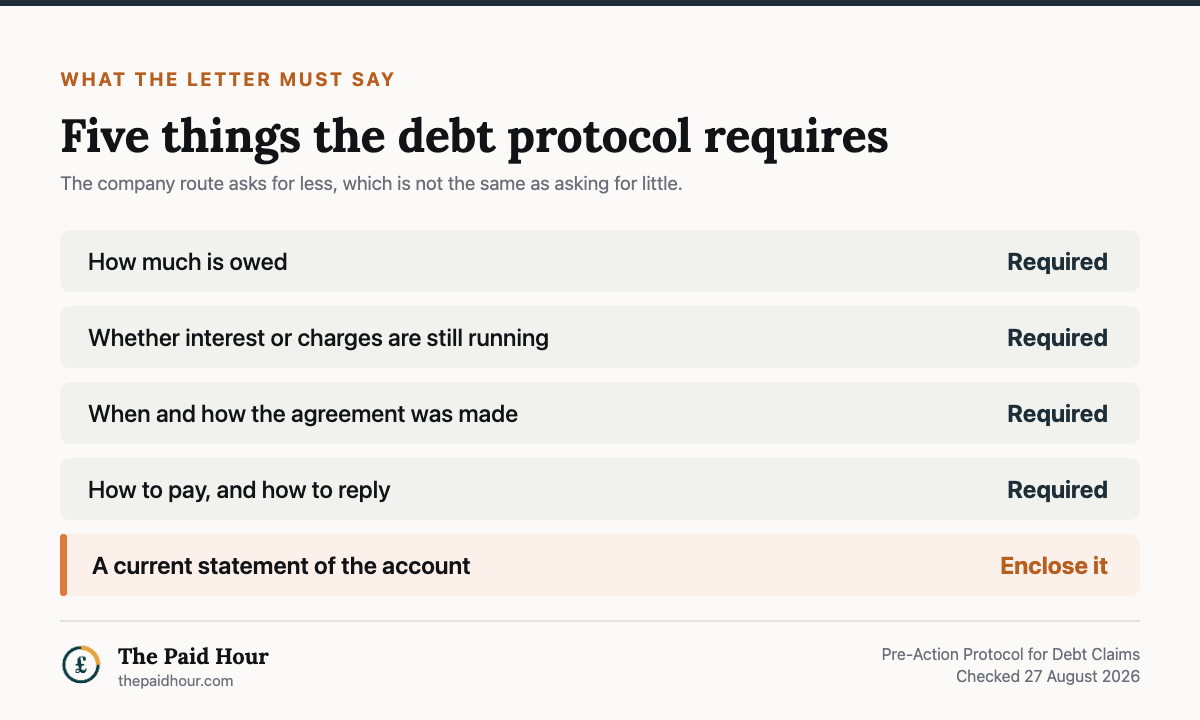
Three things go in the envelope alongside a letter before action: a current or recent statement of the account showing the interest and charges, the Information Sheet and Reply Form from Annex 1 of the protocol, and the Financial Statement form from Annex 2.
Then you wait. The protocol is explicit: if the debtor does not reply to the Letter of Claim within 30 days of the date at the top of the letter, the creditor may start court proceedings.
Thirty days from the date on the letter before action, not from when they opened it. Which is one reason to date it the day you send it and not the day you drafted it.
If the client is a company
You fall under the general Practice Direction on Pre-Action Conduct and Protocols, which is shorter, vaguer and easier, and easier is not the same as safer.
It asks for a letter before action setting out concise details of the claim, the basis on which it is made, a summary of the facts, what you want, and if money, how the amount is calculated.
On timing it declines to give a number and gives a principle instead: a reasonable time, which it puts at 14 days in a straight forward case and no more than 3 months in a very complex one. An unpaid invoice with a signed contract behind it is a straightforward case.
Fourteen days is therefore the working answer for most freelance debts, and giving longer costs you nothing except time.
Why a letter before action is worth sending
Two reasons, and the first is the practical one.
A letter before action that cites the protocol, states the figure, encloses the statement and gives a deadline reads completely differently from the fourth polite reminder. It is the first thing you have sent that looks like the beginning of a process rather than the continuation of a conversation. A great many invoices are paid at this point precisely because of that shift in register.
The second is that the court cares. The Practice Direction lists what can happen where a party has not complied: an order that the party at fault pays the costs of the proceedings, an order that they pay those costs on an indemnity basis, and adjustments to interest, up to 10% above base rate against a defendant in a money claim.
Those sanctions cut both ways. Skipping the letter and going straight to a claim can cost you your costs even if you win the debt.
Interest belongs in the letter before action
The debt protocol requires you to say whether interest or charges are continuing. Say so, and say what they are.
Most freelance invoices carry a statutory entitlement to late payment interest and a fixed compensation sum, whether or not the contract mentions them. A letter that includes those figures is asking for a larger number than the invoice, which is both correct and a useful piece of pressure.
Calculate them properly instead of rounding. A letter with a wrong figure in it is the one thing that hands an unwilling payer something to argue about.
Before you send the letter before action
Check the debt is still enforceable. There is a limitation period on chasing a debt through the courts and once it has run, the letter achieves nothing: how long you can chase an unpaid invoice covers it.
Check you have chased. A letter before action after three reminders is a natural escalation; one sent cold, six weeks after the invoice, tends to end a client relationship you might have preferred to keep. The staged version is in chasing unpaid invoices.
And check the invoice itself stands up, dates, description, amount, terms. Everything in what a UK invoice must include is also the evidence, and a contract behind it is better still.
What to keep
A copy of the letter with its date, proof of sending, and everything you enclosed. If it goes to court, the letter is the first document anyone looks at.
Keep the earlier reminders too. They establish that the client knew about the debt long before the formal letter arrived, which is the difference between an oversight and a refusal. Retention is the same as everything else — five years after the filing deadline, and a written contract is what makes the whole file worth having.
If the letter is ignored, the next steps are the Money Claim Online process and, before that, a clear look at what small claims court actually costs.
Ready to stop chasing and start recovering?
Late Payment Recovery & Legal Safeguards. The seven-stage escalation ladder with dates, every letter written for you, an interest calculator that adds what the law owes you, and the Money Claim Online walkthrough with real fees.
- Reminder letters for stages one to four, then a Letter Before Action that complies with the Pre-Action Protocol (company and individual versions)
- Auto-calculating statutory interest and compensation statement: £40 to £100 per invoice plus interest at base rate plus 8%
- Payment plan with a default clause, particulars of claim wording, hearing bundle index, and the client scorecard that fires slow payers
- Free download: Unpaid Invoice — Your First Three Moves
A solicitor charges around £40 plus VAT for a single letter before action. This is every letter in the sequence, the interest you are legally entitled to claim, and the court route, for one fee.
Buying more than one? The Complete Freelancer System, all five for £87, against £215 at full price.
Sources
- Pre-Action Protocol for Debt Claims: Ministry of Justice
- Practice Direction: Pre-Action Conduct and Protocols: Civil Procedure Rules
- Late commercial payments: charging interest and debt recovery: GOV.UK
- Make a court claim for money: GOV.UK
The scope wording, the required contents of the Letter of Claim, the three enclosures and the 30-day period are quoted from the Pre-Action Protocol for Debt Claims. The contents of a letter before claim, the reasonable-time wording of 14 days in a straightforward case and no more than 3 months in a very complex one, and the sanctions for non-compliance are quoted from the Practice Direction on Pre-Action Conduct and Protocols. Both read on 27 August 2026. This is general information about how the rules work, not legal advice: for a substantial debt, or where the client disputes the work rather than simply not paying, take advice from a solicitor before starting proceedings.