
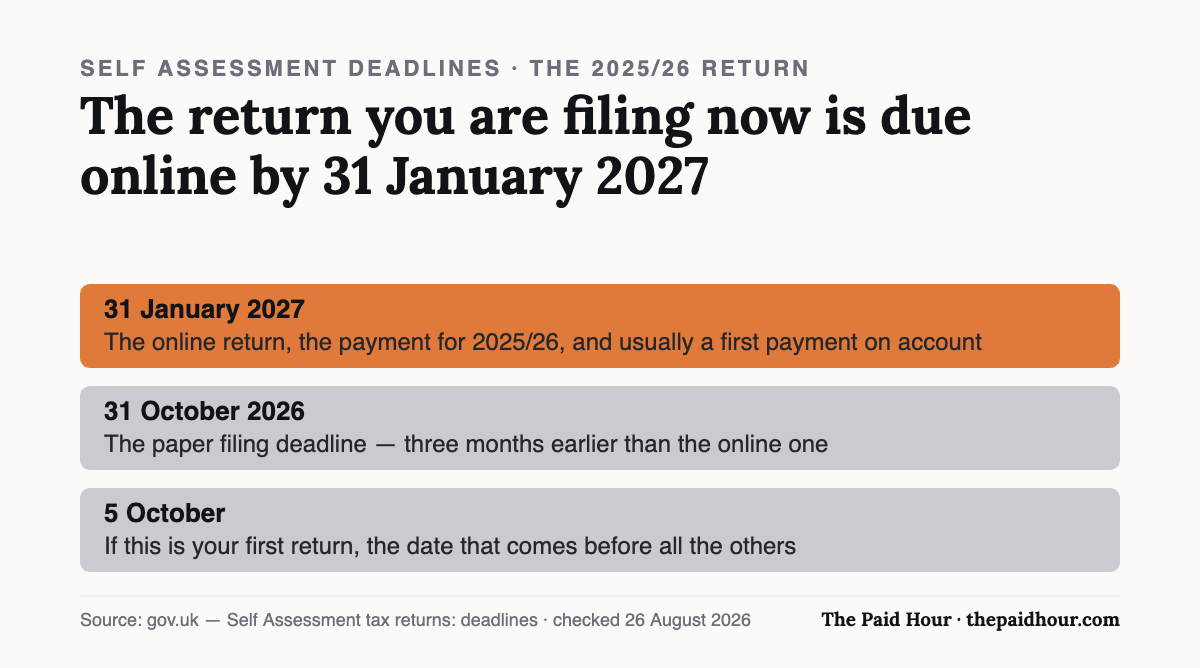
The one-paragraph answer: The return you are filing right now covers 2025/26, and it is due online by 31 January 2027: along with the payment for that year and, usually, a first payment on account toward the next. Paper filers had until 31 October 2026. If this is your first return, the date that comes before all of them is 5 October.
Table of Contents
The confusing thing about Self Assessment deadlines is not the dates. It is that you are always working on a tax year that has already finished, while living in one that has not.
So start here: which return are you filing?
Which Self Assessment return am I filing right now?
The one for 6 April 2025 to 5 April 2026. That tax year closed in April, which is what makes it fileable, and the online deadline for it is 31 January 2027.
What you are earning today belongs to 2026/27, which does not get reported until the winter after next. You cannot file it yet, and you do not need to think about it beyond putting money aside.
The Self Assessment dates
| Date | Deadline | Which tax year |
|---|---|---|
| 31 July 2026 | Second payment on account | Toward 2025/26 |
| 5 October 2026 | Register, if 2025/26 was your first year | 2025/26 |
| 31 October 2026 | Paper return | 2025/26 |
| 30 December 2026 | File online to pay through your tax code | 2025/26 |
| 31 January 2027 | Online return, balancing payment, first payment on account | 2025/26, then 2026/27 |
| 31 July 2027 | Second payment on account | Toward 2026/27 |
| 5 October 2027 | Register, if 2026/27 is your first year | 2026/27 |
| 31 October 2027 | Paper return | 2026/27 |
| 31 January 2028 | Online return and balancing payment | 2026/27 |
Every one of them is 11:59pm on the date shown. Not close of business, not “that week”.
These are the Self Assessment dates only. Making Tax Digital quarterly updates, National Insurance deadlines and the rolling VAT registration test all sit on their own schedule, those are in the 2026/27 tax year calendar.
31 October or 31 January?
Paper returns are due 31 October following the end of the tax year. Online returns get three extra months, to 31 January. That gap is why almost nobody files on paper any more.
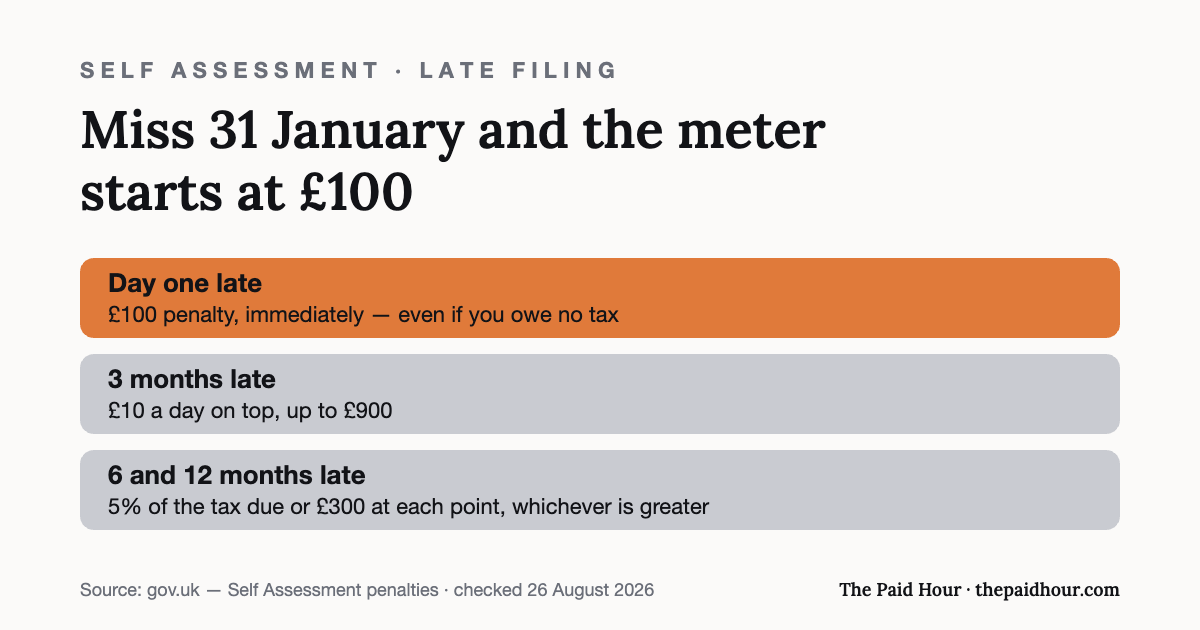
Miss either and a late filing penalty applies automatically. Including in a year you owe no tax at all. What it costs, and how it escalates, is in Self Assessment late filing penalties.
5 October: the one that comes first
If you started trading in a tax year and have never filed before, you must tell HMRC by 5 October following the end of that year.
It is the least urgent-feeling deadline on this page and the most commonly missed, because in October the bill is four months away and entirely theoretical. Registering is also how you get a UTR, which arrives by post and which you cannot file without. The walkthrough is in registering as a sole trader with HMRC.
30 December: the deadline nobody uses
File online by 30 December and HMRC can collect the bill through your PAYE tax code over the following year, instead of taking it in one January hit. No interest, no arrangement to negotiate.
Three conditions: you owe less than £3,000, you already pay tax through PAYE, and you filed in time. You cannot make a part payment to get under the £3,000. It only works if you have employment or pension income alongside the self-employment, which a lot of people do, and almost none of them use this.
What lands on 31 January
Three separate things, which is why the total so often exceeds what people expected.
- The return for the tax year that ended the previous April.
- The balancing payment: the difference between what you owed for that year and what you had already paid in advance.
- The first payment on account toward the year currently running, if your last bill was over £1,000 and less than 80% of it was collected at source.
Each payment on account is normally half your previous year’s bill, with the second due on 31 July. In a first year that means roughly one and a half times the bill you were bracing for, on one date. How they are calculated, and when you can apply to reduce them, is in payments on account explained.
Filing and paying are penalised separately
Worth stating plainly, because it changes what to do in a bad January. A late return and a late payment are two different failures with two different charges, and doing one on time is meaningfully better than doing neither.
So file, even with nothing to pay it with. Then talk to HMRC, a payment plan is a real option for someone who has filed and can see the number. And if the payment is the only problem, check the clearing times before you choose a method, because a new Direct Debit takes five working days.
Filing early is not just tidiness
Two things happen when you file in May rather than the following January.
You find out what you owe eight months before you have to pay it, which is the difference between a plan and a scramble. And HMRC’s enquiry window starts from the date the return is received, so filing early closes that window earlier too.
Nothing is gained by waiting. The money is not due any sooner for having filed.
Want the whole tax system, not one rule?
HMRC Tax & Expense Mastery 2026/27. Nine modules and eleven working templates that take a UK freelancer from “do I even need to register” to a correct return, with MTD quarters built in.
- Fifteen expense categories, with the trap inside each one (training, clothing, meals, the seven-year pre-trading rule)
- Home and vehicle: flat rate against actual cost, with the £312 break-even worked out and the mileage lock-in rule
- The year-one payments-on-account cash shock, and the routine that stops it landing twice
HMRC does not send a list of what you forgot to claim. Most freelancers leave several hundred pounds of legitimate expenses on the table every single year, and the return still gets filed.
Buying more than one? The Complete Freelancer System, all five for £87, against £215 at full price.
Need this ready-made? → UK Self-Assessment Prep Checklist Pack (PDF) £7.99
If 5 October is your date this year, which Self Assessment registration route you need sorts out which of the four HMRC routes applies to you.
Read next
- Registering a Partnership by 5 October: The Penalty Every Partner Pays
- The Freelancer Tax Checklist: every step, dated
Sources
- gov.uk: Self Assessment tax returns: deadlines
- gov.uk — Register for Self Assessment
- gov.uk, Understand your Self Assessment tax bill: payments on account
- gov.uk. Pay your Self Assessment tax bill through your tax code
- gov.uk, Self Assessment tax returns: penalties
Deadlines and the penalty ladder re-checked against gov.uk on 26 August 2026.
Every date checked against live gov.uk pages on 25 August 2026. HMRC’s Self Assessment pages are written for the current filing cycle rather than being permanently dated, so if you are reading this much later, cross-check the linked pages before relying on a date for a filing you are about to make. General information, not tax advice.