
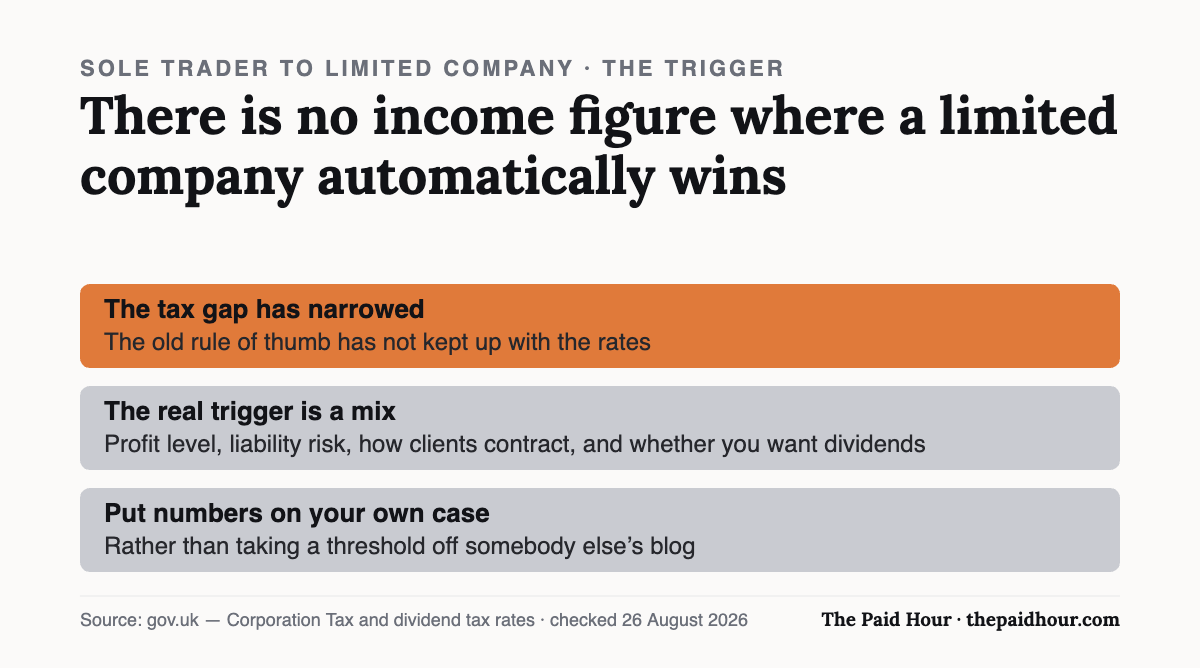
Quick answer: There is no single income figure where a limited company automatically wins. The tax gap has narrowed; the real trigger is usually a mix, profit level, liability risk, how clients contract, and whether you want dividends. This post puts numbers on the comparison rather than saying “it depends”.
Switching from sole trader to limited company is a decision most answers to this are vague about. “It depends,” or “once you’re earning enough.” This post tries to do better: it uses the actual verified 2026/27 Corporation Tax, dividend tax, Income Tax and National Insurance rates to show roughly where the numbers move in a limited company’s favour, and roughly where they don’t.
For the fuller comparison of liability, admin burden, and which structure suits which situation, see our sole trader vs limited company guide. This post is narrower: just the tax maths, and when it starts to matter.
Read the disclaimer at the end before acting on anything here. Every calculation below is illustrative, built on simplified assumptions, and no substitute for your own accountant running your actual numbers.
The 2026/27 tax rates that decide sole trader vs limited company
Sole trader (Income Tax + Class 4 NI): we’ve verified these already for the site: Personal Allowance £12,570, basic rate 20% up to £50,270, higher rate 40% above that; Class 4 NI at 6% up to £50,270, then 2% above (gov.uk, gov.uk). Full detail in our Income Tax rates and self-employed NI posts.
Corporation Tax, for financial year 2026: small profits rate 19% on profits up to £50,000; main rate 25% on profits over £250,000; profits in between get marginal relief, which works out at an effective marginal rate of 26.5% on that middle slice (gov.uk, gov.uk).
Dividend tax, 2026/27: a £500 tax-free dividend allowance, then rates of 10.75% (basic), 35.75% (higher) and 39.35% (additional) (gov.uk). These dividend rates rose by 2 percentage points from April 2026, worth flagging if you’ve seen older figures elsewhere online (gov.uk).
Illustrative example: £60,000 profit, both ways
To make this concrete, and this is a simplified illustration rather than a personalised calculation: take a single-director business with £60,000 profit, no other income, drawing out everything earned each year.
As a sole trader: Income Tax £11,432.00 + Class 4 NI £2,456.60 = £13,888.60 total (23.1% effective rate).
As a limited company, paying a director’s salary of £12,570 (the efficient level — equal to both the Personal Allowance and the employee NI threshold, so no personal tax or employee NI on it):
- Employer NI on the salary above the £5,000 secondary threshold: £7,570 × 15% = £1,135.50 (gov.uk)
- Taxable company profit after deducting salary and employer NI: £46,294.50, under £50,000, so the 19% small profits rate applies in full: £8,795.96 Corporation Tax
- Remaining £37,498.54 paid as dividend: £500 tax-free, remainder at 10.75% = £3,977.34 dividend tax
- Total: £13,908.80 (23.2% effective rate)
(Note: single-director companies with no other employees can’t claim the £10,500 Employment Allowance against that employer NI, it’s specifically excluded, so that relief isn’t included above.)
At £60,000, drawing out 100% of profit every year, the two routes land within about £20 of each other. That’s the headline finding worth sitting with: there is no clean profit figure where a limited company suddenly becomes cheaper, if you’re taking all the money out regardless of structure.
So why do people still switch to a limited company?
The move from sole trader to limited company isn’t just about the headline tax rate, it comes from not having to:
- Retained profit. A sole trader is taxed on all profit the moment it’s earned, spent or not. A company only pays Corporation Tax (19-26.5%) on profit it keeps: no personal tax is due until you draw it out, which can mean real deferral if you don’t need the full amount this year.
- Income splitting. A second shareholder (e.g. a spouse) with their own dividend allowance and basic-rate band can meaningfully lower the household total, figures are individual, so this needs proper advice.
- Employer pension contributions, paid by the company as a deductible expense instead of from taxed personal income, outside the scope of this post, but worth raising with an accountant.
For the non-tax reasons (liability protection, credibility, mortgage/lending treatment, extra admin) see our full comparison post.
What about higher profits, say, £100,000+?
Above £100,000, a sole trader’s Personal Allowance tapers away: £1 lost for every £2 of income over that threshold, gone entirely by £125,140 (gov.uk). Combined with the 40% rate and 2% NI, that pushes the effective marginal rate on that slice above 60%. A limited company doesn’t dodge this trick for money you draw out personally. Dividends count toward the same taper, but it does let you simply leave that slice in the business instead, which a sole trader can’t do.
A practical checklist rather than a magic number
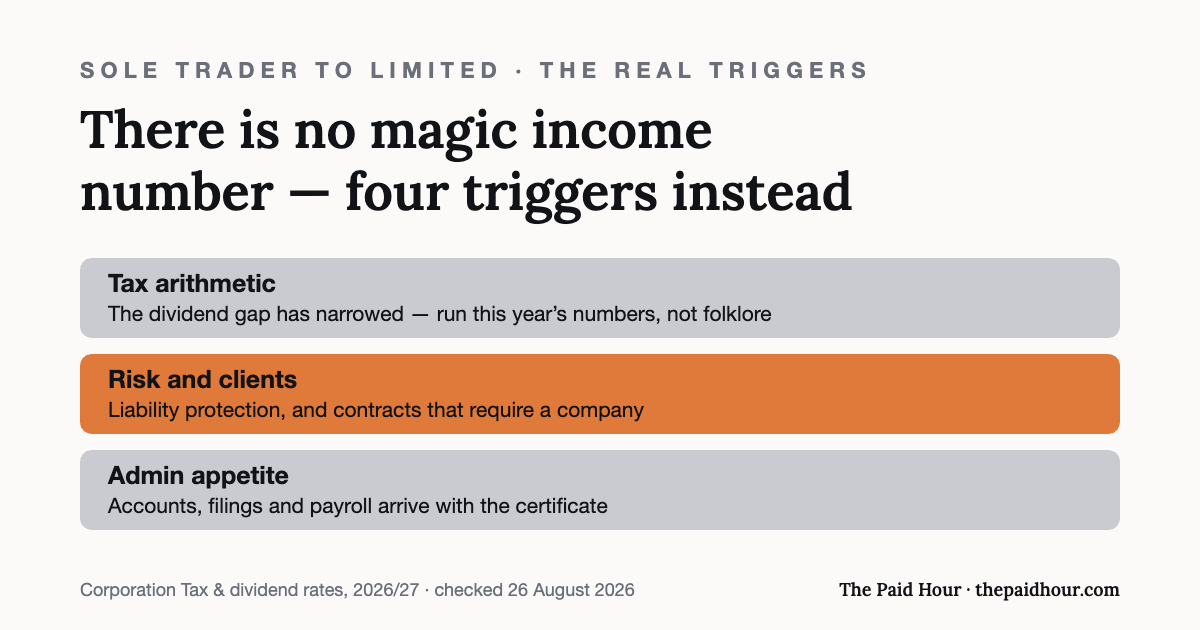
You’ll sometimes see “£30,000” or “£40,000 profit” quoted as the point to move from sole trader to limited company. That’s professional convention among accountants, not a gov.uk figure, and our £60,000 example above shows why it’s a soft one: it’s not really about the number itself, it’s about whether you meet these conditions:
- Profit is consistently above roughly £30,000-£40,000 (rough rather than official)
- You can leave some profit in the company rather than drawing it all out
- You’re willing to take on payroll, Corporation Tax and annual accounts admin
- Limited liability or client perception matters for your work
Disclaimer
This post on switching from sole trader to limited company is illustrative only instead of personalised tax advice. It assumes a single director, no other income, England/Wales/NI rates (Scotland’s Income Tax bands differ), and a specific salary/dividend split that may not suit your situation. Get an accountant to run your actual numbers before switching structure.
One nuance on names: registering a company protects the exact company name at Companies House, but brand protection is a different tool, a registered trade mark, and the case for it doesn’t change with your structure.
What the numbers say at every profit level
We ran the same comparison at £30,000, £40,000, £50,000, £60,000, £75,000 and £100,000 of profit, at published 2026/27 rates, drawing everything out each year. The pattern is not what the “incorporate at £50k” articles still ranking on Google would predict: full extraction through a company pays you less than staying a sole trader at every one of those levels, before accountancy costs of £900–£1,800 a year. At one level the two routes land within £20 of each other. At £100,000 the gap runs to four figures, the wrong way.
The full table with every assumption stated, and the calculator that recomputes the moment you change the salary, the dividend split or the amount left in the company, is in the Sole Trader to Ltd Transition course, alongside the one retention scenario where a company still wins and the fourteen-step plan if it does.
One cost that arrives with incorporation is an address. The company needs a registered office on the public register, and your home is the wrong choice for it. Registered office address: what it costs and who needs one covers the Companies House rules and the two cheapest services.
Is a limited company actually going to pay you more?
Sole Trader to Ltd Transition 2026/27. The comparison recomputed at real 2026/27 rates after the April dividend rise, the one retention scenario where a company still wins, and the fourteen-step execution plan if it does.
- The computed comparison table from £35,000 to £100,000, with every assumption stated
- The full break-even calculator: change any assumption and it recalculates
- Incorporation in fourteen steps with current Companies House fees, the identity-verification rule in force since November 2025, and the transfer schedule
- Free download: Go-Limited Scorecard
Every free calculator still ranking on Google uses pre-April-2026 dividend rates. Incorporating on the strength of one of them is a decision you pay for every year afterwards.
Buying more than one? The Complete Freelancer System, all five for £87, against £215 at full price.
Sources
- Income Tax rates and Personal Allowances: gov.uk
- Income Tax: Personal Allowance and income over £100,000 — gov.uk
- National Insurance: how much you pay, gov.uk
- Corporation Tax rates. Gov.uk
- Marginal Relief for Corporation Tax, gov.uk
- CTM03925, Marginal Relief standard fraction: gov.uk (HMRC manual)
- Tax on dividends, gov.uk
- Changes to tax rates for dividend income from April 2026. Gov.uk
- Rates and thresholds for employers 2026 to 2027, gov.uk
- Single-director companies and Employment Allowance: gov.uk
Reviewed 26 August 2026. This is general information about how the rules work, not tax advice. The links above go to the primary sources; for your own circumstances, speak to an accountant or contact HMRC directly.