
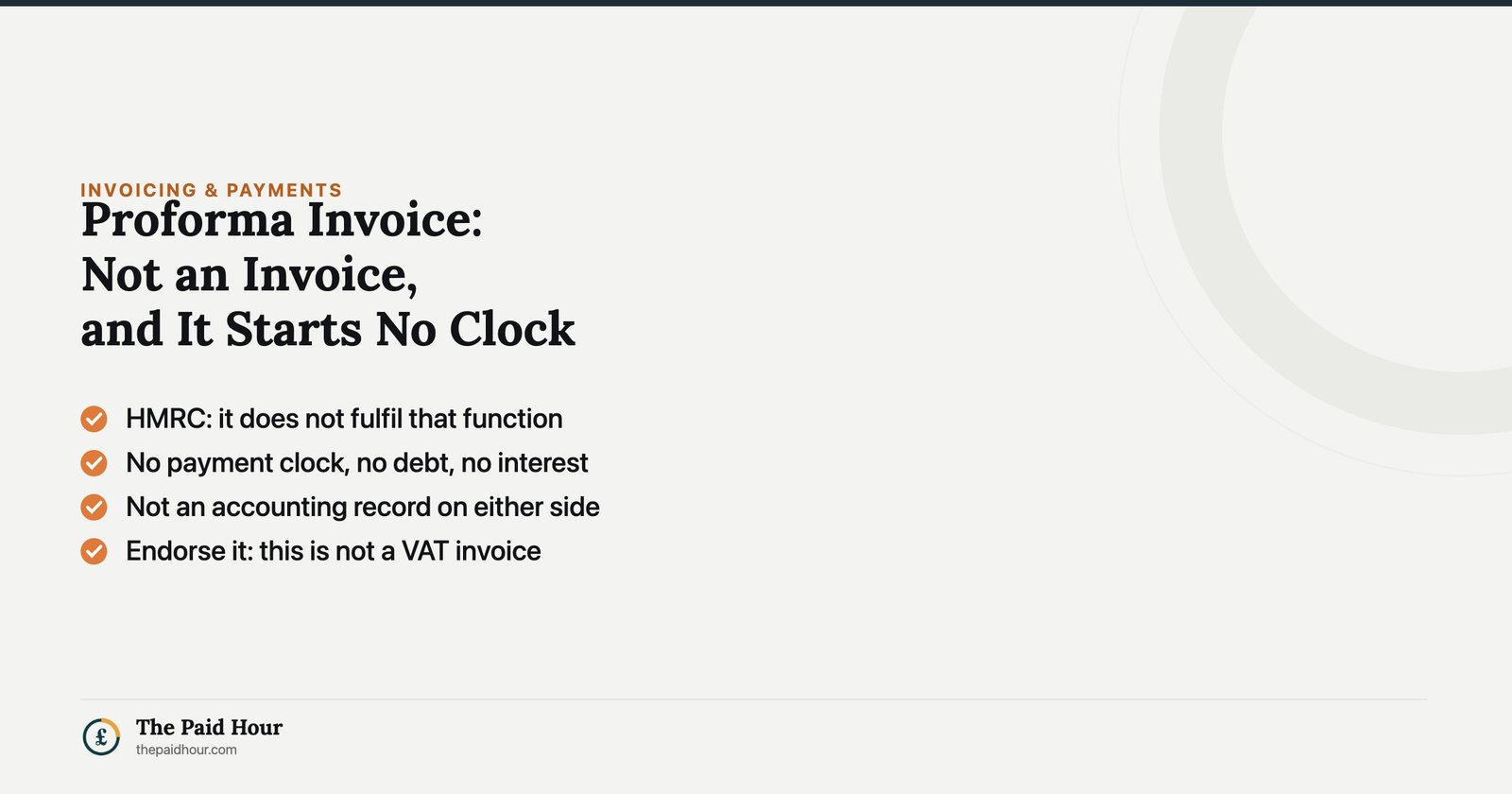
The short version: A proforma invoice is not an invoice. HMRC’s own manual calls it a commercial document that carries some or all of an invoice’s information “but which do not fulfil that primary function”. Three things follow, and freelancers get caught by all of them: it starts no payment clock, so nothing is ever late; it is not an accounting record on either side; and if you are VAT registered your client cannot reclaim a penny of VAT from it, while you still owe them a real VAT invoice within 30 days of the money arriving. If what you wanted was money up front, what you wanted was a deposit invoice.
Somewhere between the quote and the invoice, a lot of freelancers reach for a proforma invoice. It feels like the polite version of asking to be paid first: same layout, same numbers, softer word.
It is not a softer invoice. It is a different document with almost none of an invoice’s powers, and the gap only shows up when the client does not pay.
What HMRC says a proforma invoice is
The clearest definition anywhere is in HMRC’s VAT Traders’ Records Manual, which describes proformas as “commercial documents that contain some or all of the information normally contained on an invoice, but which do not fulfil that primary function”.
The same page says what they are for: offering goods or services to a customer who is new to you, or whose creditworthiness you are unsure about. It sets out what they will get once they pay, and it asks for the money. That is the whole job.
HMRC adds that a proforma “should always be clearly described as such and should preferably be endorsed ‘This is not a VAT invoice'”. Note that this is HMRC’s own internal guidance to its inspectors rather than marketing advice from an invoicing app, which is why it is worth reading before you send one.
A proforma invoice starts no clock
This is the expensive one.
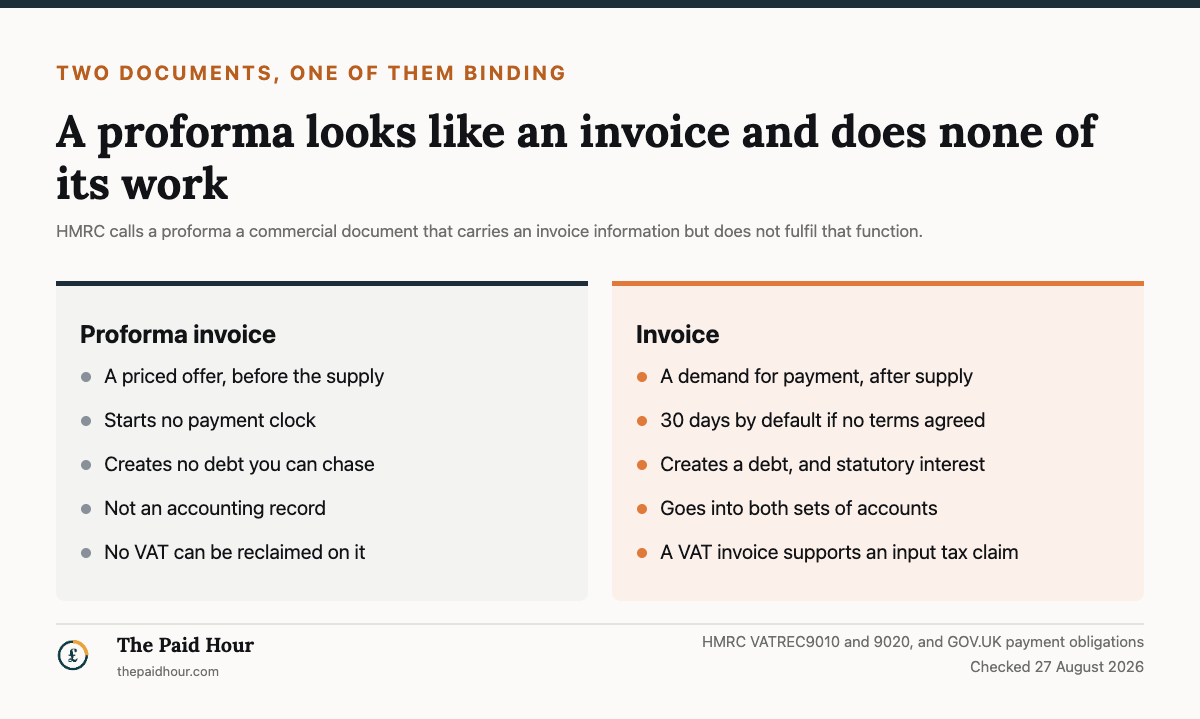
GOV.UK’s rule on payment is simple: “Unless you agree a payment date, the customer must pay you within 30 days of getting your invoice or the goods or service.” That default, and the statutory interest and fixed compensation that come with a late commercial debt, hang off an invoice.
Send a proforma invoice instead and you have made an offer rather than a demand. Sixty days later there is nothing overdue, because nothing was ever due. No interest has accrued. There is no debt to put in a letter before action, and if it ever got as far as court you would be arguing about a contract instead of pointing at an unpaid invoice.
People discover this at exactly the wrong moment, three months in, going back through the file, realising the thing they have been chasing was never a bill.
It is not a bookkeeping record either
HMRC is blunt about this: proformas are not accounting records and should not appear in either party’s books unless payment happens, at which point a proper VAT invoice has to be issued.
Two practical consequences. Your own bookkeeping should not carry a proforma as an outstanding sales invoice. On the cash basis nothing happens until the money lands anyway, and on traditional accounting you would be recognising income that has no invoice behind it. And your client’s finance system may simply refuse it: plenty of accounts payable teams cannot process a document that is not a valid invoice, which means your proforma sits in an inbox rather than a payment run.
The VAT wording, and the 30-day rule behind it
If you are VAT registered, a proforma invoice has one hard requirement and one hard consequence.
The requirement is the endorsement: mark it clearly as a proforma and, in HMRC’s preferred wording, “This is not a VAT invoice”. The consequence is that your client cannot use it. HMRC’s manual is explicit that “pro-forma or similar invoices are not, therefore, acceptable evidence” for an input tax claim under section 25 of the VAT Act 1994. If they try, it is their claim that fails.
Then the bit people forget. Once payment arrives or the supply is made, “a full VAT invoice must be issued within 30 days. The tax point will follow the normal rules.” The proforma does not discharge that duty and does not fix your tax point. You still owe a real VAT invoice, and it still has to carry everything a UK invoice must include.
The four proforma risks HMRC looks for
HMRC’s manual gives its inspectors a list, and it is a useful list to read from the other side of the desk.
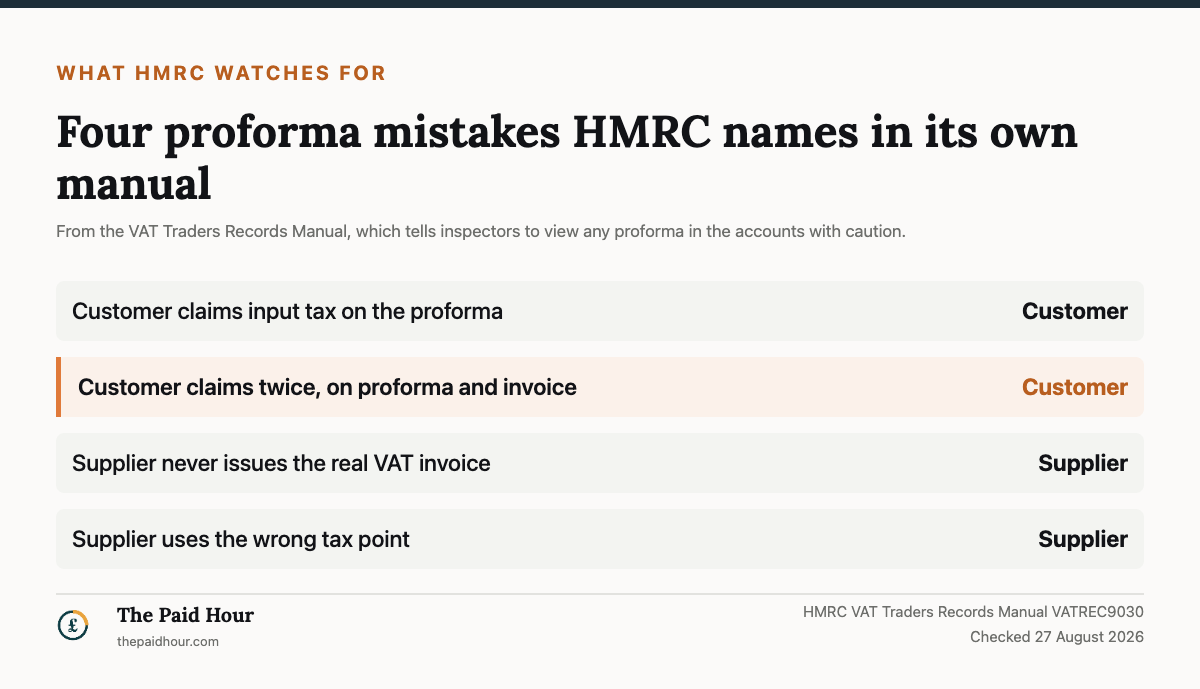
Two of the four are the supplier’s, yours. Relying on the proforma and never issuing the VAT invoice at all, and using the wrong tax point, “for example issue of VAT invoice rather than receipt of payment”. Both are easy to do when a proforma has been sitting in the job folder for a month and the money quietly arrived in week two.
HMRC closes the list with a warning that reads like a policy: “This list is not exhaustive and you should view with caution any instance of a pro-forma invoice appearing in a trader’s accounting records.” A proforma in your books is, by HMRC’s own instruction, a thing that invites a second look.
What you probably wanted was a deposit invoice
Almost every freelancer reaching for a proforma actually wants money before starting work. There is a document for that and it is an ordinary invoice.
Invoice the deposit as its own invoice, a real number in your sequence, a real due date, a real entry in your accounts, and if it is VAT-able, a real VAT invoice. It is enforceable, it accrues interest if it is late, and finance departments process it without a phone call. When the job finishes, invoice the balance and reference the deposit on it. How deposits and part payments work covers the mechanics, including the VAT timing, which is the one fiddly bit.
The deposit invoice does everything the proforma was supposed to do, and it survives the client not paying.
When a proforma invoice is the right document
It has one honest use, and it is the one HMRC describes: a priced offer to a customer you do not know and are not yet willing to extend credit to.
That is a real situation. A stranger emails, wants work done, and you would rather nothing existed on your books until their money clears. A proforma invoice says exactly what they get and what it costs, commits you to the price, creates no receivable, and leaves you nothing to write off if they vanish. Used that way it is a quoting tool with a payment reference on it, and it is fine.
It is also useful where the client’s own process demands a document before they will raise a purchase order: some organisations cannot open a payment file without a priced document, and a proforma fills that slot without you pretending a debt exists.
What it is not is a way to be paid faster by an established client. There, it is strictly worse than an invoice: the same effort, none of the rights.
What to keep
- The proforma invoice itself, marked as one, outside your sales invoice numbering
- The date the payment landed: that, not the proforma, drives your VAT timing
- The real invoice you issued afterwards, cross-referencing the proforma
- For a VAT-registered business, evidence the endorsement was on it
- The agreement behind it: a proforma is not a contract, and if the job goes wrong the contract is what you have
If the client is overseas, the wording on the real invoice matters more than the proforma. Our free Cross-Border Invoice Wording Pack has the exact VAT and place-of-supply lines to use.
Sources
- VATREC9010 — Pro-forma invoices: introduction (HMRC manual)
- VATREC9020, Can a pro-forma invoice be used to account for VAT?
- VATREC9030. Risks associated with pro-forma invoices
- Invoicing and taking payment from customers: payment obligations, GOV.UK
- VAT guide (VAT Notice 700): GOV.UK
The definition of a proforma, the endorsement wording, the point that proformas are not accounting records, the input tax position under section 25 of the VAT Act 1994, the 30-day rule for issuing the real VAT invoice and the four listed risks are all quoted from HMRC’s VAT Traders’ Records Manual, pages VATREC9010 to VATREC9030, last updated 16 January 2025 and read on 27 August 2026. The 30-day default payment period is GOV.UK’s own wording. This is general information about how the rules work, not tax advice; for your own circumstances speak to an accountant or contact HMRC.
Need this ready-made? → UK invoice templates (editable, HMRC-ready) from £4.49
Still writing every document from scratch?
Freelance Ops Playbook. Ten modules and eighteen templates: the rate floor calculation, a pipeline that rejects bad clients early, the twelve-clause contract, onboarding, change orders and a Friday rhythm that holds it together.
- The rate floor calculator, which most people find puts their current rate below cost
- The twelve-clause contract, including the revisions sentence that quietly earns more than any other
- Enquiry log with live pipeline value, thirteen-week cash forecast, three-option proposal, change order, welcome pack
One under-scoped project, or one client who “just needs a couple more rounds”, costs more than this playbook several times over. The templates exist so that never happens again.
Buying more than one? The Complete Freelancer System, all five for £87, against £215 at full price.