
Straight answer: Genuinely free accounting software exists, Pandle is the clearest example. The catch that repeats across nearly every free tier: no Making Tax Digital submissions. Free is fine for bookkeeping; check the MTD line before you build your records around it.
Free accounting software for sole traders sounds like an easy win, and in some cases it is. But there’s a catch that shows up across nearly every free plan on the market, and it’s worth knowing before you build your bookkeeping around a free tool: most free tiers don’t include Making Tax Digital submissions.
What free accounting software is free right now
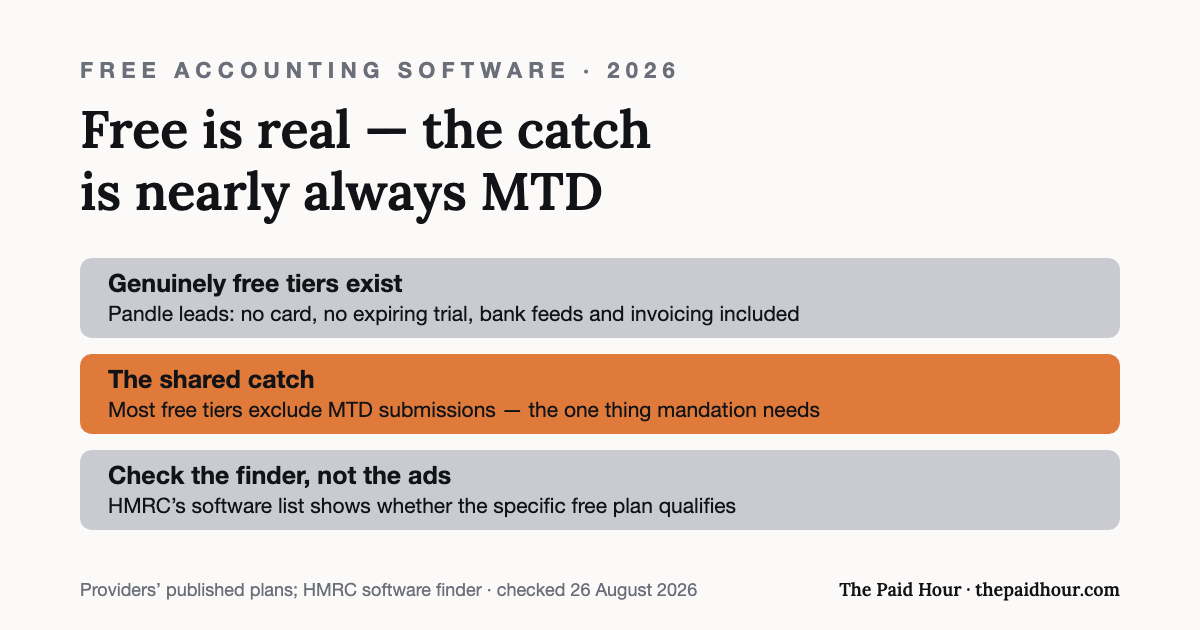
Pandle is one of the more free options. No card details required, no trial period that quietly converts to paid. The free plan covers bank feeds, invoicing, quotes, mileage tracking, cash flow forecasting, unlimited customers and suppliers, and basic business reports. The catch: automation features and MTD submissions sit behind Pandle Pro, which costs a modest £5 a month.
FreeAgent isn’t free by default, but it’s free for anyone banking with Mettle, NatWest, RBS or Ulster Bank. It’s a full-featured double-entry system when the free route applies rather than a stripped-down version.
Beyond those two, most “free” accounting tools aimed at UK sole traders are really free trials or freemium products where the free tier is deliberately limited, capped invoice counts, capped transactions, or bookkeeping only with no tax-return-ready reporting.
The MTD catch in free accounting software
This is the detail that matters most for anyone planning around free software long-term. Making Tax Digital for Income Tax requires quarterly digital submissions through compatible software, and gov.uk is explicit that while “free products are available for those with simple tax affairs,” those free products usually come with limits on how they can be used, and a free tier that includes full MTD filing is the exception rather than the rule.
Before committing to any free tool as your long-term system, remember that moving to another package later is rarely as clean as the marketing suggests. It’s worth checking HMRC’s own software finder to confirm whether the specific plan you’re on (not just the software brand generally) is recognised for MTD for Income Tax submissions. HMRC’s own guidance is blunt about this: “HMRC does not recommend any product or software provider”: it only confirms which products have been through its recognition process, so the checking is on you.
When free accounting software for sole traders is enough
If you’re below the MTD for Income Tax threshold for now, or your accountant handles the actual submission separately, a free tool that just keeps clean, organised records can be perfectly sufficient — you don’t need to pay for filing capability you’re not using yet. The point isn’t that free software is a false economy across the board. It’s that “free” and “MTD-ready” are two separate questions, and conflating them is where freelancers get caught out later, usually right before a filing deadline.
A simple way to decide: add up what a paid plan would cost over a year and ask whether the extra features are worth that specific number, not just “more features” in the abstract. For most sole traders in the early stages, free accounting software for sole traders is more than adequate until they either cross the MTD threshold or start hiring, at which point the free-tier limits usually catch up at the same time as the paperwork does.
Switching later isn’t the hassle it sounds like, either: most sole traders start with a free tool, outgrow it, and move their records across without much disruption once the volume justifies paying. The mistake is picking a paid plan pre-emptively because it feels more “proper,” not because you’ve actually hit a real limit yet.
Source: gov.uk. Find software compatible with Making Tax Digital for Income Tax and Pandle’s own pricing page, checked 23 August 2026. Software pricing and feature tiers change, confirm current terms directly with the provider before switching.
Coconut, Countingup and other free-adjacent options
Pandle and FreeAgent-via-Mettle aren’t the only names worth knowing. Coconut is a current account with built-in bookkeeping instead of free accounting software for sole traders bolted onto a bank feed: the tax estimate and expense categorisation are free if you open one of their accounts, but you’re really paying with your banking relationship, not cash. Countingup works the same way: free basic bookkeeping tied to opening their business account, with the fuller accounting package sitting on a paid tier.
Worth knowing before you get excited about “free”: Zoho Books’ free plan is genuinely free with no account tie-in, but it caps out at £50,000 in annual revenue. Cross that and you’re moved to a paid tier automatically. It’s a solid pick for a very new sole trader, less so once the business grows.
What MTD for Income Tax needs from your software
This is where it usually goes wrong. Making Tax Digital for Income Tax isn’t optional once your qualifying income crosses the threshold, and the thresholds are being phased in. Sole traders and landlords with income over £50,000 have been in MTD since 6 April 2026. The £30,000 threshold follows on 6 April 2027, and £20,000 on 6 April 2028.
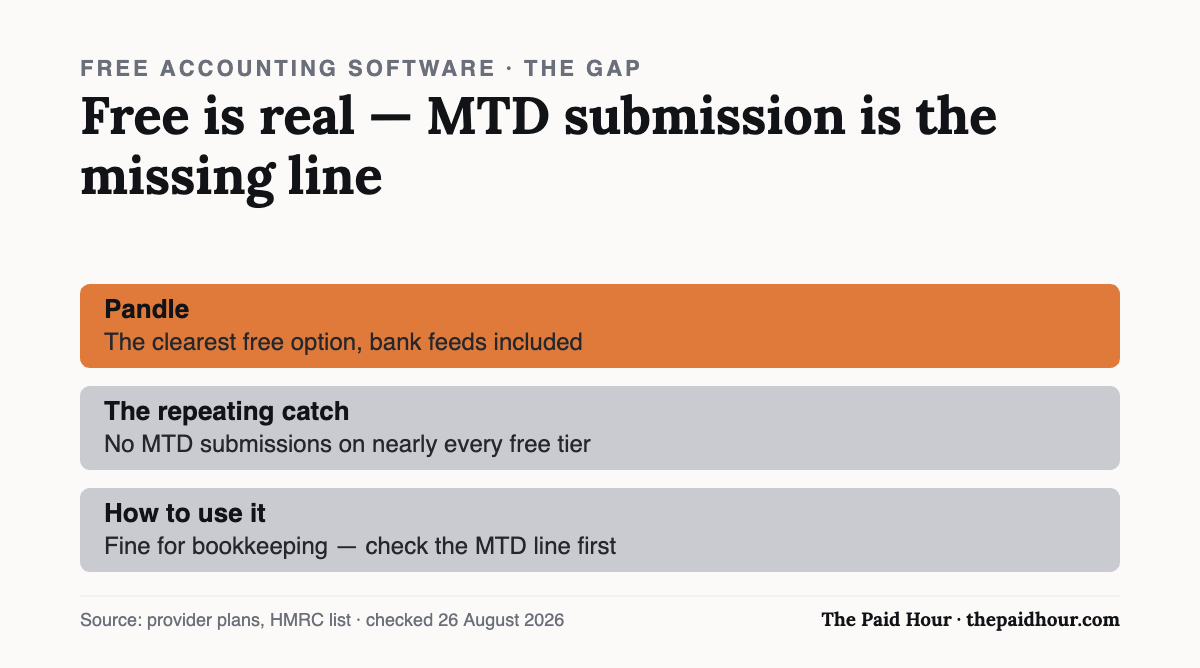
Once you’re in, HMRC requires digital record-keeping and quarterly updates submitted through MTD-compatible software, a spreadsheet with a bridging tool counts, a plain spreadsheet on its own doesn’t. This is exactly the feature that most free accounting software for sole traders leaves out. Pandle’s free tier doesn’t submit; FreeAgent-via-Mettle does, because the bank is subsidising the whole product, not just the entry tier.
If you’re close to £50,000 in qualifying income, check MTD status before you commit to a free plan. You don’t want to build a year of habits around software you’ll have to migrate away from the moment HMRC pulls you in. See our full list of HMRC-recognised MTD software for the ones that submit.
When free stops being worth your time
Free accounting software for sole traders makes sense in a specific window: pre-VAT-registration, under the MTD threshold, low transaction volume, no staff, no stock. Outside that window, the free tier usually costs you time instead of money, manual bank reconciliation, no automation, exporting data by hand for your accountant.
A rough rule that’s worked for readers who’ve written in: once you’re doing more than roughly 15-20 transactions a month, or you’ve registered for VAT (the threshold is £90,000, see our VAT registration threshold guide), the £5-£15 a month a paid tier costs is usually cheaper than the hours you’ll spend fighting a free plan’s limits.
Common mistakes people make picking free accounting software
- Choosing on price alone and only discovering the MTD gap when a submission deadline is a week away.
- Not checking whether “free” is permanent or a 30-day trial dressed up as a plan, some vendors are looser with the word than others.
- Assuming a free plan syncs with your bank the same way a paid one does: bank feed reliability is often the first thing vendors cut on free tiers.
- Sticking with free software purely out of inertia after crossing the point where a paid plan would save more time than it costs.
None of this means free accounting software for sole traders is a false economy — for the right business, at the right stage, it is free money saved. Just go in knowing exactly what you’re not getting, particularly around MTD, before a deadline forces the decision for you. If you’d rather see the fuller picture across paid tools too, our best accounting software for UK freelancers roundup compares both.
If you outgrow the free tools, FreeAgent is the usual next step for sole traders; our FreeAgent review covers what the paid plan actually adds.
MTD quarters coming and the books are a shoebox?
Digital Bookkeeping System (MTD-ready) 2026/27. Seven modules and a seven-sheet toolkit, built around a category-to-tax-box mapping table that makes your quarterly updates fill themselves.
- A software decision sheet costed over three years, split by turnover, VAT status and phone-or-desktop
- The chart of categories mapped to the Self Assessment and MTD boxes, and the three categories never to auto-categorise
- Weekly and month-end cards, an MTD quarter-close checklist, and an export-and-archive index so their cloud is never your only copy
Software is priced monthly, excluding VAT, and you will hold the subscription for years. Pick on the wrong number and the difference over three years is more than every course on this site combined.
Buying more than one? All ten 2026/27 courses for £107, against £328 at full price.
Sources
This is general information, not financial advice. Pricing and terms are the provider’s own and change, check the linked pages before you rely on them.