
Straight answer: A retainer is not a standing arrangement, it’s a series of individual invoices, each needing its own date and its own unique number in one unbroken sequence. Let your software generate them on schedule, decide separately how the money gets collected (standing order and Direct Debit behave differently when the price changes), and put a review date on the retainer itself so the automation never outlives the deal.
Recurring invoices for retainer clients sound like they should simplify your admin, and mostly they do, but only if you set them up properly the first time. A retainer isn’t a subscription in the Netflix sense. It’s still a series of individual invoices, each one needing its own record, even if the amount never changes. Here’s how to set the schedule up, the numbering mistake that quietly ruins records, and the part most guides skip: how the money arrives.
Why recurring invoices still need issuing every month
It’s tempting, once a retainer settles into a rhythm, to treat it informally, a standing instruction rather than a fresh invoice each period. That’s a mistake for two reasons. Each invoice is still a record HMRC can ask to see, with its own date and reference, however repetitive the amount. And if a dispute ever surfaces (a client questioning what was agreed, or a payment you need to chase formally), a clean trail of individual invoices is far stronger evidence than “we had an understanding.”
The recurring invoices numbering trap
Gov.uk’s invoicing rules put “a unique identification number” at the top of what every invoice must include, alongside the supply date, the invoice date and the amounts. Recurring billing is where that rule quietly breaks. Duplicate the same invoice each month by hand and sooner or later a copy goes out carrying last month’s number, or the same number twice. Either way, the sequence develops holes, and a numbering sequence with holes in it is the kind of thing that turns a routine records question into a long afternoon.
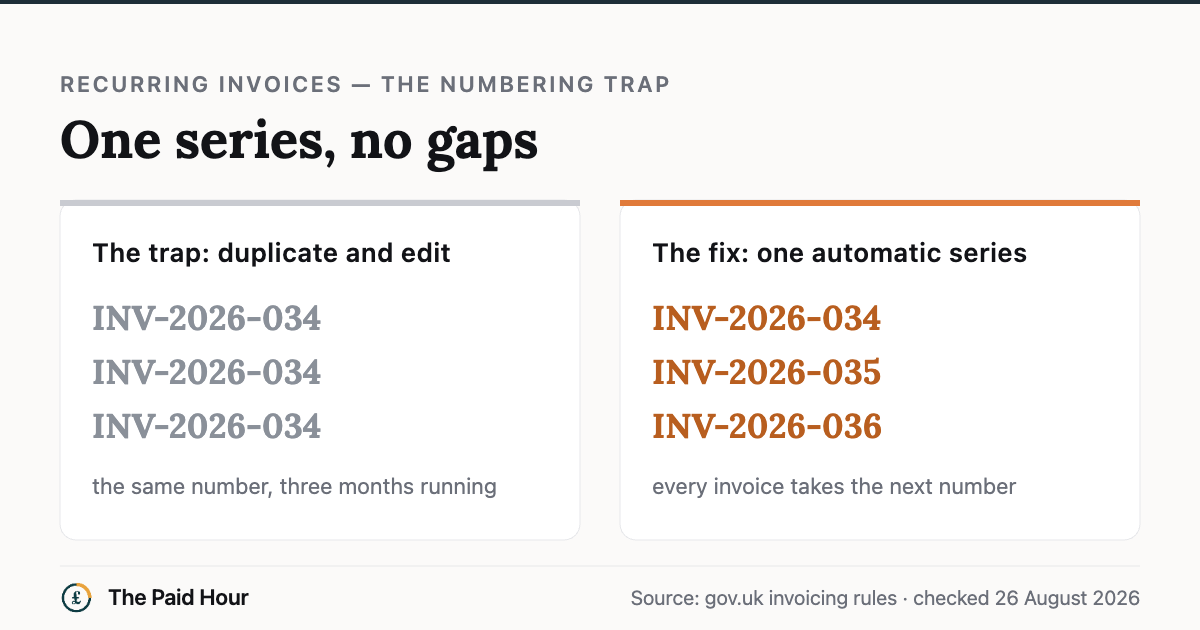
The fix costs nothing: one series for all your invoicing (retainers and one-off projects in the same sequence), with each generated invoice taking the next number automatically. That’s exactly what the recurring-invoice feature in invoicing software does for you, and it’s the strongest argument for using it over manual duplication. The baseline fields every invoice needs, retainer or not, are in what a UK invoice must legally include.
Lock these down before recurring invoices start
Four things belong in writing before the schedule starts. What the retainer covers: hours, deliverables, or availability regardless of hours used; vague retainers are where scope creep quietly turns into unpaid work. What happens to unused time and overflow — rolls over, expires, or billed separately, decided upfront rather than argued later. The billing date and payment terms, identical every cycle; inconsistent billing dates are one of the more common reasons retainer payments start drifting late. And a notice period, so ending the arrangement isn’t ambiguous for either side.
Setting up recurring invoices in your software
Every serious invoicing tool has a recurring-invoice feature: it generates and sends the invoice on the schedule you set, numbers it in sequence, and stops when you tell it to. Preview the first generated invoice before it goes anywhere, a wrong VAT rate or a stale rate-card line caught at setup is a ten-second fix, and the same error caught by the client is a credit note. VAT registered? The VAT invoice rules apply to every recurring invoice exactly as they do to a one-off. gov.uk’s VAT invoice rules carry the detail.
Getting paid from recurring invoices is a separate automation
A recurring invoice sends itself. It does not collect itself, and pairing the invoice schedule with a payment method is the half of the setup most retainers never get. The two hands-off options behave differently in the one scenario that matters. A standing order is the client’s instruction to their own bank: fixed amount, fixed date, and only the client can change it, so every price review means asking them to amend it, and a missed amendment means underpayment nobody notices for months. A Direct Debit runs the other way: the client authorises once, you collect what each invoice says, and a price change needs nothing from them at all.
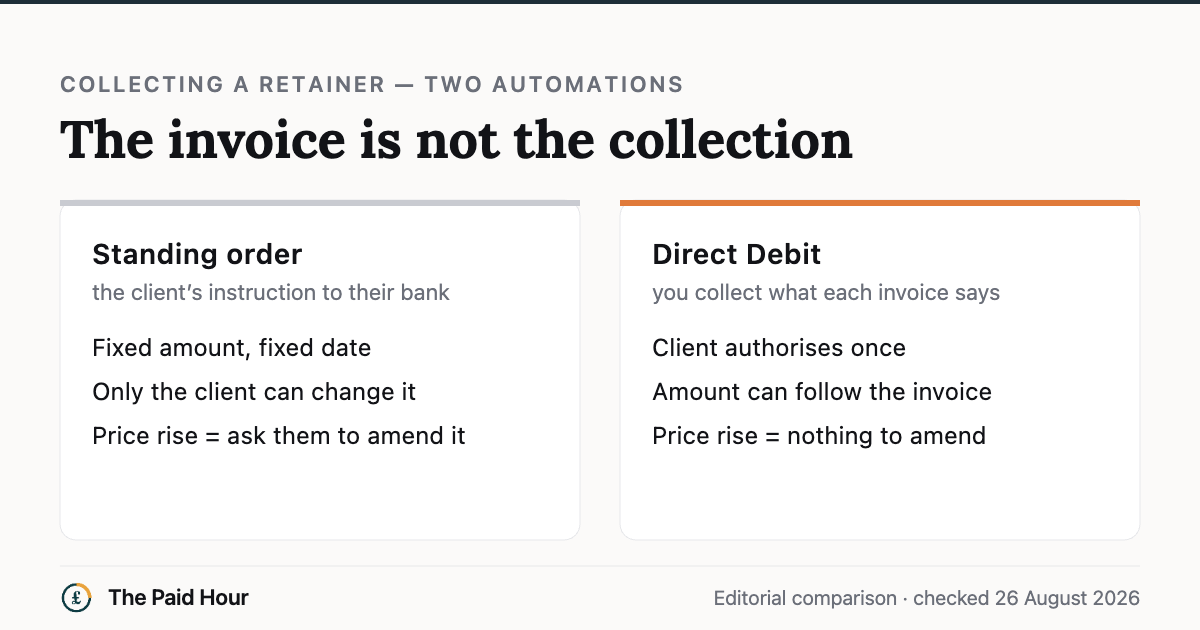
For a retainer whose amount never moves, a standing order is fine and free. For one that gets reviewed, which should be all of them, Direct Debit is the version that survives the review. Neither replaces the invoice itself: the collection is the money, the invoice is the record.
Put a review date on the retainer itself
The risk with recurring anything is that it runs on autopilot after the underlying deal has stopped making sense: a retainer priced for last year’s scope, still billing the same amount while the workload has doubled. Build in a review point every few months, even an informal one, instead of letting an automated invoice mask a retainer that needs renegotiating. Running several retainers at once? Keep each on its own schedule instead of batching them through one manual reminder, that’s what stops one client’s invoice quietly slipping a month behind.
Retainers are also where Direct Debit stops being a hassle and starts paying for itself, because its fee is capped and card fees are not, the numbers are in what card payments cost a freelancer.
Quoting a rate you have never actually costed?
Freelance Ops Playbook. Ten modules and eighteen templates: the rate floor calculation, a pipeline that rejects bad clients early, the twelve-clause contract, onboarding, change orders and a Friday rhythm that holds it together.
- The rate floor calculator, which most people find puts their current rate below cost
- The twelve-clause contract, including the revisions sentence that quietly earns more than any other
- Enquiry log with live pipeline value, thirteen-week cash forecast, three-option proposal, change order, welcome pack
One under-scoped project, or one client who “just needs a couple more rounds”, costs more than this playbook several times over. The templates exist so that never happens again.
Buying more than one? The Complete Freelancer System, all five for £87, against £215 at full price.
Need this ready-made? → UK invoice templates (editable, HMRC-ready) from £4.49
Sources
- Invoicing and taking payment from customers: what invoices must include, GOV.UK
- VAT record keeping: VAT invoices: GOV.UK
The invoice-content requirements were checked against gov.uk on 26 August 2026. General guidance based on standard UK invoicing practice, not legal advice, and not a substitute for your own client contract terms. No affiliate links on this page.