
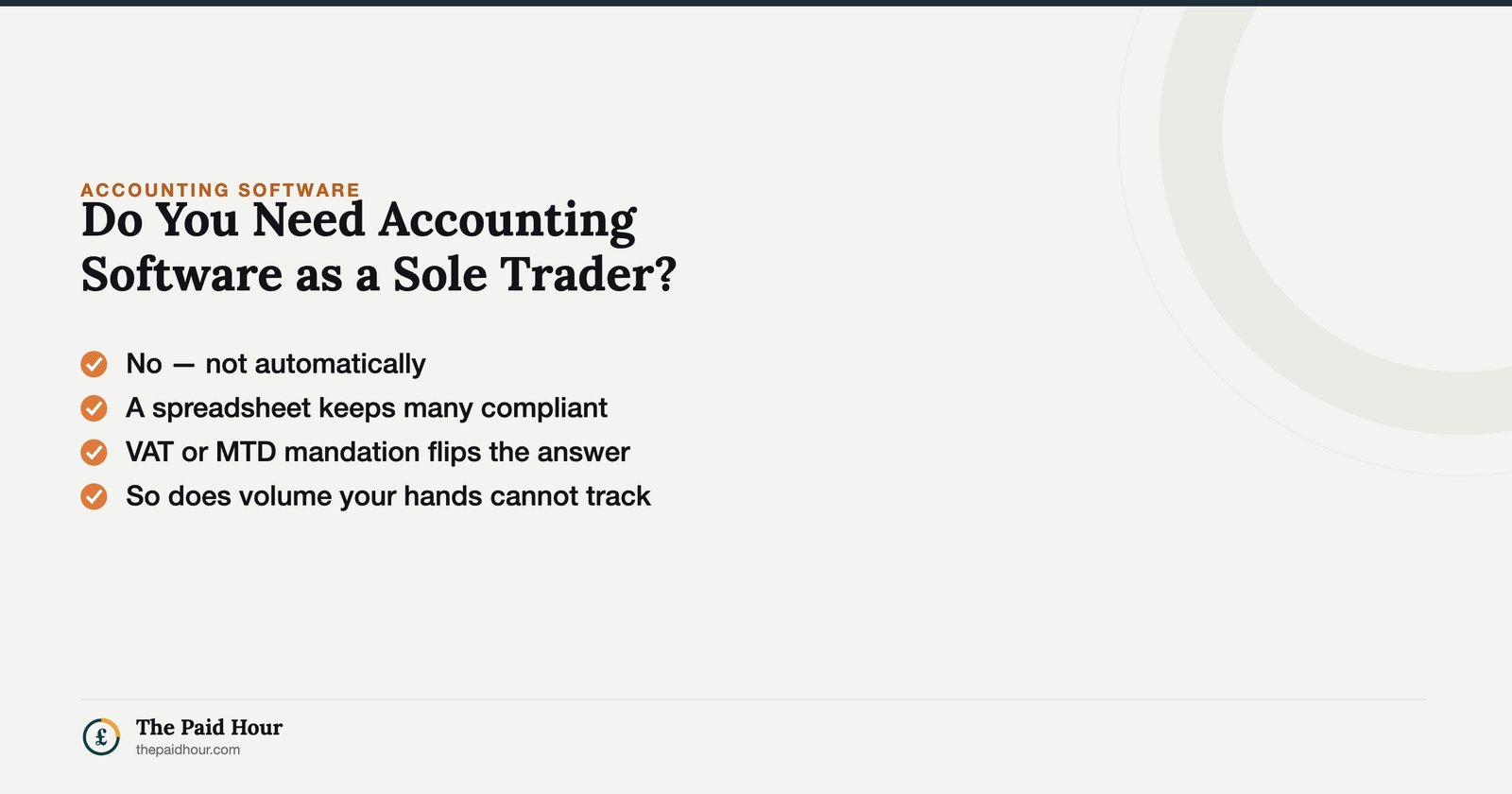
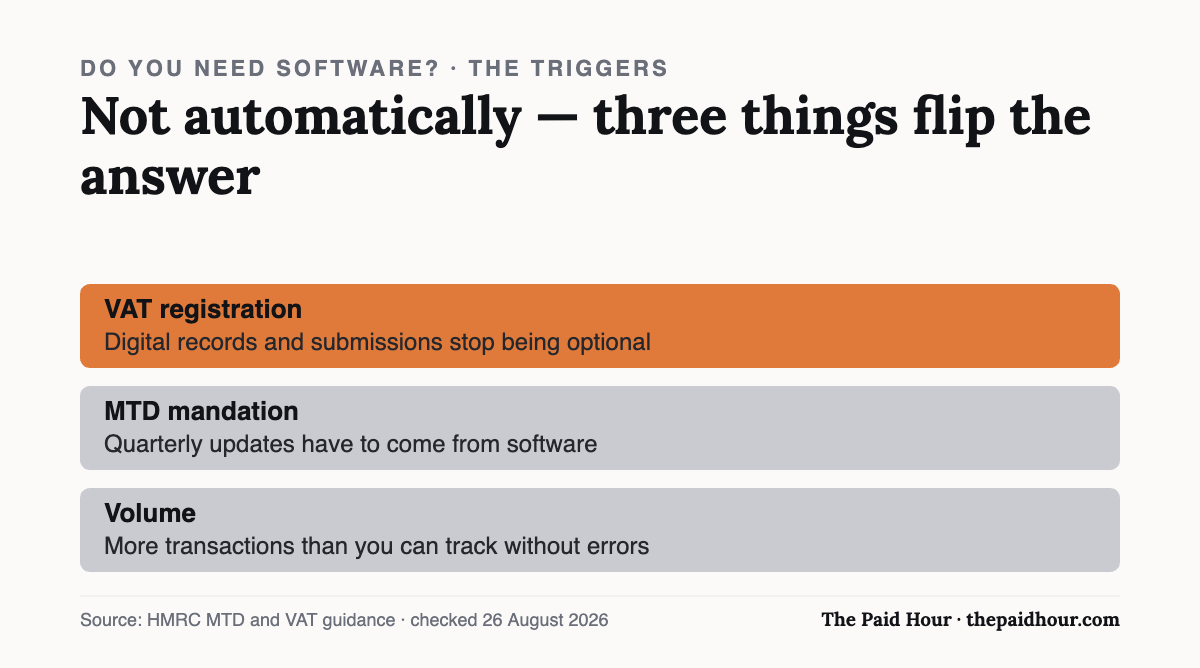
The one-paragraph answer: No rather than automatically. A spreadsheet and a separate account keep plenty of sole traders compliant and organised. The answer flips when something specific changes: VAT registration, MTD mandation, or more transactions than you can track by hand without errors creeping in.
No rather than automatically. That’s the honest answer, and it’s not the one most software companies want you to read. Plenty of sole traders run perfectly compliant, perfectly organised businesses on a spreadsheet, and only need accounting software once specific things change, VAT registration, Making Tax Digital mandation, or simply too many transactions to track by hand without errors creeping in. Whether you need accounting software right now is a narrower question than most guides make it sound.
This isn’t an anti-software post. Plenty of people are better off with it from day one. It’s a guide to figuring out honestly whether you need accounting software at all, instead of signing up for a £15-a-month subscription because everyone else seems to have one.
What HMRC requires, which is less than you’d think
HMRC’s own guidance on what records to keep lists what you need: records of all sales and income, all business expenses, VAT records if you’re VAT-registered, PAYE records if you employ anyone, and records of your personal income. Nowhere does it say those records have to live in a piece of accounting software.
A spreadsheet, a paper cash book, or even a well-organised folder of receipts with a running total can satisfy that requirement, provided it’s accurate, complete, and you can actually produce it if HMRC ever asks. The one thing that overrides all of this is Making Tax Digital. Once you’re mandated into it, informal record-keeping stops being legally sufficient regardless of how tidy it is, and at that point you do need accounting software, full stop.
The moment you need accounting software
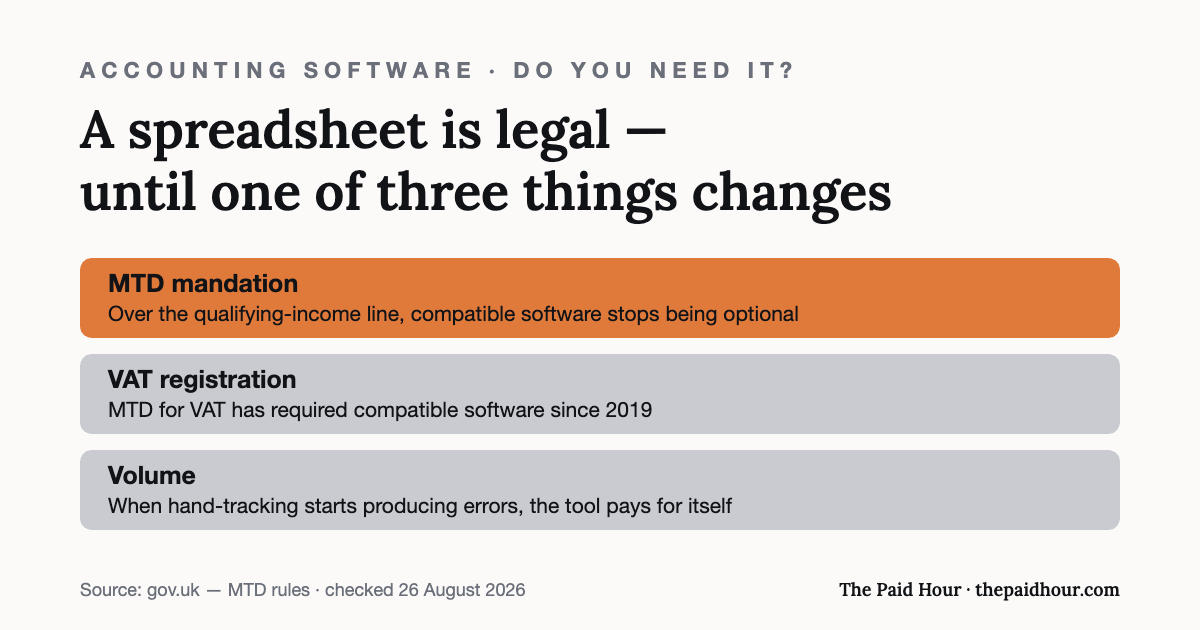
There’s one non-negotiable trigger: Making Tax Digital. Anyone whose qualifying self-employment or property income was over £50,000 in the 2024 to 2025 tax year had to start using recognised software from 6 April 2026, that’s already in effect. The threshold drops to £30,000 from April 2027 and £20,000 from April 2028, per HMRC’s own guidance on who needs to join and when, pulling in more sole traders each year.
Once you’re mandated, a spreadsheet alone can’t be used to submit anything, though a spreadsheet plus bridging software still counts, which is worth knowing before you assume a full switch is the only option.
VAT registration is the second trigger, if you’re not already caught by Income Tax mandation. VAT-registered businesses have been required to use compatible software under Making Tax Digital for VAT since 2019, with very few exceptions. If you register for VAT voluntarily below the £90,000 threshold, this requirement kicks in immediately, not gradually.
Outside those two triggers, nothing in tax law forces the decision either way. That’s the part worth sitting with for a moment, because it means “do I need accounting software” and “am I legally required to use accounting software” are different questions with different answers for most sole traders below the thresholds.
Working out which question you’re answering
Start with the legal question, because it’s the one with a definite answer. Pull your qualifying income for the last full tax year, self-employment and property income combined, before expenses, and check it against £50,000, £30,000, or £20,000 depending on which year applies. If you’re VAT-registered, that question is already answered regardless of income. Either of those puts you in “need accounting software” territory with no real judgment call left to make, and no amount of preferring a spreadsheet changes that.
If neither applies, you’re answering the practical question instead, and that one does come down to judgment: your own transaction volume, your own tolerance for manual admin, and how much your time is worth per hour spent reconciling a spreadsheet versus spent doing billable work. There’s no universal right answer to that second question, which is exactly why so much generic advice online skips past it and just tells everyone to get software.
The moment it stops being about compliance and starts being about sanity
Below those legal triggers, the decision becomes purely practical. A spreadsheet works fine for maybe a dozen transactions a month, a handful of client invoices, a handful of expenses. Once you’re past roughly thirty or forty transactions a month, or juggling multiple income streams, the manual reconciliation that felt manageable in month one starts eating a unreasonable amount of time by month six, and that time cost is usually the real reason people decide they need accounting software after all.
The other practical trigger is simply getting things wrong. If you’ve had a near-miss (a duplicated invoice, an expense claimed twice, a bank transaction that never quite reconciled), that’s usually the moment a spreadsheet has stopped being “simple” and started being “a source of errors nobody’s catching.” Software doesn’t eliminate mistakes, but bank feed matching and built-in checks catch a category of error that manual entry doesn’t.
Two people who landed on different answers
Tanya does occasional freelance copywriting alongside a part-time job, invoicing three or four clients a month for modest amounts. She’s well under the VAT threshold and nowhere near the Making Tax Digital income threshold. A simple spreadsheet with one tab for income and one for expenses, backed up monthly, does everything she needs — she genuinely doesn’t need accounting software right now, and paying for it would just be an unnecessary subscription.
Marcus runs a small web design business, billing around twenty clients a month with a mix of one-off projects and retainers, plus a handful of subcontractors he pays. He’d been using a spreadsheet for a year and was regularly finding reconciliation errors by the time he switched. For him, the switch wasn’t about a legal requirement (his income sat below the Making Tax Digital threshold at the time), it was about the spreadsheet costing him more time and more mistakes than a subscription would.
Neither of them made the wrong call. Tanya spending money on accounting software she doesn’t need would be worse for her business than the spreadsheet she’s using now, and Marcus sticking with a spreadsheet he’d already outgrown would have kept costing him hours every month that a modest subscription would have bought back. The point of both examples isn’t which choice is “better” in general, it’s that the right answer to whether you need accounting software depends entirely on specifics that only you actually know.
What a spreadsheet can’t do, even a good one
A well-built spreadsheet handles income and expense tracking fine. What it struggles with: automatic bank feed reconciliation, generating and sending professional-looking invoices with payment tracking, VAT calculation and submission if you’re registered, and giving you a real-time picture of who owes you money without you manually checking each row.
If none of those gaps bother you. You invoice rarely, you’re not VAT-registered, and you’re comfortable checking your own totals, a spreadsheet isn’t a compromise. It’s just the right tool for a smaller job. Don’t let software marketing convince you otherwise if your actual situation doesn’t call for it.
Doing the actual cost comparison
Most sole trader accounting software sits somewhere between £10 and £30 a month once you’re past any introductory offer, which works out to £120–£360 a year. Whether that’s worth it comes down to a simple sum: how many hours a month does bookkeeping currently take you, and what’s an hour of your time worth if you spent it on billable work instead?
If reconciling a spreadsheet takes three hours a month and you charge £40 an hour for client work, that’s £120 of opportunity cost every month, considerably more than most subscriptions cost. If it takes twenty minutes because your business is small and simple, the maths points the other way, and paying for software you don’t need accounting software for yet is just a needless expense eating into a thin margin.
This is why a blanket answer to “do I need accounting software” is close to useless, the honest answer is always conditional on numbers specific to your own business rather than a general rule that applies to every sole trader in the same way. Whether you need accounting software comes down to your own transactions, your own time, and your own numbers.
If you decide you don’t need it yet
Build a proper spreadsheet rather than a running note in your phone. Separate tabs for income and expenses at minimum, a running total, and (critically), a backup that isn’t just “saved on this one laptop.” Cloud storage with version history is the easy way to cover yourself here, since a corrupted or lost file with a year of financial records in it is a genuinely bad day.
Keep digital copies of receipts and invoices alongside the spreadsheet, not just totals. HMRC can ask for evidence behind a figure, and “£340, materials” without the receipt behind it is a weaker answer than the same line with a scanned copy attached.
Our guide to what’s free in UK accounting software is worth a look too: some free tiers give you invoicing and receipt storage without the full cost of a paid plan, a reasonable middle ground if a pure spreadsheet is starting to feel thin but a paid subscription still feels premature.
If you decide you do
Check the HMRC recognised software list before picking anything, particularly if you’re anywhere near either Making Tax Digital threshold, no point choosing something you’ll have to replace within a year because it was never going through recognition.
Beyond that, match the software to the gap you actually identified: invoicing-heavy business, prioritise invoicing and payment tracking features; VAT-registered, prioritise MTD-compliant VAT submission; multiple income streams, prioritise reporting that separates them cleanly. Once you’ve confirmed you need accounting software at all, this matching step is where most of the value in choosing well sits.
Migrating existing spreadsheet data in isn’t usually worth the effort for a small operation. Setting an opening balance and starting clean from the switch date is simpler and less error-prone than importing a year of manually-tracked rows, a lesson covered in more detail in our guide to switching accounting software cleanly.
Mistakes people make on both sides of this decision
Paying for software out of habit or peer pressure, without checking whether anything in your situation calls for it, is the most common one on the “getting software” side. A £20-a-month subscription for a business generating a handful of invoices a year is money that could just stay in the business.
On the other side, sticking with a spreadsheet purely to avoid the hassle of switching, well past the point where it’s costing more time in errors and manual reconciliation than a subscription would cost in money, is just as common. Neither mistake is really about accounting, both come from not revisiting the decision once, a year or two after making it, when the actual facts of the business have quietly changed.
A third, more serious mistake: assuming “I don’t need accounting software” also means “I don’t need to check Making Tax Digital thresholds.” Those are two separate questions. You might not need software today and still be six months from a mandation date that changes the answer completely: check your qualifying income against the thresholds specifically, don’t just go on gut feeling about whether you’re “probably fine.”
A fourth is copying what a friend or fellow freelancer does without checking whether their situation actually matches yours. Someone running a VAT-registered business with fifteen clients has a different answer to whether they need accounting software than someone doing occasional freelance work on the side of a day job — the fact that they both call themselves “self-employed” doesn’t mean the same tool fits both.
Quick answers to the questions people ask
Can I get in trouble for using a spreadsheet if I’m not required to use software? No, as long as your records are accurate, complete, and you can produce them if HMRC asks, the format doesn’t matter outside Making Tax Digital’s specific requirements. A tidy spreadsheet is a legitimate record-keeping method, not a shortcut you’re getting away with.
Does an accountant require me to use accounting software? Not necessarily, though many prefer it since it makes their job faster and reduces the chance of errors in what they’re working from. Some accountants are happy working from a well-organised spreadsheet, especially for a smaller, simpler business, worth asking directly instead of assuming either way.
What if I’m right on the edge of the VAT threshold? Plan ahead rather than waiting until you cross it. If you can see registration coming within the next few months, it’s usually easier to set up recognised software before you’re mandated than to scramble afterward while also learning a new system under time pressure.
Is free accounting software a reasonable middle ground? Often, yes, particularly for someone who’s outgrown a spreadsheet but doesn’t have the transaction volume to justify a paid plan yet. Free tiers usually cap transaction numbers or history, so check those limits against your actual volume before assuming it’ll cover you long-term.
How often should I revisit this decision? Once a year is reasonable for most sole traders, ideally around the same time you’re doing your Self Assessment anyway, when your income and transaction volume for the year are already in front of you. It’s also worth a specific check any time your income jumps meaningfully, rather than waiting for the annual review.
Will I need accounting software just to prepare for Making Tax Digital, even before my mandation date arrives? Not strictly, but plenty of people choose to get used to it a few months early instead of learning a new system in the same quarter it becomes compulsory. If your income is climbing toward a threshold, starting the switch on your own schedule rather than HMRC’s is usually the less stressful route.
Does having an accountant change whether I need accounting software myself? It can reduce the urgency, since your accountant may keep their own records from what you send them. But it doesn’t remove the underlying legal triggers, if you’re VAT-registered or mandated into Making Tax Digital, the software requirement sits with the submission itself, not with whichever party happens to be doing the typing.
What to do before deciding
Check your qualifying income against the Making Tax Digital thresholds first, that’s the one answer that isn’t really a judgment call. If you’re mandated, or close to it, the decision is largely made for you. If you’re not, be honest about transaction volume and how many small errors your current system is actually producing, rather than going on habit or what other freelancers seem to be using.
Whichever way it lands, revisit it once a year. The sole trader who didn’t need accounting software eighteen months ago might well need it now, and the one paying for a subscription they’ve barely opened in months might not need it at all anymore.
What it adds up to for whether you need accounting software
If you’re VAT-registered or mandated into Making Tax Digital, the question is already answered, you need accounting software, specifically a recognised product, and there’s no version of this decision where a plain spreadsheet remains an option. That’s not a judgment call to revisit; it’s a fact to check against your own numbers.
Below those thresholds, you might not need accounting software at all, and there’s nothing unusual or risky about staying on a well-kept spreadsheet for years if your business stays small and simple. What matters more than which tool you pick is that whichever one you’re using (spreadsheet or software), it’s accurate, backed up, and something you’d feel comfortable handing to HMRC without dreading the conversation.
If the answer is yes, the next question is where the software runs. That one turns out to be about money rather than rules, see cloud vs desktop accounting software and the real cost of each.
If you decide you do need software, start with our FreeAgent review, the package most UK sole traders end up comparing everything else against.
Picking software, or fixing the one you have?
Digital Bookkeeping System (MTD-ready) 2026/27. Seven modules and a seven-sheet toolkit, built around a category-to-tax-box mapping table that makes your quarterly updates fill themselves.
- A software decision sheet costed over three years, split by turnover, VAT status and phone-or-desktop
- The chart of categories mapped to the Self Assessment and MTD boxes, and the three categories never to auto-categorise
- Weekly and month-end cards, an MTD quarter-close checklist, and an export-and-archive index so their cloud is never your only copy
Software is priced monthly, excluding VAT, and you will hold the subscription for years. Pick on the wrong number and the difference over three years is more than every course on this site combined.
Buying more than one? All ten 2026/27 courses for £107, against £328 at full price.
Sources
- gov.uk: Self-employed records: what to keep
- gov.uk, Find out if and when you need to use MTD for Income Tax
The MTD triggers were re-checked against gov.uk on 26 August 2026.
This is general information, not financial advice. Pricing and terms are the provider’s own and change, check the linked pages before you rely on them.