
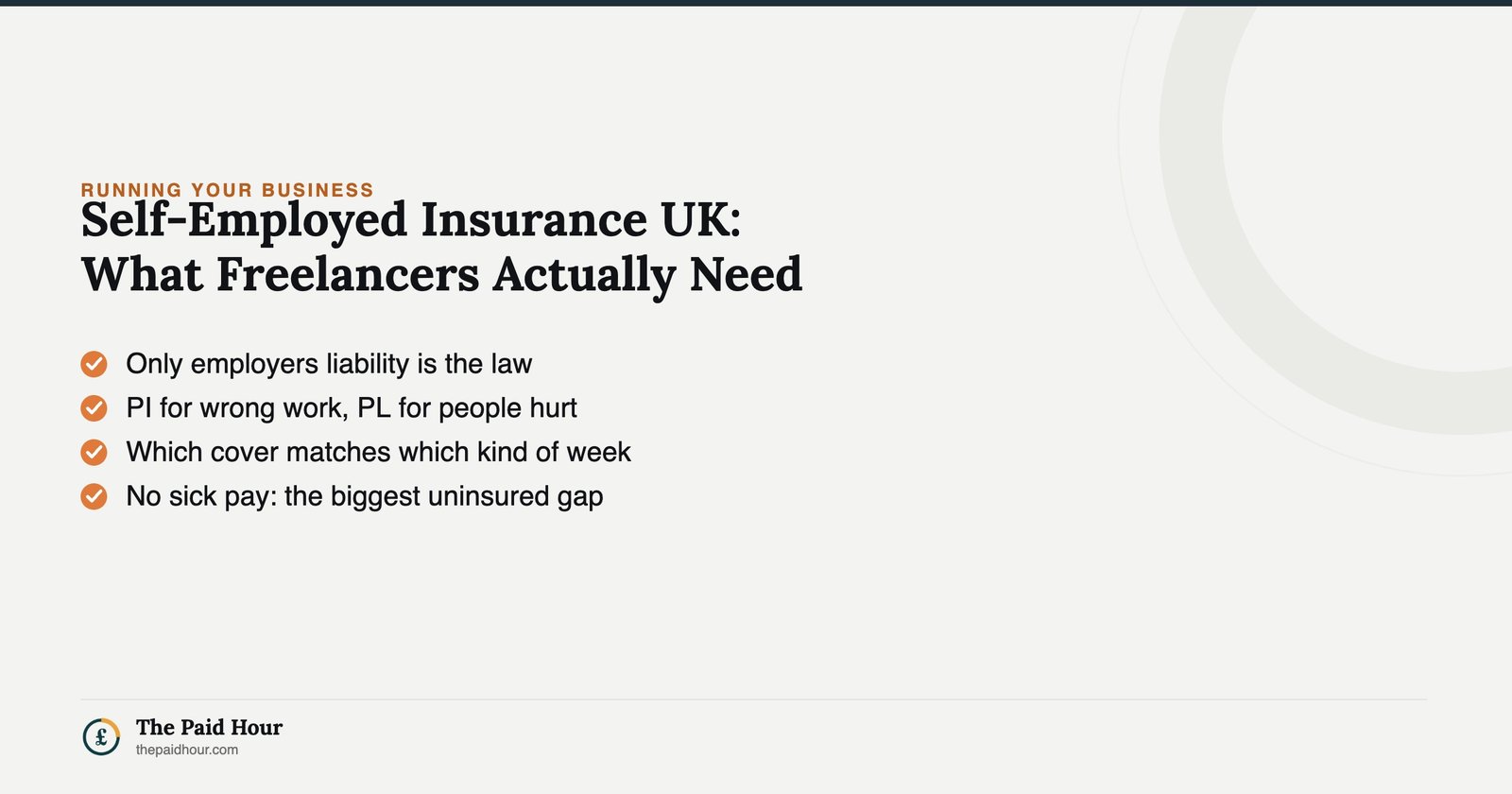
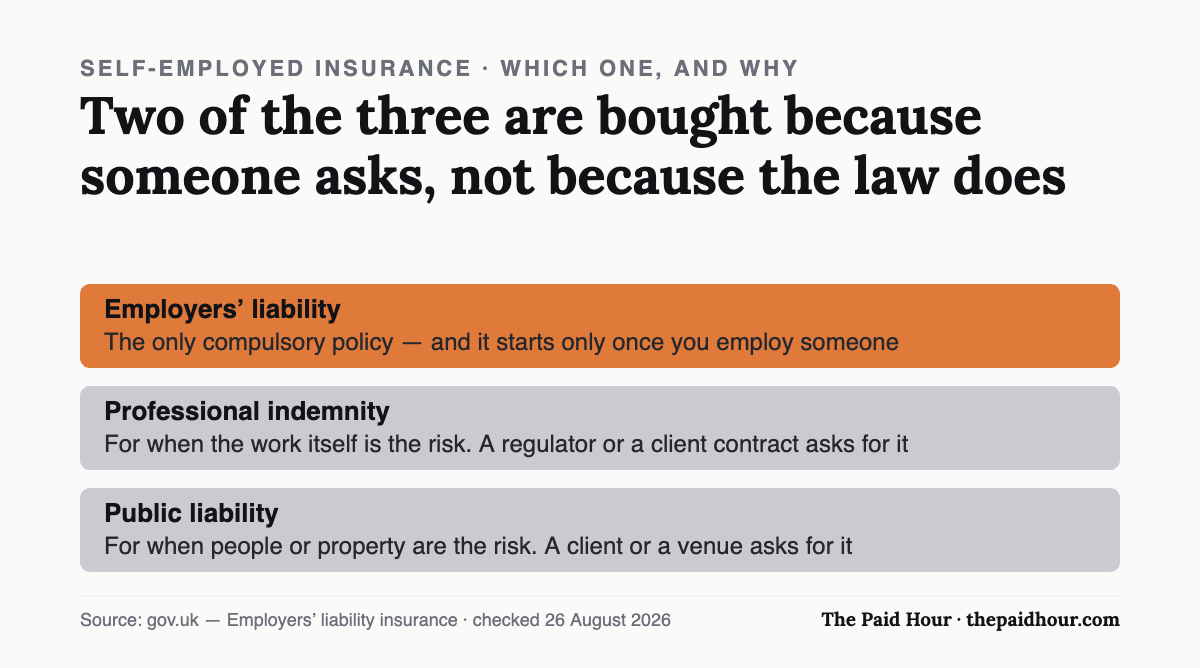
Straight answer: For a solo freelancer with no staff, none of it is a legal requirement. Employers’ liability is the only compulsory policy and it only starts once you employ someone. Everything else is a contract requirement, a regulator’s rule, or a decision. The two that matter for most people are professional indemnity, for when the work is wrong, and public liability, for when someone gets hurt.
This self employed business insurance UK guide sorts what the law requires from what a client, a regulator, or plain risk will require instead. Insurance for freelancers is easy to put off, right up to the afternoon a client’s procurement form asks you to attach a certificate before they will set you up as a supplier.
So it is worth separating two questions that get answered as one. What does the law require? Almost nothing. What will somebody refuse to work with you without? That is a much longer list, and it is the one that governs what you buy.
The only insurance the law requires
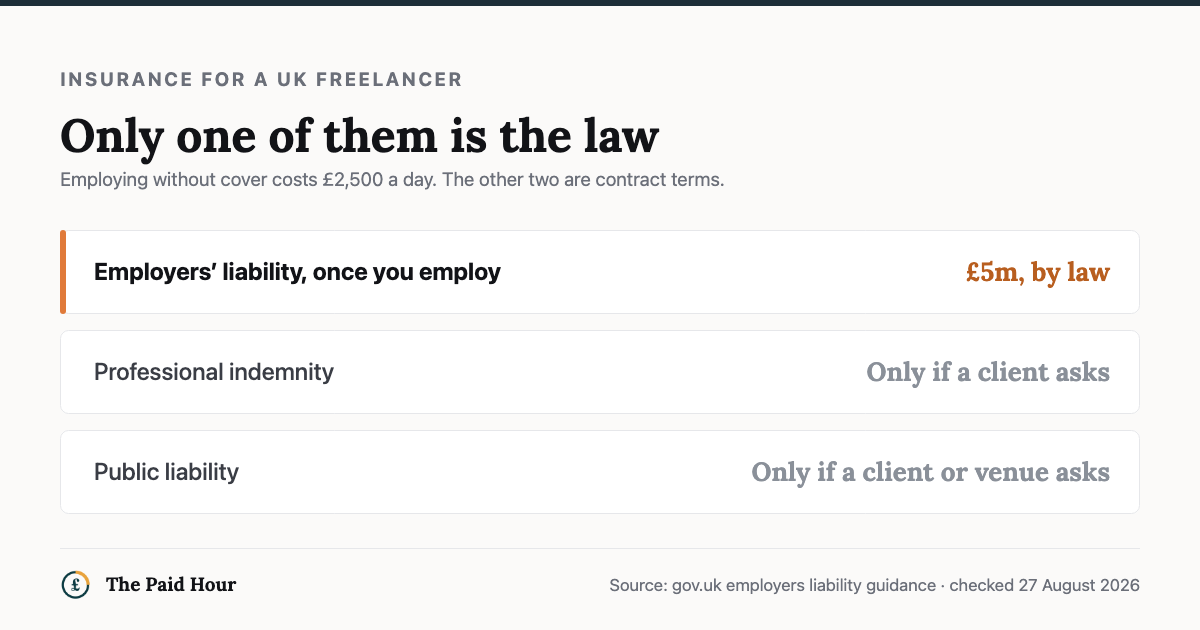
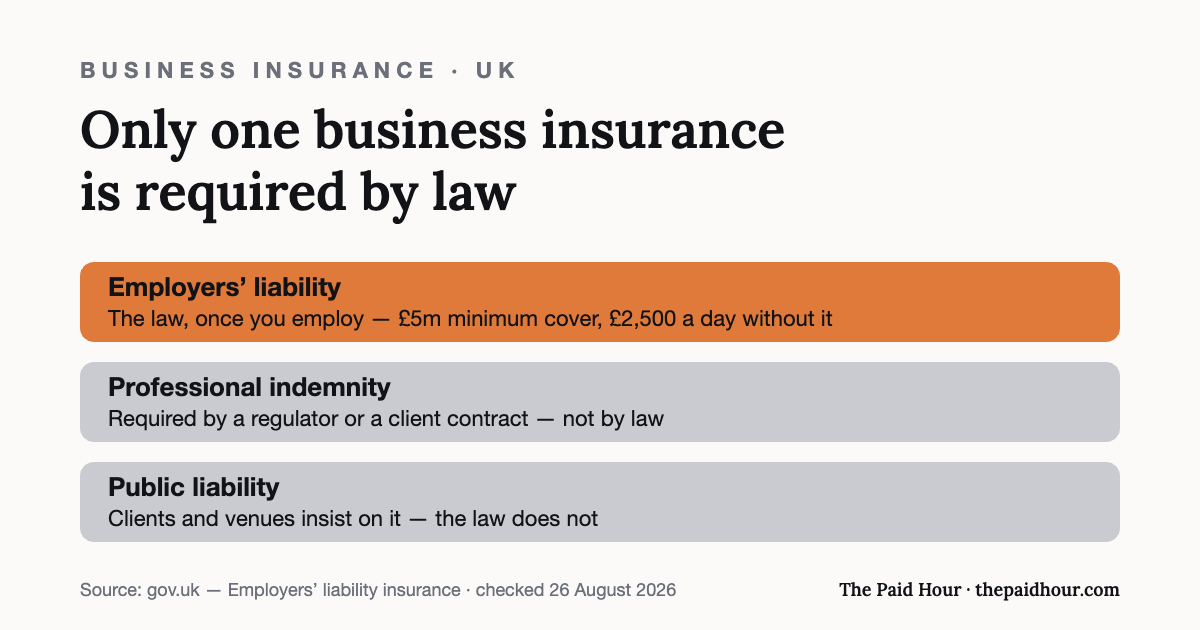
Employers’ liability. gov.uk: you need it “as soon as you become an employer”, covering you “for at least £5 million”, and the penalty is £2,500 for every day you go without, plus £1,000 for not displaying the certificate.
Solo, with nobody working for you, it does not apply. The catch is that “employer” is decided by how the relationship works rather than what you call it, and volunteers and work-experience students usually count, the detail is in the guide to employers’ liability.
Beyond that, Companies House is blunt: “There’s only one policy you’re legally required to have as a small business, and that’s employers’ liability insurance.”
Professional indemnity: when the work is the risk
The Association of British Insurers describes professional indemnity as covering “loss or damage resulting from services or advice provided by a business or individual”. Negligent work, negligent advice, and the financial damage that follows.
If you consult, design, build, write, translate or advise, this is the policy that matches what you actually do. Regulated professions (solicitors, accountants, architects, surveyors, financial advisers, several healthcare roles), are required to hold it by their own regulator, at a minimum their regulator sets. Everyone else is there because a client asked.
It also has a feature no other policy on this page has: it works on a claims-made basis, so cover has to continue after you stop trading. Both the SRA and the ARB require six years of run-off. That is covered properly here, and it is the single most expensive thing to find out late.
Public liability: when people are the risk
The ABI puts it as cover for “the cost of claims made by members of the public for incidents that occur in connection with your business activities”. Injury, death, or damage to property, for anyone other than your own employees.
It matters when your work brings people physically near you or you near their property. Client sites, workshops, events, home visits, market stalls. A freelancer who emails deliverables and never meets anyone carries almost none of this exposure, which does not stop it being the policy they buy first, because it is the phrase everyone has heard.
Not a legal requirement either, for almost everyone. What it is, routinely, is a condition of the contract or the gate pass. More in public liability insurance for the self-employed, and what it costs.
The shortlist, by how you work
Use this self employed business insurance UK guide’s shortlist below to match how you actually work to the cover that fits it.
| If this is your week | The cover that matches | Required by |
|---|---|---|
| Remote, deliverables by email, nobody visits | Professional indemnity, if anything | Client contracts, sometimes |
| Advice, code, designs or reports a client relies on | Professional indemnity | Contracts; a regulator if you have one |
| Client sites, workshops, events, home visits | Public liability, usually alongside PI | Contracts, venues, site access |
| Anyone works for you, paid or not | Employers’ liability | The law, from day one |
Read the contract before you buy anything. The limit is usually specified in it, and buying £1 million before discovering the framework wants £5 million means paying twice.
What the insurance costs
Less than the advertising suggests and more than the headline. Simply Business publishes public liability “from £5.40 a month”, which its own footnote defines as the cheapest 10% of customers paying “£64.78 or less annually between 1st Jan – 30th Jun 2026”, before whatever paying monthly adds. Its published example quotes for sole traders with no staff run £86.49 and £100.08 a year.
Professional indemnity costs more than public liability for most desk-based freelancers, because the sums at stake are larger and the claims last longer. Get quotes for the combination instead of each policy separately, packaged cover is usually cheaper than two standalone policies and easier to keep track of.
The gaps nobody mentions until they matter
Three things sit outside the two big liability policies and surprise people.
You get no sick pay. Statutory Sick Pay requires you to “be classed as an employee”. Self-employed means none, at all, from day one of any illness. Whatever else is on your list, this is the largest uninsured hole in most freelance finances, and the products that fill it: income protection, critical illness, are worth understanding before you need them. That is a decision to take with an FCA-authorised adviser rather than off a comparison table.
Your tools are not covered by your liability policies. Neither PI nor public liability pays for your own laptop, camera or van contents. That is separate equipment cover, sometimes bundled — one of the published example quotes above includes “£1,000 tools cover” as an add-on, which tells you it is an add-on.
Working from home can affect your home insurance. Home policies commonly restrict or exclude business use, and the definition varies by insurer, a laptop on the kitchen table is treated differently from clients coming through the front door. Read your own policy wording and tell your insurer what you do. Finding out at claim time is the expensive version.
All of it comes off your tax bill
HMRC is broad about this: “You can claim for any insurance policy for your business, for example public liability insurance.”
For a sole trader inside the basic rate band the marginal relief is 20% Income Tax plus 6% Class 4 National Insurance, so a £150 premium has a real cost nearer £111. That is arithmetic from the published rates rather than a figure HMRC prints. It goes on the return with the rest of your allowable expenses, and a surprising number of people pay the premium and then forget to claim it.
Before you buy insurance
- Find the insurance clause in your client contract and read the limit and the run-off wording.
- Check whether the limit is per claim or aggregate for the year. Same headline number, different policy.
- Check the excess, and check whether tools and equipment are in or out.
- Pay annually if the cash allows. On a policy this small, the monthly loading is the one cost you can remove entirely.
- Keep the certificates. For professional indemnity in particular, the year matters years later.
One that did not make the shortlist above, and usually should not: cyber cover. The government survey puts the median cost of a breach under £200, and Cyber Essentials bundles £25,000 of cover anyway, see cyber insurance for freelancers and what it will not cover.
Do you need employers’ liability for subcontractors?
This is the question that catches people, because the answer does not follow the label on the invoice. The duty attaches to employees, and whether someone is an employee is decided by how the working relationship actually operates. Who sets the hours, who directs the work, who provides the kit, not by whether you both call it subcontracting.
GOV.UK names two exemptions worth knowing. You do not need cover if the only people you employ are family, a spouse, parent, grandparent, step-relation, sibling or half-sibling, or if the person is based outside England, Scotland and Wales.
The cost of getting it wrong is the reason to check instead of assume:
- £2,500 a day for every day you employ someone without the cover.
- £1,000 for not displaying the certificate where employees can see it.
- £5 million is the legal minimum, and most policies come at that level as standard.
If you bring people in for a busy month and are not sure which side of the line they fall, ask the insurer before the work starts rather than after. Hiring a subcontractor as a sole trader covers the rest of what changes when you do, and employers’ liability for the self-employed goes through the cover itself.
Insurance sized to a guess?
Protect the Business: Legal, IP & Insurance 2026/27. Eight modules and five working sheets built around a complete annotated freelance contract, with a negotiation note under every clause.
- Registering a trade mark yourself: searching, classes, fees and the opposition period
- UK GDPR without a consultant: the ICO fee tiers, a privacy notice, and the 72-hour breach plan
- An insurance sizing calculator by work type, and the client clauses never to sign as they stand, with the redline for each
You own the copyright in what you make until you assign it in writing. Most clients assume the opposite, and most freelance contracts are silent on it.
Buying more than one? All ten 2026/27 courses for £107, against £328 at full price.
Sources
- gov.uk: Employers’ liability insurance
- Companies House, What insurance does a small business need?
- Association of British Insurers. Liability insurance
- gov.uk, Statutory Sick Pay: eligibility
- Simply Business: Public liability insurance, published pricing and example quotes
- gov.uk — Expenses if you’re self-employed: legal and financial costs
Legal requirements re-checked against gov.uk, and headline prices against the insurers’ own published pages, on 26 August 2026.
Checked 25 August 2026. This is general information about how these policies work and what the law requires, not insurance advice, The Paid Hour is not authorised or regulated by the Financial Conduct Authority, does not arrange or recommend insurance, and earns nothing from any insurer named here. For cover suited to your own work, get quotes from more than one insurer or speak to an FCA-authorised broker. The tax points are general information rather than tax advice; for your own circumstances, speak to an accountant or contact HMRC.
Read next
- Public Liability Insurance: Do the Self-Employed Need It?
- Professional Indemnity Insurance: What Sole Traders Miss
- Employers’ Liability Insurance: £2,500 a Day Uninsured
- Cyber Insurance for Freelancers: What It Will Not Cover
- Business Storage UK: What It Costs and What You Can Claim
Self-employed insurance: common questions
What insurance do I need as a self-employed person in the UK?
Legally, none — until you employ someone, at which point employers’ liability becomes compulsory. In practice the two that earn their place are professional indemnity, for when the work turns out to be wrong, and public liability, for when a person or their property gets hurt. Which of the two you need is decided by how you work, not by your job title.
Is business insurance a legal requirement for the self-employed?
Only employers’ liability, and only once you have employees. It requires at least £5 million of cover and HSE can fine an uninsured employer up to £2,500 for every day without it. (HSE — Employers’ liability insurance guide, checked 3 September 2026.)
Do freelancers need insurance if they work from home?
Not by law, but two gaps catch people out. A home policy generally will not cover business equipment or a client injured while visiting, and a client contract can still demand professional indemnity or public liability regardless of where you sit.
What is the difference between public liability and professional indemnity?
Public liability answers for physical harm — someone trips over your cable, or you damage a client’s property. Professional indemnity answers for the work itself — advice, designs or figures that turn out to be wrong and cost the client money. A desk-based freelancer usually needs the second more than the first.
Is self-employed insurance tax deductible?
Yes. Business insurance is an allowable expense, so it reduces your taxable profit rather than costing you the full sticker price.