
The one-paragraph answer: Having a UTR is not the same as being registered for the thing you are now doing. GOV.UK is explicit: if you already file for another reason and you have started working for yourself, “you’ll need to register again as a sole trader”, and the reason it gives is your Class 2 National Insurance record, the one that builds State Pension years. There is a second version for people who stopped filing and have started again, where the account has to be reactivated. Both are 5 October 2026 jobs, and both are invisible on the tax return itself, which is exactly why they go unnoticed for years.
“I already file a tax return, so I do not need to register” is the most reasonable-sounding wrong answer in UK tax. It is wrong because HMRC does not hold one flag saying this person files. It holds a record of why you file, and the why is what drives what happens next, which pages appear on your return, and, more quietly, whether your self-employment reaches the National Insurance side of HMRC at all.
Three situations look identical from the outside and are not.
Situation one: you file for something else, and now you work for yourself
You have filed for three years because you let out a flat, or because of the High Income Child Benefit Charge, or because you had capital gains to report. This year you also start freelancing.
GOV.UK’s sole trader page addresses this directly, and it is the single least-read sentence in the whole registration process:
“If you have already registered for Self Assessment for another reason, you’ll need to register again as a sole trader. This is so you are registered for Class 2 National Insurance contributions, which will help you qualify for benefits like the State Pension.”
Note what it does not say. It does not say your return will be rejected. It does not say you will be fined. The return you file in January will be perfectly correct: the self-employment pages will accept the income, the tax will calculate, the bill will be right. Nothing visible goes wrong. What is missing sits somewhere you never look.
What Class 2 is doing for you
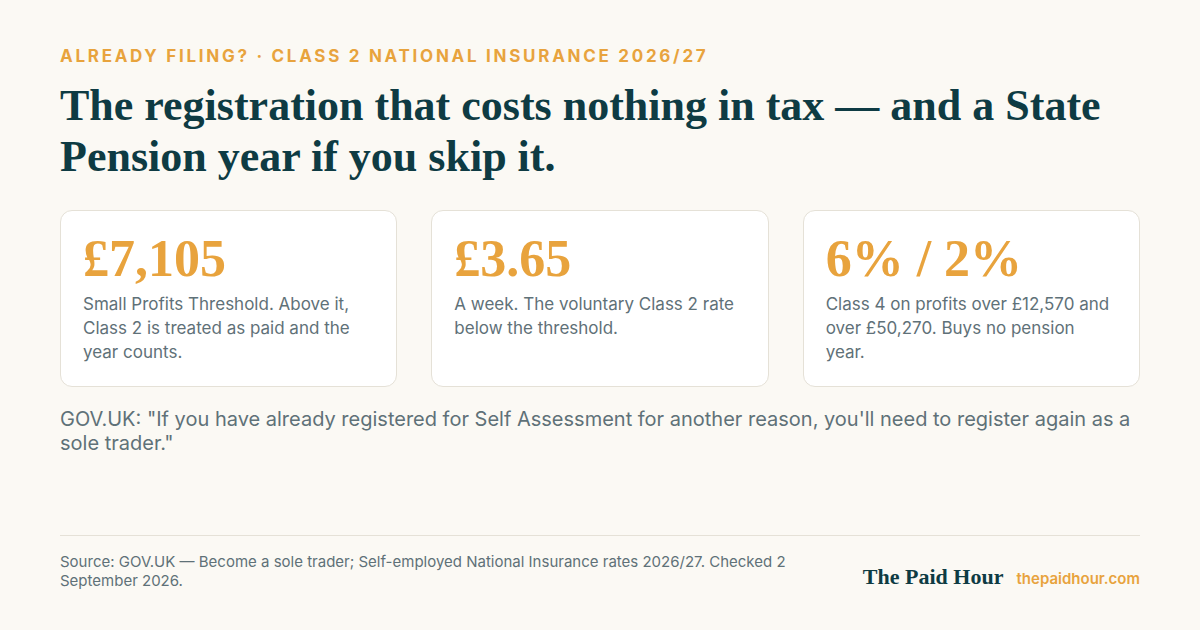
Class 2 National Insurance is the contribution that buys qualifying years toward the State Pension and some contributory benefits. For 2026/27 the Small Profits Threshold is £7,105 and the rate is £3.65 a week. Above that threshold, GOV.UK’s wording is that Class 2 contributions “are treated as having been paid to protect your National Insurance record”, you get the year without a bill. Below it you pay nothing, but you can choose to pay voluntarily, which is the cheapest way there is to fill a gap.
Class 4 is the separate one that behaves like tax: 6% on profits over £12,570 up to £50,270, then 2% above that. Class 4 buys you nothing. It is Class 2 that carries the record. The split is explained properly in Class 2 vs Class 4 National Insurance.
Which is why the missing registration matters more than it first appears. The tax is right either way. The pension year is the thing at risk, and a year of State Pension entitlement is worth vastly more than the £190 or so of Class 2 it represents. It also does not announce itself. You find out decades later, on a forecast, when it is far more expensive to fix. Anyone in this position should check their record: voluntary Class 2 contributions covers what filling a gap involves.
Situation two: you stopped filing, and now you are back
You freelanced for a couple of years, took a permanent job, told HMRC you no longer needed a return, and the returns stopped. Now you are freelancing again, or you have picked up enough side income to cross the £1,000 trading allowance.
Your UTR has not gone anywhere, a UTR is yours for life, as UTR numbers explained covers. But the Self Assessment record attached to it has been closed down, and GOV.UK spells out the fix:
“If you’ve registered for Self Assessment before but did not send a tax return last year, you may need to reactivate your Self Assessment account. You’ll find out how to do that within the service.”
The reactivation happens inside the registration service itself, so the route is the same one a first-timer uses. What you must not do is assume that because you can still log in and see your old returns, you are live again. Being able to read history is not the same as being expected to file.
Situation three: you registered, but had nothing to file last year
This one is written into the scope of the deadline itself. You have to tell HMRC by 5 October 2026 if you need a return for 2025/26 and either you have never sent one, or you “registered before but did not need to send a tax return for the tax year 2024 to 2025”.
So a quiet year does not carry you forward. If 2024/25 produced nothing worth a return and 2025/26 did (a returning client, a property sold, a side project that finally took), you are back inside the 5 October rule, on the same footing as somebody who has never filed at all. Whether you are in scope in the first place is the subject of do I need to file a tax return?
The test that settles it
Forget whether you have a UTR. Ask one question instead: has the reason I file changed since I last registered?
- Registered for rental income, now also self-employed: register again, as a sole trader
- Registered as self-employed, now also have rental income — the return covers it; no new registration needed for Class 2, because you already have it
- Registered as a sole trader, stopped filing, now self-employed again, reactivate, and check the self-employment is on the record
- Registered as a sole trader, still trading, filed last year. Nothing to do
- Joining a partnership, whatever you have done before, register as a partner; the routes are in which registration form you need
The asymmetry in that list is deliberate and it is the whole point. Adding a non-self-employed source to an existing self-employed record is just extra pages on the return. Adding self-employment to anything else is a new registration, because self-employment is the only one that carries National Insurance with it.
Doing it, and what it costs to leave it
Registering again takes about ten minutes. Have your National Insurance number, your existing UTR, and the date the self-employment started: that date decides which year your first self-employed return covers, so do not round it to “sometime last spring”. If you cannot pin it down, the badges of trade is the honest way to work out when a hobby became a business.
Leave it past 5 October and two separate things happen. HMRC moves your filing date, “this will be 3 months from the date on the letter or email”, while leaving the payment date exactly where it was: “You must still pay the tax you owe by 11:59pm on 31 January 2027 or you’ll get a penalty.” And the failure-to-notify penalty, which is calculated from tax unpaid at 31 January rather than from the missed date itself, sits on top; the penalty for registering late works through the arithmetic.
Neither of those is the expensive part for someone in this guide’s situation, though. The expensive part is silent, does not appear on any bill, and is only visible on a State Pension forecast years later.
Sources
- Become a sole trader: Register as a sole trader. GOV.UK
- Register for Self Assessment, GOV.UK
- Self-employed National Insurance rates: GOV.UK
- Self Assessment tax returns: deadlines — GOV.UK
- Register for Self Assessment if you are not self-employed (SA1), GOV.UK
The “register again as a sole trader” wording and its Class 2 explanation, the reactivation sentence, the scope of the 5 October 2026 deadline including people who registered before but had no return for 2024/25, the £7,105 Small Profits Threshold and £3.65 weekly Class 2 rate for 2026/27, the Class 4 rates of 6% and 2%, and the three-month letter for late registrations are all quoted from the GOV.UK pages listed above, read and checked on 2 September 2026. This is general information about how the rules work, not tax advice; for your own circumstances speak to an accountant or contact HMRC.
Coming back to Self Assessment after a gap? → Side Hustle Tax Starter takes it from registration to a filed return.
Related guides
- Which Self Assessment registration route you need
- UTR numbers explained
- Class 2 vs Class 4 National Insurance
- Do I need to file a tax return?
- Employed and self-employed at the same time
A job plus a side income: where does it land?
Side Hustle Tax Starter 2026/27. A six-module starter course and six working templates that tell you, in an evening, whether you owe anything at all, and set up the twenty-minute monthly routine that keeps it that way.
- The nine badges of trade as questions you can answer about your own income
- What the platforms send HMRC, the small-seller exemption, and three reply letters for when a letter arrives
- A sales log with a running £1,000 alert, an allowance-versus-expenses sheet, and a tax set-aside calculator at 2026/27 rates
Selling platforms now hand your sales data to HMRC once a year. Selling your own old possessions is never taxable. Buying to resell, making things, or freelancing is. Knowing which side you are on is the whole question.
Buying more than one? All ten 2026/27 courses for £107, against £328 at full price.