
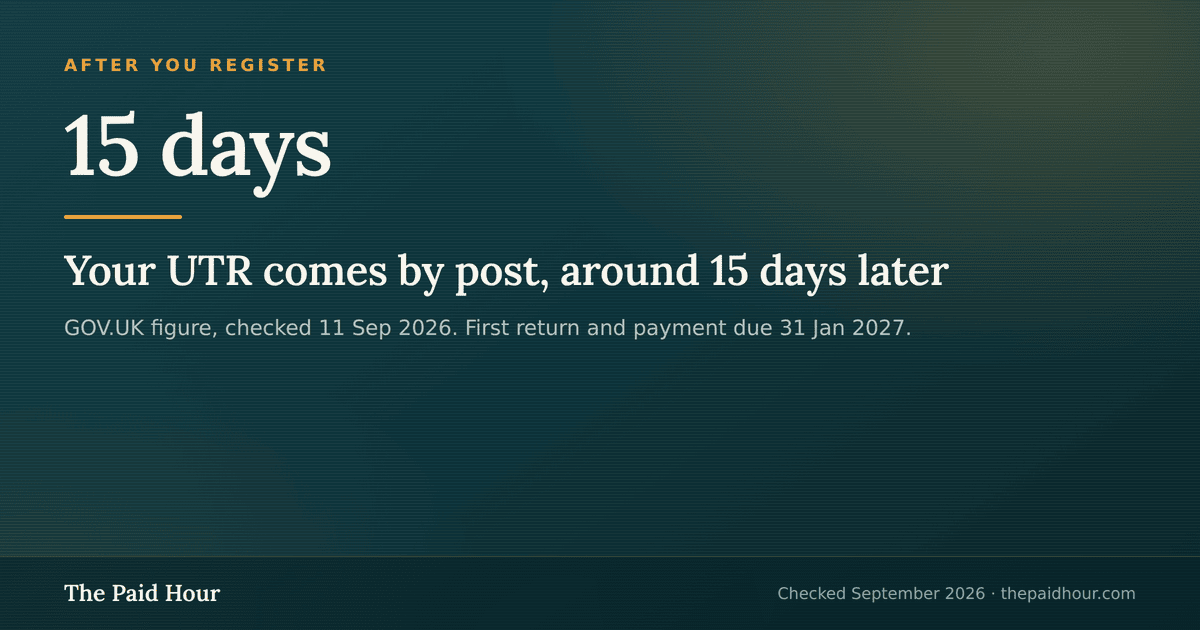
Straight answer: After you register, HMRC posts your 10-digit Unique Taxpayer Reference. GOV.UK says it usually arrives around 15 days after you register, longer if you live overseas. You then sign in to HMRC online services, check Self Assessment shows on your account, and file your 2025/26 return online by 11:59pm on 31 January 2027, paying the same day. Checked against GOV.UK on 11 September 2026.
Your first January bill is one and a half times the tax you actually owe. On £28,000 of profit that means £6,017.70 leaving your account on 31 January 2027, not the £4,011.80 the year’s tax comes to. Nobody mentions that on the registration screen. So this is what happens after registering for Self Assessment, in the order it happens, with dates, and with the arithmetic for that first bill further down.
I re-checked every figure here against GOV.UK on 11 September 2026. The one that surprised me is the UTR timing. GOV.UK now says around 15 days, and a lot of older guides still say 10 working days.
The UTR letter: around 15 days, not 10
Nothing is emailed. Your Unique Taxpayer Reference comes by post to the address you gave when you registered, and GOV.UK’s “Find your UTR number” page puts it like this: “You’ll usually get your UTR by post around 15 days after you register. It takes longer if you live overseas.” It’s a 10-digit number and you’ll need it for every return, every payment and every call to HMRC from now on.
Once it exists, the same number also shows in your personal tax account and in the HMRC app, and it’s printed on later HMRC letters. So the letter matters less than people think, as long as you can sign in. If the letter hasn’t turned up after three weeks, use GOV.UK’s “Check when you can expect a reply from HMRC” tool, which has a Self Assessment option covering UTRs, before you ring the Self Assessment helpline on 0300 200 3310 (Monday to Friday, 8am to 6pm). Don’t register a second time. Two registrations mean two records to untangle. There’s more on the number itself in our UTR number guide.
One catch worth knowing. If you’d already registered for Self Assessment for another reason (rental income, say) and have now started trading, GOV.UK says you need to register again as a sole trader so that Class 2 National Insurance is set up on your record. Same UTR, but a second registration through the self-employed route.
Government Gateway, One Login and the activation code
There are two ways into HMRC online services now: a Government Gateway user ID (up to 12 characters) with a password, or GOV.UK One Login with an email address and password. GOV.UK’s advice is to keep using whichever sign-in details you already have. If you created new ones during registration, those are the ones to use in January. Write them down somewhere that isn’t the same phone you’ll use for the security code.
Now the activation code question, because the answer changed quietly. The public GOV.UK registration pages no longer mention a code at all. The detail lives in HMRC’s own Self Assessment Manual (SAM126001, updated 21 August 2026), which says that once you’ve registered for the Self Assessment online service you get an activation code, that “this Code is sent through the post within 7 days of enrolment and should arrive within 10 days (21 days if it is being sent abroad)”, and that the service “must be activated within 28 days of the date shown on the Activation Code letter”. HMRC’s Self Assessment contact page still lists “activation codes” as a topic its digital assistant handles. So yes, codes still exist in 2026.
Whether you get one depends on your account. When the UTR letter arrives, sign in and look for Self Assessment on your account page. If it’s already there, you’re done and no code is coming. If it isn’t, add the service using your UTR, and expect the letter. Miss the 28-day window and you request another one, which costs you a fortnight you may not have in January.
Download the HMRC app while you’re at it. GOV.UK’s app page (updated 14 August 2026) lists your UTR, how much Self Assessment you owe and making a Self Assessment payment among the things it does. You sign in with the same details, then set a 6-digit PIN, fingerprint or face unlock so you’re not typing a password every time.
Registered on 25 September 2026: the dated timeline
Say you registered on Friday 25 September 2026, online, through the self-employed route, for income you started earning in the 2025/26 tax year. Here is what should land and when, with the job for each week. Dates in the “what arrives” column come from GOV.UK and the HMRC manual; the “what you do” column is mine.
| Date | What arrives or falls due | What you do that week |
|---|---|---|
| Fri 25 Sep 2026 | You submit the registration. Nothing arrives. | Screenshot the confirmation screen and note the date. |
| Mon 28 Sep to Fri 2 Oct | Nothing from HMRC yet. | Open a separate account for business money. Start one spreadsheet or app for income and expenses from 6 April 2025. Move 25% of each client payment into a tax pot (see how much to save for tax). |
| Mon 5 Oct 2026 | Registration deadline for the 2025/26 return. You’ve met it. | Nothing. |
| Around Sat 10 Oct 2026 | UTR letter expected (25 Sep plus “around 15 days”). No Sunday post, so realistically the week of 12 October. Overseas addresses take longer. | Photograph the letter. Save the UTR in your password manager. |
| Week of Mon 12 Oct | Nothing new arrives. | Sign in to HMRC online services. If Self Assessment shows on the account, stop here. If not, add it using your UTR. |
| By about Thu 22 Oct 2026 (Mon 2 Nov if abroad) | Activation code letter, only if you had to add the service. Posted within 7 days, arriving within 10 (21 abroad). | Activate within 28 days of the date printed on the letter. Install the HMRC app and check your UTR appears. |
| Sat 31 Oct 2026 | Paper return deadline. | Irrelevant if you’re filing online. Ignore it. |
| November 2026 | Nothing arrives. | Fill in the return early. HMRC shows the calculation before you submit, so you’ll know the bill two months ahead. |
| Wed 30 Dec 2026 | Online deadline if you want a bill under £3,000 collected through a PAYE tax code. Only applies if you also have PAYE income. | File by today if that route suits you. |
| Fri 29 Jan 2027 | Last working day before the deadline (31 January is a Sunday). Bacs takes 3 working days, so send by Tue 26 Jan. | Pay by Faster Payments or card if you’ve left it to the weekend. |
| Sun 31 Jan 2027, 11:59pm | Online filing deadline. Balancing payment for 2025/26 plus first payment on account for 2026/27 due. | £6,017.70 in the £28,000 example below. |
| Sat 31 Jul 2027 | Second payment on account due. | £2,005.90 in the example. |
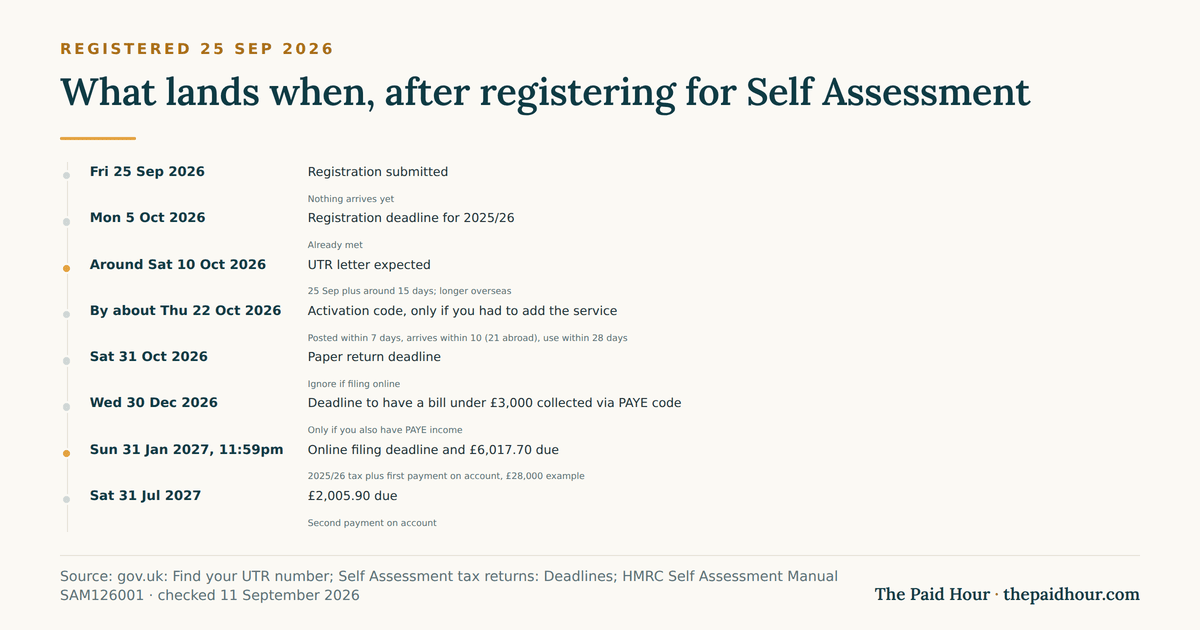
Two things the table can’t show. First, HMRC’s “around 15 days” is a typical figure, not a promise, and late September is a busy registration period, so treat 10 October as the earliest you should start wondering, not the day you start ringing. Second, the 5 October deadline is about telling HMRC you exist. It has nothing to do with when the return or the money is due. Both of those are 31 January 2027 regardless. Our first Self Assessment walkthrough covers the return itself, box by box.
Your first January bill on £28,000 profit
This is the part that catches people. Take a sole trader whose 2025/26 profit (income minus allowable expenses, 6 April 2025 to 5 April 2026) was £28,000, with no employment income, no student loan and an address in England, Wales or Northern Ireland. The rates are the 2025/26 ones from GOV.UK, and they’re unchanged for 2026/27: Personal Allowance £12,570, basic rate 20%, Class 4 National Insurance 6% on profits between £12,570 and £50,270. Our free UK tax calculator runs on the same rates if you’d rather not do it by hand.
| Step | Arithmetic | Amount |
|---|---|---|
| Profit for 2025/26 | £28,000.00 | |
| Less Personal Allowance | £28,000 minus £12,570 | £15,430.00 taxable |
| Income tax at 20% | £15,430 × 0.20 | £3,086.00 |
| Class 4 NI at 6% | £15,430 × 0.06 | £925.80 |
| Class 2 NI | Profit above £6,845, so treated as paid | £0.00 |
| Tax and NI for 2025/26 | £3,086.00 plus £925.80 | £4,011.80 |
| First payment on account for 2026/27 | £4,011.80 ÷ 2 | £2,005.90 |
| Due 31 January 2027 | £4,011.80 plus £2,005.90 | £6,017.70 |
| Due 31 July 2027 | Second payment on account | £2,005.90 |
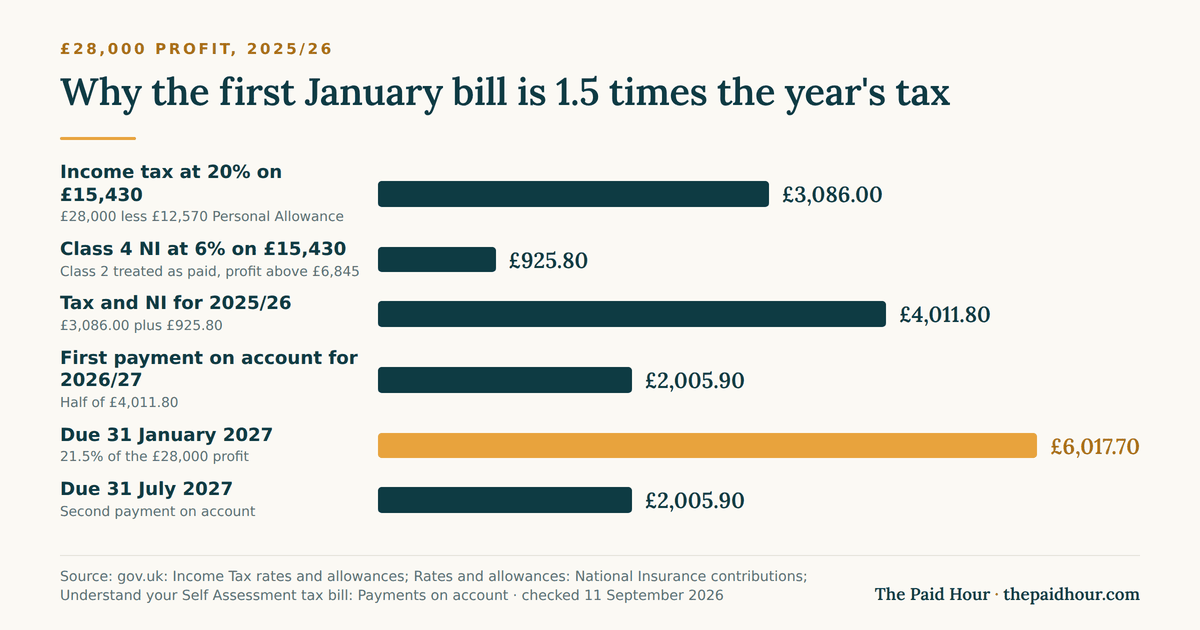
Why the extra £2,005.90? Payments on account kick in when last year’s bill was £1,000 or more and less than 80% of it was collected at source, which describes almost every full-time sole trader. GOV.UK’s rule: each payment is half of the tax you owed last year, including Class 4, due 31 January and 31 July. In year one you pay the whole of 2025/26 and half of 2026/27 on the same day. That’s £6,017.70, or 21.5% of the £28,000. From the second January onwards it settles down: if profit stays at £28,000, January 2028 is a balancing payment of nil plus one payment on account of £2,005.90.
If you expect 2026/27 profit to be lower, you can ask HMRC to reduce the payments on account. Reduce them too far and interest runs on the shortfall, so guess carefully. The mechanics, and what happens if you had a PAYE job alongside, are in payments on account explained. One more thing on the £28,000 profile: it’s under the £30,000 Making Tax Digital line that starts in April 2027 and the £20,000 line from April 2028, so this first return is the ordinary online one, not quarterly updates.
The Side Hustle Tax Starter course takes a new registrant from this point through to the submitted return, with the pot percentages worked out for your own numbers.
After registering late: what happens if you missed 5 October
Register after Monday 5 October 2026 and two things change. GOV.UK’s deadlines page says HMRC “will send you a letter or email with a different deadline to send your tax return by – this will be 3 months from the date on the letter or email”. So the filing date can move later than 31 January. The payment date doesn’t. Tax for 2025/26 is still due by 11:59pm on 31 January 2027, and interest runs from then on anything unpaid.
The second change is that GOV.UK says “you could get a penalty” for telling HMRC late. In practice that penalty is worked out on tax still unpaid at 31 January, so paying on time is what protects you even if the return itself is on a later date. The detail is in our guide to the penalty for registering self-employed late. Filing late once the return is due costs £100 straight away, then £10 a day after three months, up to £900.
Questions new registrants ask
How long does it take to get a UTR number after registering?
GOV.UK says you’ll usually get it by post around 15 days after you register, and longer if you live overseas. It also appears in your personal tax account and the HMRC app once issued. After three weeks with nothing, use the “Check when you can expect a reply from HMRC” tool, then the helpline on 0300 200 3310.
Do I still need an activation code for Self Assessment in 2026?
Only if Self Assessment isn’t already showing on your online account when you sign in with your UTR in hand. If you have to add the service, HMRC’s Self Assessment Manual says the code is posted within 7 days, should arrive within 10 (21 abroad) and must be used within 28 days of the date on the letter.
When is my first tax return due after registering for Self Assessment?
If you registered by 5 October 2026 for the 2025/26 tax year, the online return is due by 11:59pm on 31 January 2027 (paper by 31 October 2026), with payment due 31 January 2027. Register after 5 October and HMRC’s letter or email gives you 3 months from its date to file, but the payment date stays at 31 January 2027.
What to do, in order
- Put 25% of every client payment into a separate pot from today. On £28,000 the first January needs £6,017.70, and that’s before the July instalment.
- Diary 10 October as the earliest UTR date and 16 October as the day you check the reply-time tool if nothing has arrived.
- When the letter lands, sign in the same day, confirm Self Assessment shows, and add it if it doesn’t so any activation code is in your hands by late October.
- Install the HMRC app and confirm your UTR appears there, so losing the letter costs you nothing.
- Draft the return in November using the payment methods and lead times to pick how you’ll pay: Faster Payments or card if it’s the last weekend, Bacs by 26 January otherwise.
- File and pay before 31 January 2027, then set a reminder for 31 July 2027 and the second £2,005.90.
Sources
- GOV.UK: Register for Self Assessment
- GOV.UK: Become a sole trader: Register as a sole trader
- GOV.UK: Find your UTR number
- GOV.UK: HMRC online services: sign in or set up an account
- GOV.UK: HMRC Self Assessment Manual SAM126001, filing returns online
- GOV.UK: Self Assessment: general enquiries
- GOV.UK: Check when you can expect a reply from HMRC
- GOV.UK: Download the HMRC app
- GOV.UK: Self Assessment tax returns: Deadlines
- GOV.UK: Self Assessment tax returns: Penalties
- GOV.UK: Understand your Self Assessment tax bill: Payments on account
- GOV.UK: Pay your Self Assessment tax bill
- GOV.UK: Pay your Self Assessment tax bill: Through your tax code
- GOV.UK: Income Tax rates and allowances for current and past years
- GOV.UK: Rates and allowances: National Insurance contributions
Figures checked against GOV.UK and the HMRC Self Assessment Manual on 11 September 2026. This is general information, not financial or tax advice.
Do you actually owe HMRC anything yet?
Side Hustle Tax Starter 2026/27. A six-module starter course and six working templates that tell you, in an evening, whether you owe anything at all, and set up the twenty-minute monthly routine that keeps it that way.
- The nine badges of trade as questions you can answer about your own income
- What the platforms send HMRC, the small-seller exemption, and three reply letters for when a letter arrives
- A sales log with a running £1,000 alert, an allowance-versus-expenses sheet, and a tax set-aside calculator at 2026/27 rates
Selling platforms now hand your sales data to HMRC once a year. Selling your own old possessions is never taxable. Buying to resell, making things, or freelancing is. Knowing which side you are on is the whole question.
Buying more than one? All ten 2026/27 courses for £107, against £328 at full price.
Read next
- Self Assessment Deadlines: Which Return Are You Filing?
- Reducing Your Payments on Account: When and How to Apply