
What matters here: The rule for allowable expenses is “wholly and exclusively”: a cost has to be for the business to come off your profit. The 2026 change most guides missed, mileage rose from 45p to 55p for the first 10,000 miles. Claim the business share of mixed costs as allowable expenses, keep records five years, and check the disallowable list before filing.
Table of Contents
Allowable expenses for UK freelancers are the legitimate business costs HMRC lets you deduct before working out your tax bill, get the list right and you keep more of what you earn.
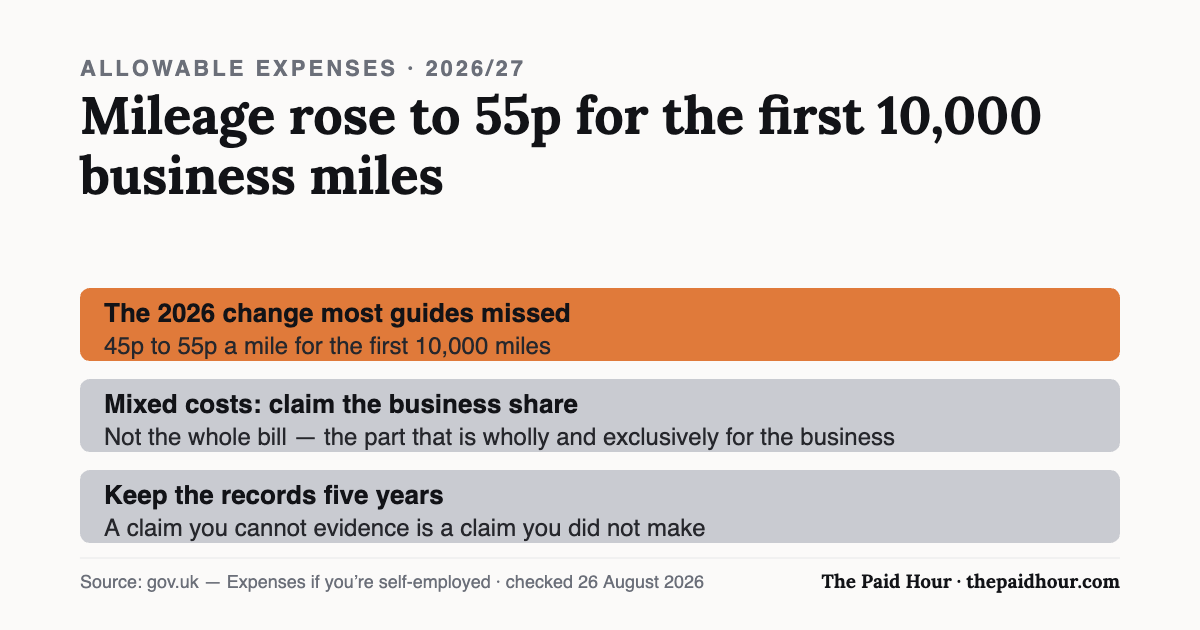
The headline change. The simplified-expenses mileage rate rose from 45p to 55p per mile for the first 10,000 business miles, from 6 April 2026. Most guides online still quote 45p. If you drive for work, that’s real money, and plenty of people are going to under-claim this year without realising.
Expenses are the difference between paying tax on what you turned over and paying tax on what you kept. Get them wrong one way and you overpay; get them wrong the other way and HMRC can come back for it years later. Here’s what a UK sole trader can claim, and where the line sits.
The basic rule for allowable expenses: wholly and exclusively
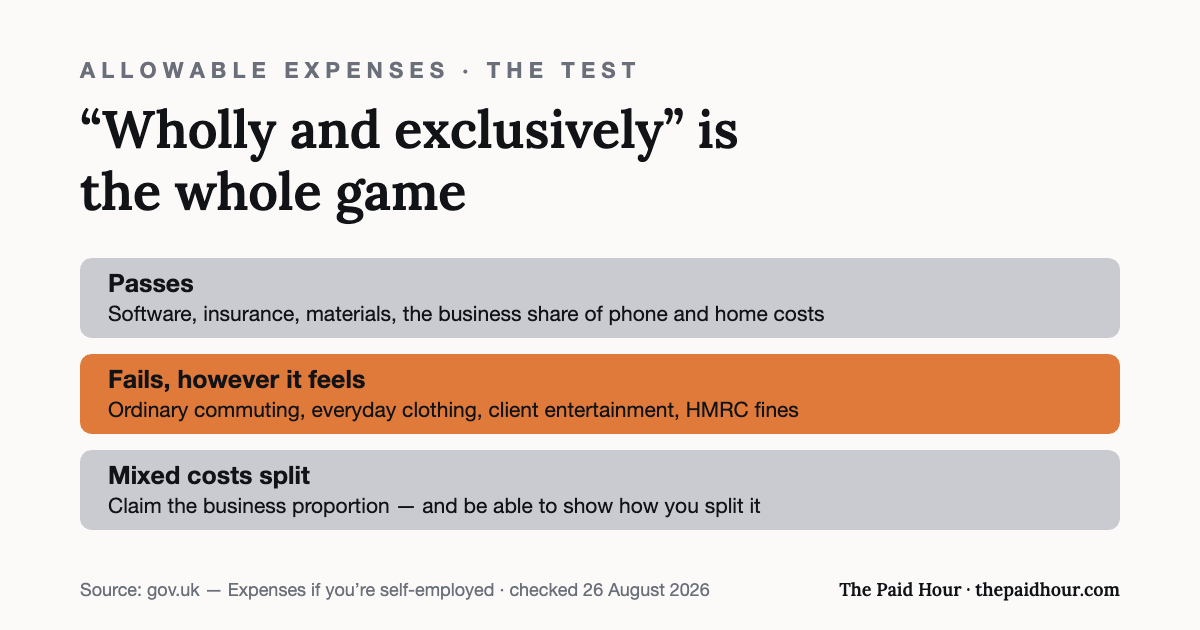
The basic rule is simple to state and harder to apply: the cost has to be wholly and exclusively for your business.
You can deduct costs that are wholly and exclusively for the purposes of the business. That phrase does all the heavy lifting. A laptop used only for client work is allowable. A laptop the family also uses on weekends isn’t, though you can claim the business proportion of a mixed cost, as long as you can justify how you split it.
Equipment that lasts is a different question from a running cost, and which route you use depends on the accounting basis you are on. That is the capital allowances side of the rules.
Things that are never allowable, however it might feel: ordinary commuting to a regular workplace, everyday clothing (even a suit you only wear to client meetings), client entertaining, and fines.
Two ways to claim allowable expenses: actual costs or flat rates
For vehicles, working from home, and living at your business premises, HMRC lets you skip the arithmetic entirely and use flat rates instead, simplified expenses. You can use them if you’re a sole trader or in a partnership with no company partners. Limited companies can’t.
Simplified expenses are optional, and you’re free to compare. HMRC has a checker that shows which method gives you more.
Mileage. Check this one, it changed
Flat rate per mile. The first band rose by 10p from 6 April 2026. Source: HMRC.
For the 2026–27 tax year the flat rates are:
- Cars and goods vehicles, first 10,000 business miles: 55p (it was 45p before 6 April 2026)
- Cars and goods vehicles, after 10,000 miles: 25p
- Motorcycles: 24p
So 11,000 business miles works out as (10,000 × 55p) + (1,000 × 25p) = £5,750.
Two traps to know about. First, you can’t use flat rates for a vehicle you’ve already claimed capital allowances on, or already included as a business expense. Second, once you start using the mileage rate for a particular vehicle, you’re locked into it for that vehicle, you can’t switch to actual costs later.
Keep a log. Date, journey, purpose, miles. If HMRC asks and you’ve got nothing written down, the claim’s gone.
Working from home: the allowable expenses version
If you work 25 hours or more a month from home, you can use the monthly flat rate instead of working out your actual bill proportions:
| Hours of business use per month | Flat rate per month |
|---|---|
| 25 to 50 | £10 |
| 51 to 100 | £18 |
| 101 and more | £26 |
Worth being honest about scale here: even at the top band, that’s £312 a year. If you run the business from a dedicated room and your bills are substantial, working out the actual proportion might beat it comfortably. Run both numbers and use whichever’s bigger.
One thing the flat rate doesn’t cover: phone and internet. Claim the business share of those separately, based on actual use.
What counts as allowable expenses? The full list
- Office costs: stationery, printing, postage, software subscriptions, professional subscriptions.
- Equipment: computers, tools, furniture. Often claimed through capital allowances rather than as a straight expense.
- Travel: train and bus fares, parking, business mileage, accommodation and meals on overnight business trips. Not commuting.
- Clothing: uniforms, protective gear and costumes only. Not the suit.
- Staff: salaries, subcontractor costs, employer NICs, pension contributions.
- Stock and raw materials: what you buy to resell or to make what you sell.
- Professional fees: accountants, solicitors, and professional indemnity insurance.
- Bank and finance: business account charges, interest on business loans, card processing fees.
- Marketing: website costs, advertising, hosting, domain names.
- Training: courses that maintain or update skills you already use in the business. Training for an entirely new trade generally isn’t allowable.
HMRC lists these in full under expenses if you are self-employed.
Records for allowable expenses: five years, not five minutes
You have to keep records for at least five years after the 31 January filing deadline for that return, receipts, invoices, bank statements, mileage logs. Digital copies are fine.
If Making Tax Digital applies to you, this stops being optional good housekeeping and becomes an actual requirement, records have to be kept digitally in compatible software. The guide to what Making Tax Digital changes covers who’s caught and when.
The allowable expenses mistakes that cost people money
The mirror image of this page is worth reading alongside it: the costs that look like business expenses and are not allowable at all.
- Not claiming mileage at all because logging it feels like a faff. At 55p a mile, 4,000 miles is £2,200 off your taxable profit.
- Using last year’s rate. Most articles still say 45p. Check the current figure before you file.
- Claiming the whole phone bill. Claim the business proportion, and be able to explain how you worked it out.
- Forgetting the small recurring things. Software subscriptions, domain renewals, professional memberships, individually trivial, annually substantial.
- Claiming things that are clearly personal because someone on a forum said it was fine. It’s your return, and your penalty.
Your MTD ITSA start date is decided by an earlier tax year’s qualifying income. Source: HMRC, checked 19 August 2026.
Related: your profit figure decides what National Insurance you owe.
You need proof for every one of these, and a photo will do, see what HMRC requires from a scanned receipt.
Business insurance belongs on this list too. HMRC uses public liability insurance as its own worked example of an allowable policy.
Every pound you claim in the basic rate band saves 26p once Class 4 National Insurance is counted rather than 20p. The arithmetic is in self-employed tax rates for 2026/27.
Interest and charges on borrowing used for the business belong here as financial costs, which is a good reason not to let one card carry both business and personal spending. Business credit cards for sole traders goes through the rest.
If you rent a storage unit for stock or tools, that rent is business premises rent: see our guide to business storage costs and what you can claim.
Filing it yourself this year?
HMRC Tax & Expense Mastery 2026/27. Nine modules and eleven working templates that take a UK freelancer from “do I even need to register” to a correct return, with MTD quarters built in.
- Fifteen expense categories, with the trap inside each one (training, clothing, meals, the seven-year pre-trading rule)
- Home and vehicle: flat rate against actual cost, with the £312 break-even worked out and the mileage lock-in rule
- The year-one payments-on-account cash shock, and the routine that stops it landing twice
HMRC does not send a list of what you forgot to claim. Most freelancers leave several hundred pounds of legitimate expenses on the table every single year, and the return still gets filed.
Buying more than one? The Complete Freelancer System, all five for £87, against £215 at full price.
Need this ready-made? → UK Sole Trader Expense Tracker (Excel) £5.99
Sources
- HMRC: Expenses if you’re self-employed
- HMRC — Simplified expenses: vehicles
- HMRC, Simplified expenses: working from home
- HMRC. Simplified expenses checker
The wholly-and-exclusively rule was re-checked against gov.uk on 26 August 2026.
The wholly-and-exclusively rule, the expense categories, the 55p/25p and 24p mileage rates, the £10/£18/£26 home-working bands and the five-year records rule were re-checked against gov.uk on 26 August 2026, and apply to the 2026–27 tax year. This is general information, not tax advice, whether a specific cost is allowable in your case depends on your circumstances, so ask a qualified accountant if it matters.