
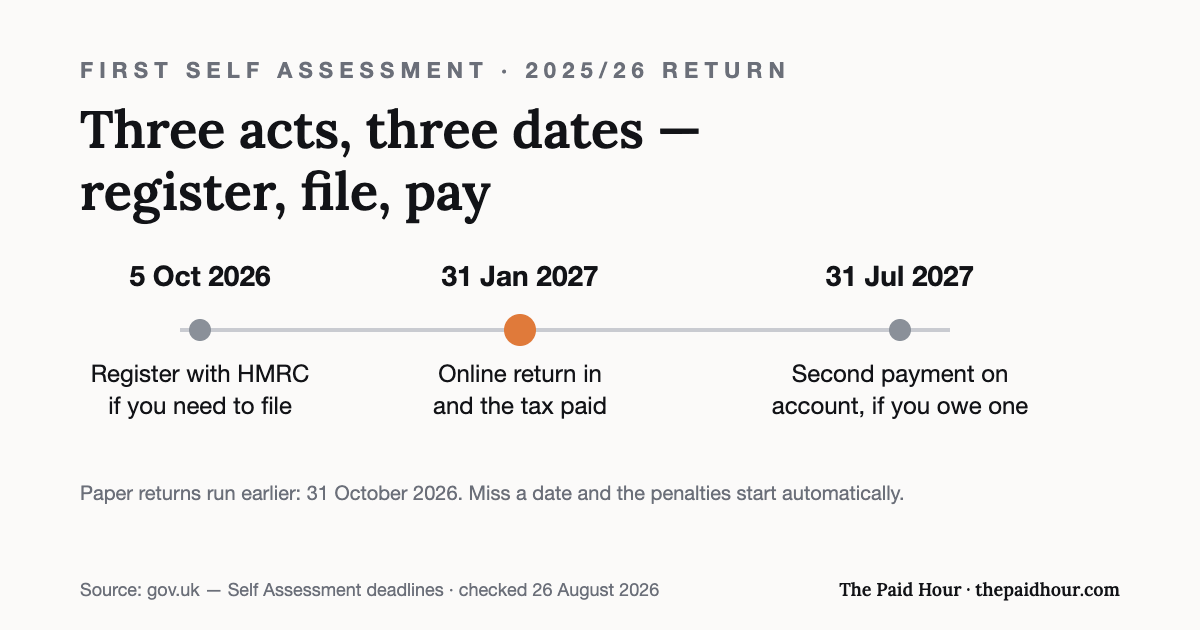
The short version: Three separate things happen, each with its own deadline. Tell HMRC you need to file by 5 October after the tax year you started. File the online return by 31 January. Pay by the same date. And if the bill tops £1,000, HMRC adds a payment on account, half the bill again, due that same January day.
Table of Contents
A first Self Assessment is frightening mostly because nobody explains the order things happen in. Registering, filing and paying are three different acts on three different dates, and people who think of it as one job in January discover the first deadline passed four months ago.
Here is the sequence, then what the Self Assessment return actually asks you.
Do you need to file a Self Assessment at all?
If you were self-employed as a sole trader and earned more than the trading allowance: £1,000, in the tax year, yes. Other things trigger it too: untaxed income, rental income, the high income child benefit charge.
Read that threshold carefully, because it is the first thing people get wrong. It is £1,000 of income rather than profit. Turn over £3,000 and spend £2,500 on equipment and you are still filing, despite having made almost nothing.
Step one: tell HMRC you exist
If you have never filed before, you must tell HMRC by 5 October following the end of the tax year you started trading in. That is the deadline nobody has heard of, and the one most commonly missed, because in October the bill still feels theoretical.
Register late and HMRC writes with a different filing deadline, three months from the date on the letter or email. Generous, until you notice what does not move: the payment deadline stays at 31 January. So you can file perfectly on time under your new date and still be paying late.
Registration is also how you get a Unique Taxpayer Reference, and it arrives by post rather than instantly. Leaving this to the last week of September is how people end up locked out of their own return in January. There is more on that in the guide to what a UTR number is and how to get one.
Step two: the dates
For the 2025–26 tax year, the one being filed now. All deadlines are 11:59pm.
| Date | What is due |
|---|---|
| 5 October 2026 | Tell HMRC, if this is your first return |
| 31 October 2026 | Paper return |
| 30 December 2026 | File online to have the bill collected through your tax code, if eligible |
| 31 January 2027 | Online return, payment, and first payment on account |
| 31 July 2027 | Second payment on account |
Started trading in 2026/27 instead? Everything shifts by a year. Register by 5 October 2027, file by 31 January 2028. The full map is in the 2026/27 tax year calendar.
Step three: what to have in front of you
The return takes about an hour with everything to hand and an entire weekend without it.
- Your UTR and Government Gateway login.
- Your National Insurance number.
- Total self-employment income for the year, and your expenses.
- P60 or P45 if you were also employed.
- Records of other income, interest, dividends, rent.
- Pension contributions and Gift Aid donations, because both reduce what you owe.
Then keep all of it. HMRC expects the records for at least five years after the 31 January deadline, and that is the version of this job that goes badly if you have thrown things away.
What the Self Assessment return asks you
This is the part that makes people nervous, and it is smaller than it looks. The self-employment section comes in two versions. You use the short one, SA103S, if “your annual business turnover was below the VAT threshold for the tax year”: £90,000, and you “have relatively simple tax affairs”. Above that, or with anything complicated, it is the full version.
On the short pages you are asked for, in order:
- What the business is: a name if you trade under one, and a plain description of what you do.
- Turnover. Everything you invoiced in the tax year, before any expenses come off. Not what landed in your bank if you are on the accruals basis, and not net of your costs.
- Then a fork. Either claim the £1,000 trading allowance and no expenses at all, or claim your actual allowable expenses and no allowance. One or the other, never both.
- Expenses, if you went that way. Below the VAT threshold you can enter one total instead of itemising every category, which is a genuine time saver.
- Net profit or loss. The figure the tax is calculated on, and the number that matters everywhere else in your financial life.
After that the return moves on to everything else, employment income, interest, dividends, pension contributions, student loan, Gift Aid. If it does not apply to you, you say so and it disappears.
Which expenses count is the part worth reading before you start rather than during: the full list is in allowable expenses for UK freelancers, and the choice between the two accounting methods sits in cash basis versus traditional accounting.
The bit nobody warns you about
If your bill comes to more than £1,000, HMRC does not just ask for the tax you owe. It asks for that, plus half of it again, as an advance toward next year. A second instalment follows on 31 July.
So a first-time filer expecting a £2,000 bill gets a demand for £3,000, in one go, in January. It is the single most common nasty surprise in a first Self Assessment, and it is not a penalty or a mistake: it is the system working as designed, catching you up to the schedule everyone else is already on.
Budget for it and it is an inconvenience. Discover it on 30 January and it is a crisis. The mechanics, including when you can apply to reduce them, are in payments on account explained.
Filing and paying are two different acts
Submitting the return moves no money. Nothing leaves your account because you pressed send.
And the method matters on the last day: some payments reach HMRC the same day, a new Direct Debit takes five working days. Leaving it to 31 January and picking a slow route is exactly how people get charged interest on tax they paid. The timings are in how to pay a Self Assessment tax bill.
Stuck before you can even start: four things that block a first Self Assessment
Most guides assume you can log in. A first-timer’s real problem is usually not the return at all — it is getting to the point where HMRC will let you file one. Four blockers account for nearly all of it.
1. Your UTR has not arrived
You cannot file without it, and it comes by post, GOV.UK puts it at around 15 days after you register, longer if you live overseas. That is fine in October. It is fatal in the third week of January.
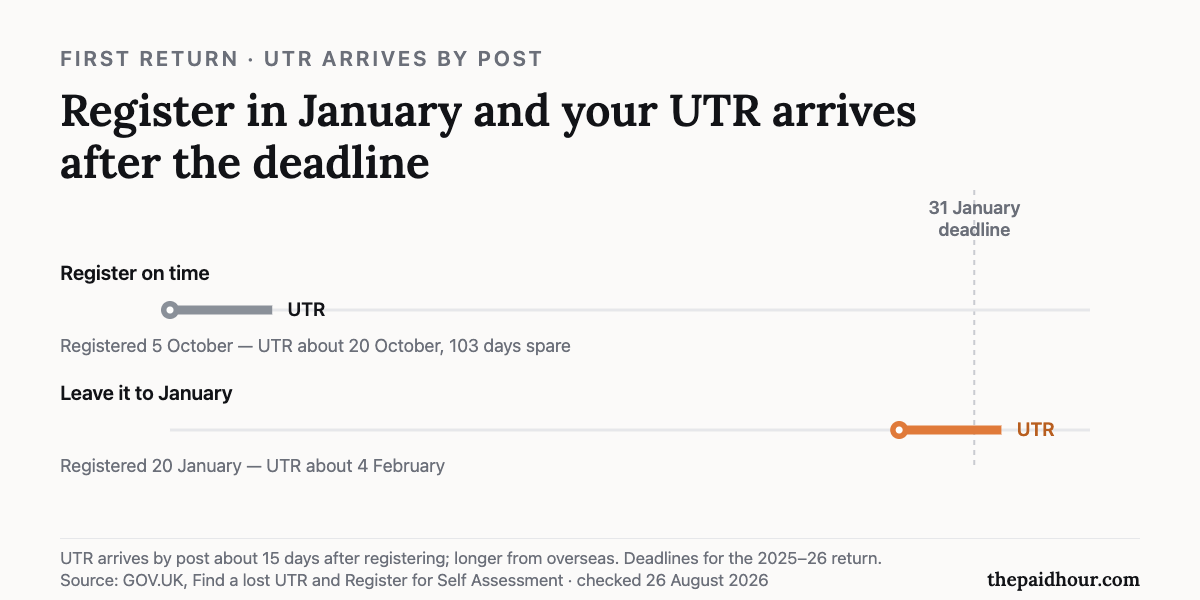
If you registered a while ago and are still waiting, HMRC publishes a tool for checking when to expect a reply rather than guessing. Chasing it a week in is wasted effort; chasing it in mid-January is not.
2. You had a UTR and cannot find it
Look before you phone. It is in your Personal Tax Account, in the HMRC app, and on any previous return or letter HMRC has sent you. Only if none of those work is the helpline the answer, and a UTR sent out again also comes by post.
3. You filed years ago, took a break, and assumed you were still registered
This one catches returning freelancers and almost nobody writes about it. GOV.UK is explicit: if you registered before but did not need to send a return for the previous tax year, you have to tell HMRC again by 5 October, and you may need to reactivate your Self Assessment account before you can file. Having a UTR is not the same as being registered for the year in front of you.
4. You need to ask a person, and don’t know who
HMRC’s Self Assessment helpline is 0300 200 3310, Monday to Friday, 8am to 6pm, closed on bank holidays. It is free. Its digital assistant handles the mechanical things. Registering, activation codes, filing, paying, appealing a penalty, refunds, and hands you to a person when it cannot. There is also a separate extra support service for anyone who needs help using the online system, including because of a health condition or personal circumstances.
Worth saying plainly, since most pages ranking for Self Assessment help for freelancers are selling something: for a straightforward sole trader return, HMRC’s own guidance and that helpline are usually enough, and they cost nothing. Paying someone is a reasonable choice when your affairs are complicated, or when the hours are worth more than the fee. It is not a requirement, and nothing on this site is trying to sell you one.
If you are going to be late anyway
File regardless. Filing and paying carry separate penalties, so filing late with the money still owing is meaningfully cheaper than doing neither, and HMRC will discuss a payment plan with someone who has filed and can see the number.
The penalty ladder starts at £100 whether or not you owe anything. What it does after that is in the guide to late filing penalties, and if paying is the real problem, what to do when you cannot pay.
One thing that has changed
If your qualifying income is over the Making Tax Digital threshold, the annual return is no longer the only thing you send. Quarterly updates go through software as well.
They do not replace the return and they do not move the January payment date. Who is in, and when, is in Making Tax Digital for Income Tax for sole traders.
Rather pay someone to file it? The Taxfix vs TaxScouts comparison covers the two best-known filing services.
Common questions about Self Assessment
When is the Self Assessment deadline if this is my first return?
Three dates instead of one. Tell HMRC by 5 October after the tax year you started trading. File online and pay by 31 January. Paper returns are earlier, 31 October. Register late and HMRC gives you three months from the date on its letter to file, the 31 January payment date does not move with it.
Can I file without a UTR?
No. The Unique Taxpayer Reference arrives by post, around 15 days after you register, and nothing can be filed without it. That postal gap is the whole reason the 5 October deadline exists.
What happens if I file my Self Assessment late?
£100 to start, whether or not you owe a penny of tax. Filing and paying carry separate penalties, so file even if you cannot pay: a late return with the money still outstanding costs less than missing both, and HMRC will discuss a payment plan with someone who has actually filed.
Want the whole tax system, not one rule?
HMRC Tax & Expense Mastery 2026/27. Nine modules and eleven working templates that take a UK freelancer from “do I even need to register” to a correct return, with MTD quarters built in.
- Fifteen expense categories, with the trap inside each one (training, clothing, meals, the seven-year pre-trading rule)
- Home and vehicle: flat rate against actual cost, with the £312 break-even worked out and the mileage lock-in rule
- The year-one payments-on-account cash shock, and the routine that stops it landing twice
HMRC does not send a list of what you forgot to claim. Most freelancers leave several hundred pounds of legitimate expenses on the table every single year, and the return still gets filed.
Buying more than one? The Complete Freelancer System, all five for £87, against £215 at full price.
Need this ready-made? → UK Self-Assessment Prep Checklist Pack (PDF) £7.99
Not sure you registered through the right door in the first place? Which Self Assessment registration route you need runs through all four.
Read next
- UTR Number Explained: What It Is and How to Get One
- Reducing Your Payments on Account: When and How to Apply
- Tax Year Dates 2026/27: Every Deadline UK Freelancers Need
- UK Freelancer Tax Calculator 2026/27
- The Freelancer Tax Checklist: every step, dated
- How to register as a sole trader with HMRC: the 5 October 2026 deadline
Sources
- gov.uk, Self Assessment tax returns: deadlines
- gov.uk. Check if you need to send a Self Assessment tax return
- gov.uk, Register for Self Assessment
- gov.uk: Self-employment (short) SA103S
- gov.uk: Payments on account
- gov.uk — Self Assessment tax returns: penalties
Deadlines, the UTR postal lead time, the reactivation rule and the helpline hours re-checked against gov.uk on 26 August 2026; the January timeline in the chart is the post’s own arithmetic from the published 15-day figure.
Dates and thresholds checked against gov.uk on 25 August 2026. The dated deadlines above are for the 2025–26 tax year. This is general information, not tax advice: for your own position, speak to a qualified accountant or contact HMRC.
Need an invoice that’s already sorted?
Editable, HMRC-compliant invoice templates, no subscription.
Browse templates