
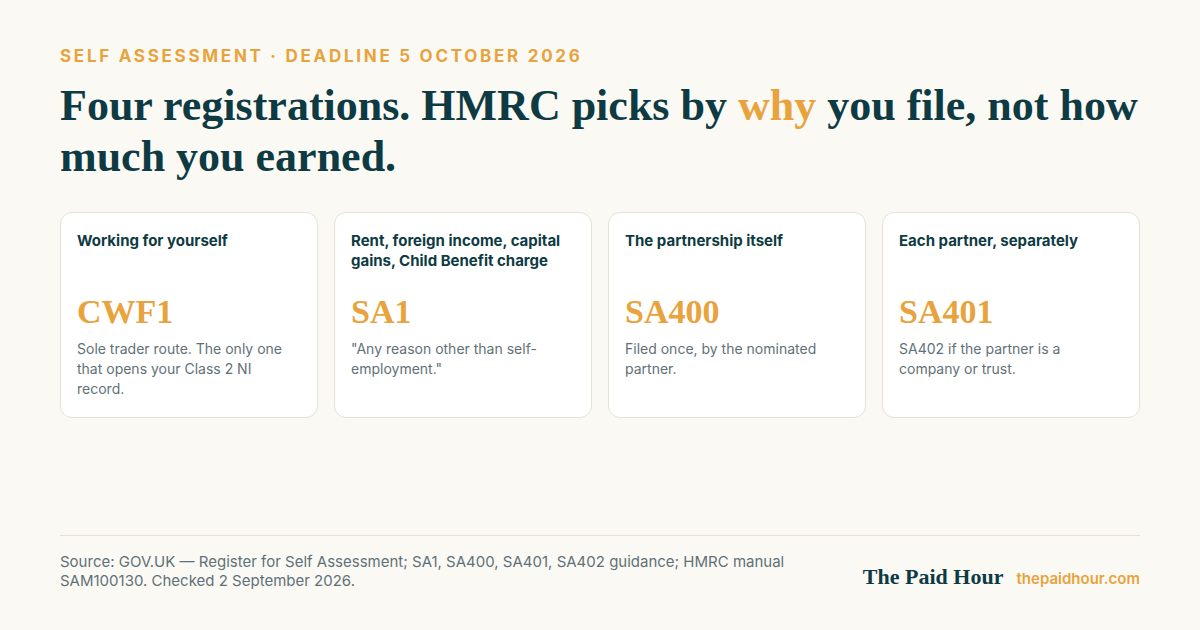
The one-paragraph answer: There is one deadline: 5 October 2026, but four different front doors, and HMRC decides which one you walk through by why you need a tax return, not by how much you earned. Self-employment goes through the sole trader route (the paper form is CWF1). Anything that is not self-employment, rent, foreign income, capital gains, the Child Benefit charge, goes through SA1. Partnerships need two separate registrations, SA400 for the business and SA401 for each partner. Pick the wrong door and the commonest casualty is your Class 2 National Insurance record.
Almost everything written about registering for Self Assessment stops at the date. Tell HMRC by 5 October, it says, and moves on. That is fine if you are a straightforward sole trader. It is not much help if you started freelancing and let out a room, or joined two friends in a partnership, or already file a return for something else and have just gone self-employed on top.
HMRC does not run one registration. It runs several, and they write to different parts of your tax record. This guide is about picking the right one on the first attempt, because the wrong one costs you weeks you do not have between now and January.
One deadline, four different front doors
The date first, so it is out of the way. GOV.UK puts it plainly: you must tell HMRC by 5 October 2026 if you need to complete a tax return for the previous year, that is the tax year that ran from 6 April 2025 to 5 April 2026. The return itself is then due online by 31 January 2027.
You are in scope if you have not sent a tax return before, or if you registered before but did not need to send one for the 2024 to 2025 tax year. That second group catches far more people than it sounds like, see the who has to file a tax return guide if you are not sure you are in it at all.
What changes from person to person is the route. There are four, and the question that sorts them is not “how much did I make?” but “what kind of income is it?”
Self-employed: the sole trader route, and the form behind it
If the income is from working for yourself, freelancing, trading, a side hustle over the £1,000 trading allowance, contracting direct with clients, this is your door. GOV.UK’s wording is blunt: “You register as a sole trader by registering for Self Assessment.” There is no separate sole trader registry, no company number, nothing to look up. The tax registration is the registration.
Most people now do this inside the online service. The paper equivalent is form CWF1, and it is worth knowing it exists because it is what the online route is doing behind the scenes. HMRC’s own Self Assessment manual describes it as the single form for the job: an individual starting a new business or self-employment “will complete one form only, CWF1”. The manual also notes two things that cause the most mistakes: the form needs a validated National Insurance number to be processed at all, and photocopies are rejected outright.
The reason this route matters more than a bit of paperwork: it is the one that opens your Class 2 National Insurance record. Class 2 is what builds qualifying years toward the State Pension. Registering through any other door does not do it. More on the mechanics in Class 2 vs Class 4 National Insurance.
Not self-employed: SA1
GOV.UK’s instruction is a single sentence: “Use form SA1 to register for Self Assessment for any reason other than self-employment.” That “any reason” list is longer than most people expect:
- UK rental income from land and property
- Foreign income that is taxable in the UK
- The High Income Child Benefit Charge, where it is not being collected through PAYE
- Income from a trust or settlement
- Untaxed income that cannot be collected through your tax code
- Capital Gains Tax to pay
Two of those catch people who would never describe themselves as needing a tax return. Selling a second property or a chunk of crypto puts you in the capital gains line — the crypto tax guide covers where that threshold now sits. And the Child Benefit charge arrives by household income, not by anything you did at work.
Have your details in front of you before you start, because HMRC warns that you cannot save your progress part-way through: full name, postal address, date of birth, a daytime telephone number, your National Insurance number if you have one, and the reason you are registering together with the date it started. After a postal SA1, HMRC says it will usually contact you within 21 days.
Partnerships: two registrations, three forms
This is where the most expensive mistakes happen, because a partnership is not one registration. It is two, and they are easy to confuse for each other.
The business registers once. One partner is the “nominated partner”, and GOV.UK is explicit that being nominated “means you’re responsible for sending the partnership tax return”. That person registers the partnership itself, online, or on form SA400, where the guidance says simply that “the nominated partner must complete the form”. To do it online you need a Government Gateway user ID and either a UTR or a VAT reference number for the business.
Then every partner registers separately. GOV.UK: “The other partners need to register separately”, and “All partners also need to send their own tax returns as individuals.” The form for an individual joining a partnership is SA401, which covers Self Assessment and Class 2 National Insurance in one go. There is a catch buried in that guidance worth reading twice: “Only the nominated partner can register online. If you’re not the nominated partner and are joining a partnership, you must register by post.” If you are partner number two, budget the postal time.
Where a partner is a company or a trust rather than a person, the form is SA402: “register a new partner who is not an individual for Self Assessment, for example a company or trust”.
The partnership deadline is worded differently from everyone else’s, and it is the one partnerships miss: “You must register by 5 October in your business’s second tax year, or you could be charged a penalty.” Not the first year. The second.
Already registered? You may still have to register again
This is the least-known line on the whole GOV.UK sole trader page, and it costs people State Pension years:
“If you have already registered for Self Assessment for another reason, you’ll need to register again as a sole trader. This is so you are registered for Class 2 National Insurance contributions, which will help you qualify for benefits like the State Pension.”
Read that against a common situation. You have filed a return for three years because you let out a flat. This year you also start freelancing. You already have a UTR, you already file, so you assume there is nothing to do, and the freelance income simply goes on the self-employment pages in January. The return is right. The National Insurance record is not, because nothing ever told HMRC’s NI side that a self-employment had started.
There is a second version of this for people who stopped and restarted. GOV.UK: “If you’ve registered for Self Assessment before but did not send a tax return last year, you may need to reactivate your Self Assessment account.” The service tells you how once you are inside it. Either way, the rule of thumb is the safe one, if the reason you file has changed since you last registered, register again.
What to have in front of you
Whichever door you use, the questions are similar. Gather these first and the whole thing takes ten minutes:
- Your National Insurance number: the sole trader and partner routes will not process without a valid one
- Your UTR, if you have ever filed before
- The date the self-employment started, and for a partner, the date you joined the partnership
- The partnership’s details and its Company Registration Number, if it has one
- For SA1: full name, address, date of birth, daytime phone, and the reason and start date
The start date is not a formality. It sets which tax year your first return covers and how much Class 2 you owe, and it is the answer people guess at. If yours is fuzzy, the badges of trade guide is the honest way to work out when a hobby became a business.
If you miss 5 October
Nothing detonates on 6 October. What happens is that HMRC sets you a different filing date: “HMRC will send you a letter or email with a different deadline to send your tax return by, this will be 3 months from the date on the letter or email.”
The sting is in the next sentence. “You must still pay the tax you owe by 11:59pm on 31 January 2027 or you’ll get a penalty.” The filing date moves; the payment date does not. Register in December and you may have until March to file, but you are still expected to have paid in January a bill you have not worked out yet. That is the real reason to register now rather than in the new year, and it is separate from the failure-to-notify penalty, which the late registration penalty guide sets out in full.
The dates after this one
- 5 October 2026: tell HMRC you need a return for 2025/26
- 31 October 2026, 11:59pm: paper returns must have arrived
- 30 December 2026: the cut-off if you want tax under £3,000 collected through your tax code
- 31 January 2027, 11:59pm: online return, the 2025/26 balancing payment, and usually a first payment on account
- 31 July 2027: second payment on account
The full picture, including what a payment on account is, sits in Self Assessment deadlines and payments on account explained.
So which door is yours?
- Working for yourself, on your own: sole trader registration (CWF1 behind the scenes). Opens Class 2.
- Rent, foreign income, capital gains, the Child Benefit charge, trust income: SA1.
- In business with other people: SA400 for the partnership by the nominated partner, then SA401 for each individual partner, or SA402 where the partner is a company or trust.
- Already file, but the reason has changed: register again for the new reason, especially if the new reason is self-employment.
Do it once, do it through the right door, and the January return is bookkeeping instead of firefighting. The next step from here is registering as a sole trader with HMRC, and then your first Self Assessment.
Sources
- Register for Self Assessment, GOV.UK
- Become a sole trader: Register as a sole trader: GOV.UK
- Register for Self Assessment if you are not self-employed (SA1), GOV.UK
- Register a partnership for Self Assessment (SA400). GOV.UK
- Register a partner for Self Assessment and Class 2 National Insurance (SA401), GOV.UK
- Register a partner who is not an individual (SA402): GOV.UK
- Set up a business partnership: register with HMRC: GOV.UK
- SAM100130 — Notification of new business or self employment (HMRC manual)
- Self Assessment tax returns: deadlines, GOV.UK
The 5 October 2026 deadline, the SA1 income list and its “you cannot save your progress” warning, the sole trader wording, the Class 2 re-registration sentence, the nominated partner rules, the SA401 postal restriction, the partnership “second tax year” deadline and the three-month letter for late registrations are all quoted from the GOV.UK pages listed above. The CWF1 processing detail comes from HMRC’s Self Assessment manual, page SAM100130. All read and checked on 2 September 2026. This is general information about how the rules work, not tax advice; for your own circumstances speak to an accountant or contact HMRC.
Want the whole first year mapped out? → Side Hustle Tax Starter walks a first-timer from registration to a filed return.
Related guides
- How to register as a sole trader with HMRC
- Do I need to file a tax return?
- The penalty for registering self-employed late
- Self Assessment deadlines
- UTR numbers explained
- Registering a partnership by 5 October
- Already file a tax return? You may still need to register again
Had a letter about your Vinted or Etsy sales?
Side Hustle Tax Starter 2026/27. A six-module starter course and six working templates that tell you, in an evening, whether you owe anything at all, and set up the twenty-minute monthly routine that keeps it that way.
- The nine badges of trade as questions you can answer about your own income
- What the platforms send HMRC, the small-seller exemption, and three reply letters for when a letter arrives
- A sales log with a running £1,000 alert, an allowance-versus-expenses sheet, and a tax set-aside calculator at 2026/27 rates
Selling platforms now hand your sales data to HMRC once a year. Selling your own old possessions is never taxable. Buying to resell, making things, or freelancing is. Knowing which side you are on is the whole question.
Buying more than one? All ten 2026/27 courses for £107, against £328 at full price.